
Thinking about selling your business? It’s a huge decision. From the moment you decide to sell until the day you sign the final papers, the whole thing usually takes about 6 to 12 months. The secret to a good sale is getting ready long before you put up the "for sale" sign. Let's walk through how to start.
Is It Time to Sell Your Business?
Deciding to sell your business is a big deal. Maybe you’re dreaming of retirement, you’re excited about a new idea, or you’re just ready for a change. Whatever the reason, the first step is to be really clear about why you're selling. This "why" will keep you going through a process that can be long and sometimes tough.
Thinking about this first helps you set clear goals. Do you want to get the highest possible price? Is selling quickly more important? Or is your main goal to make sure your team is taken care of after you leave? Your reason for selling will guide every choice you make from here on out.
Getting Your Ducks in a Row
Before you even think about talking to a buyer, you need to get organized. I tell my clients to think of it like getting a house ready to sell—you clean everything up so it’s ready for people to look at. For a business, this means gathering all your important papers.
This first step can feel like a lot of work, but doing it now will save you from big headaches later. Buyers want to see proof that your company is healthy and well-run. Having your paperwork ready shows them you’re serious.
Here’s a simple way to look at the first three things every business owner should do.
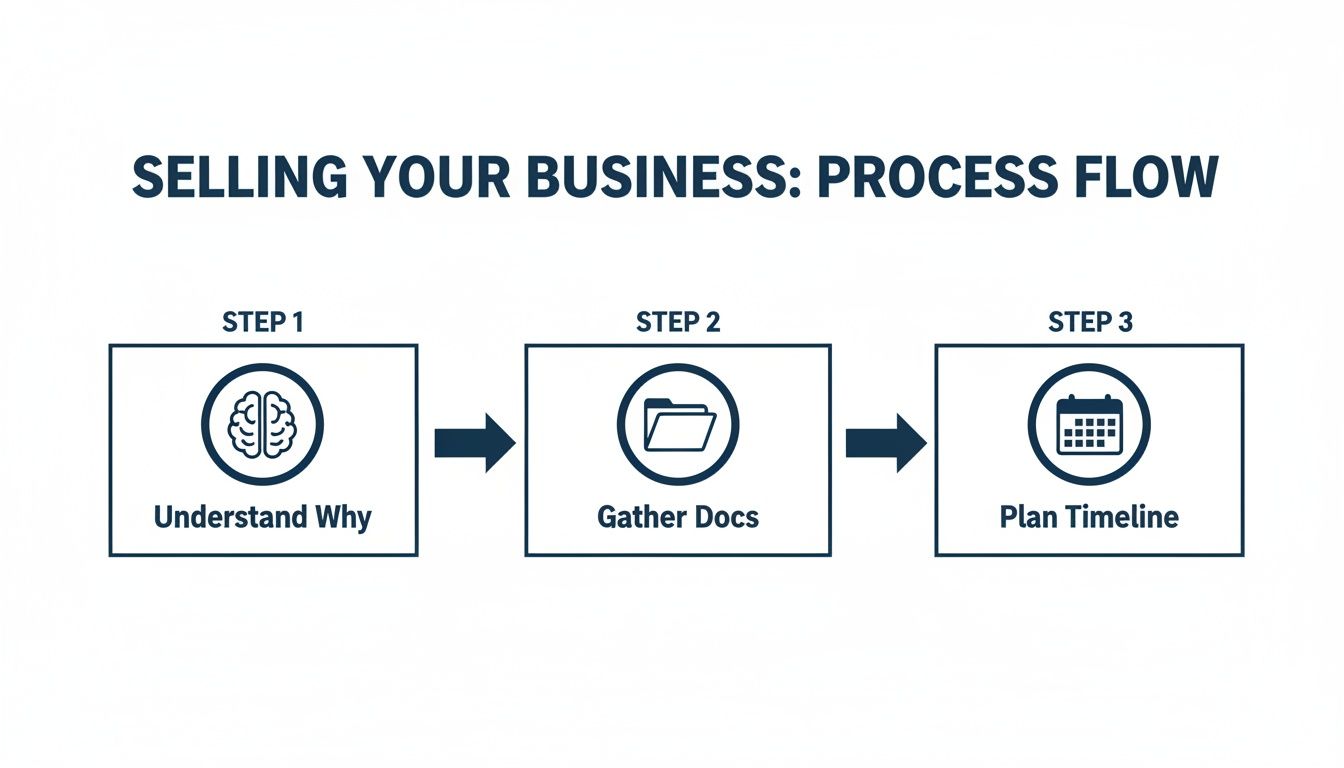
This simple flow—knowing why you’re selling, getting your papers in order, and making a plan—is the foundation for the whole process.
Your First Document Checklist
To get started, focus on pulling together the main financial and legal papers that tell your business's story. Don't worry about making it perfect yet. The goal is just to get everything in one place.
Here’s a handy checklist to get you started:
- Financial Statements: You'll need your Profit & Loss (P&L) statements, balance sheets, and cash flow statements for the last three to five years. This is the first thing any serious buyer will ask for.
- Tax Returns: Gather your business tax returns for the same three-to-five-year period. These papers prove the numbers on your financial statements are real.
- Key Contracts: Find copies of all your important agreements. This includes your office lease, big client contracts, and any major deals with suppliers.
- Employee Information: Make a list of your employees, what they do, and any formal job agreements you have with them.
Selling a business is a marathon, not a sprint. The work you do at the beginning has a huge impact on the final price and how smoothly the deal goes. Rushing this part is one of the biggest mistakes owners make.
The best time to start this is a year or two before you want to sell. That gives you plenty of time to find and fix any problems, clean up your financial records, and get your business ready to attract the best offers. It’s not about racing to the finish line; it’s about setting yourself up for a smart, well-planned sale that honors all the hard work you’ve put in.
Getting Your Business Ready for a Buyer
So, you’ve decided it might be time to sell. Great. Now the real work starts—getting your business ready so a buyer can see all the value you’ve built. This is where you roll up your sleeves and make your company shine.
Think of it like this: you wouldn't sell a car without washing it and making sure the engine runs well. Getting your business ready for sale is the exact same idea. Buyers are looking for a company that’s organized, makes good money, and is easy to understand.

Clean Up Your Financial Records
Let's be direct: the very first thing a serious buyer wants to see is your numbers. They need to look at your financial records and see a clear story of how your business makes money. If your books are a mess, it's like trying to read a book with half the pages missing—it’s confusing, frustrating, and a huge red flag.
You need at least three years of clean, accurate financial statements. This means your P&L, balance sheets, and tax returns all need to match up. A buyer will use these papers to check everything you say about your sales and profits. Any little thing that doesn't add up can create doubt.
This isn't just about avoiding problems; it’s about building trust. Clean books show that you run a professional business. Honestly, this one step can make or break a deal. Studies show that a shocking 65% of deals fall apart during the checking phase, often because of messy finances. The same study found that well-prepared sellers got 6.2 times their profit, while unprepared sellers only got 4.1 times.
Find Ways to Boost Your Profits
Once your books are clean, the next job is to make them look as good as possible. It's simple: a business that makes more money will sell for a higher price. Now is the time to look for small changes that can make a big difference to your bottom line.
You don't need to reinvent your business. Often, it's about making small, smart changes. I once worked with a construction contractor here in the Philly area who realized he was barely making money on small home projects. He switched his focus to bigger commercial jobs, and his profit jumped by 20% in one year. That move added six figures to his final sale price.
Here are a few places to start looking:
- Look at Your Pricing: When was the last time you raised your prices? Do they match the value you provide? Even a small increase goes straight to your profit.
- Cut Extra Costs: Go through your expenses one by one. Are you paying for software you don't use? Can you get a better deal from a supplier? Every dollar saved is a dollar of profit.
- Work Smarter: Can you find ways to get things done faster or with less waste? For a service company, this might mean finally using that project management tool you’ve been thinking about.
- Focus on What Sells Best: Like that contractor, figure out which of your products or services make the most money. Put your sales and marketing energy there.
The months before you sell are your chance to tell a great story with your numbers. Every dollar you add to your net profit could add several dollars to your final sale price.
Making these changes shows progress. It shows a buyer that your business is growing and has a bright future.
Write Down How You Do Things
Imagine handing the keys to your business to a stranger. Would they know what to do on the first day? If the answer isn't a strong "yes," you have some work to do. Buyers aren't looking for a new job; they're looking for an investment that runs smoothly, even without the founder.
This is where Standard Operating Procedures (SOPs) come in. Don’t let the name scare you. SOPs are just simple, written instructions on how to do the important tasks in your business. It's the "how-to" guide for your company.
This might sound like a big job, but you can start small. Just writing down your main processes is a huge step. Check out our guide on business exit planning strategies to see how this fits into the bigger picture.
Think about the main parts of your business:
- How do you find new customers and make sales?
- What are the steps for delivering your product or service?
- How do you send bills and collect payments?
- What are the key tasks your team does every day, week, and month?
Creating this playbook makes your business a much safer bet for a buyer. It proves that the company's success is built on good systems, not just on you being there every day. A business that can run on its own is a business that’s truly ready to sell.
How to Determine What Your Business Is Worth
Figuring out what your business is worth is the million-dollar question—sometimes for real. This part can feel scary, with lots of confusing words and math. But really, it’s just about finding a fair price that both you and a buyer can agree on.
Let's break it down. You don't need a finance degree to get the basics. Thinking about your business's value early helps you set a realistic price and gives you a powerful tool when you start to negotiate.

Common Ways to Value a Business
There isn't one single formula to calculate your business's price. Instead, buyers and brokers usually look at it from a few different angles to get a solid number. The most common way is a simple multiplication problem.
You take your business's profit and multiply it by a certain number, called a "multiple." A common profit number used for this is EBITDA. It’s just a fancy way of saying the cash your business makes from its main operations, before things like interest and taxes are taken out.
The multiple can change a lot depending on your industry, the size of your company, and how much a buyer thinks it can grow.
- A software company with customers who pay every month has very predictable income. It's low-risk, so it might get a high multiple, like 8 or 10 times its EBITDA.
- A construction company that has to win one big project at a time has less predictable income. It might get a lower multiple, maybe 3 or 4 times its EBITDA.
This method is popular because it shows what real buyers are actually paying for businesses like yours right now.
Getting a professional business valuation isn't just about finding a price tag. It's about understanding what makes your business valuable—the good and the bad—so you can tell a convincing story to buyers and defend your asking price.
It’s More Than Just A Math Problem
While profits and multiples are the starting point, they don't tell the whole story. A smart buyer will look past the numbers to see what really makes your business work. Several other things can push your business's value up—or pull it down.
These other factors can have a huge impact on the final sale price. They help a buyer feel sure that the business will keep making money long after you're gone. Having these things in place can often lead to a much higher multiple.
For business owners wondering where to start, you can learn more about how professional business valuation services work and what they cover.
Key Factors That Change Your Business Value
Here are the main things that can increase or decrease the final sale price. This table helps you see where to put your energy before you put your company on the market.
| Factor | Why It Matters to a Buyer | Simple Example |
|---|---|---|
| Clean Financials | Messy or missing records make buyers nervous. They need to see a clear, provable history of sales and profits. | Your tax returns, P&L statements, and balance sheets all tell the same story for the past three years. |
| Customer Concentration | If one customer makes up 50% of your sales, that's a big risk. If they leave, the business could be in trouble. | A marketing agency has 20 clients, and no single client is more than 10% of its total sales. |
| Owner Dependence | Can the business run without you? If you're the only one who knows how things work, the value drops. | You have written instructions (SOPs) and a strong team that handles day-to-day work without you. |
| Growth Potential | Buyers are paying for future profits, not just what you did in the past. They want to see clear ways to grow the business. | A local doctor's office has a great reputation and a clear chance to open a new office in the next town. |
Looking at these factors shows that what a buyer is really buying is confidence and a clear path to making money in the future.
Ultimately, being prepared makes all the difference. Statistics show that about 80% of deals fail because of poor financial records. By cleaning up your books and boosting profits ahead of time, you put yourself in a much stronger position to negotiate. For example, sellers with healthy profit margins of 15% or more often get multiples of 5-7 times their profit, compared to just 3-4 times for less profitable companies.
Finding the Right Buyer and Structuring the Deal
Once your business is polished up and you have a good idea of what it’s worth, it’s time for the next big step: finding the person or company who will buy it. It's easy to think the "right" buyer is just the one with the biggest check, but I've seen enough deals to know it’s not that simple.
The person on the other side of the table affects everything—the price, the terms of the deal, and what happens to your company and your team after you’re gone. That’s why knowing who you’re selling to is just as important as knowing what you’re selling.
Who Is Buying Businesses Like Yours?
Buyers usually fit into a few different groups. Each one has a different reason for wanting your company, and understanding why they're buying is key to a good negotiation.
Strategic Buyers: Think of these as competitors or bigger companies in your industry. A large construction firm in Philly might buy a smaller plumbing contractor because they want to offer plumbing services themselves. They often pay more because they can merge your business into theirs, cut costs, and get your customers. They're buying your spot in the market, your team, and your good name.
Financial Buyers: These are usually private equity groups or investment firms. Their job is to buy businesses, and they are focused on one thing: getting a good return on their money. They will look at your cash flow and growth potential very carefully. They aren't buying a job for themselves; they are buying a well-run, money-making machine.
Internal Buyers: This could be a long-time manager, a group of employees, or even a family member. The big plus here is that they already know the business, which can make the changeover much smoother. The downside is they often have less cash and may need you to finance part of the deal (called seller financing).
The best buyer isn't always the one with the highest offer. A slightly lower, all-cash offer from a buyer who promises to take care of your team might be a better fit for you than a complicated, higher offer that has a real chance of falling apart.
The market for selling businesses is very busy right now. Recently, deals worth $4.9 trillion were made around the world. For business owners here in the Philadelphia area, this means more potential buyers are out there. With the right preparation, I've seen sellers in this hot market get 20-30% higher prices. You can see what experts are saying about current dealmaking trends.
The Path from "For Sale" to "Sold"
Selling a business usually follows a standard set of steps. Knowing the steps ahead of time makes the whole thing feel less confusing. It all starts with getting the word out (secretly, of course) and ends with signing a lot of papers.
First, your business broker will create a document called a Confidential Information Memorandum (CIM). Think of this as the ultimate sales brochure for your company. It has all the details a serious buyer would want, like your financial history, how you operate, your team structure, and clear ways the business can grow.
After looking at the CIM, interested buyers will make an offer, usually with a Letter of Intent (LOI). This is a non-binding agreement that lays out the basic terms of the deal, like price, payment plan, and a timeline. It’s like agreeing on the main points before you spend a lot of money on lawyers to write up the final contracts.
Once an LOI is signed, the buyer gets a set period of time to do due diligence. This is where they check everything very carefully to make sure what you've told them is true. Our article on what is financial due diligence explains exactly what they'll be looking for in your books.
Structuring the Deal: Asset Sale vs. Stock Sale
One of the most important parts of the negotiation is how the deal is legally set up. The two most common ways are an asset sale or a stock sale, and the difference means a lot for your taxes.
Asset Sale: In this deal, the buyer purchases specific things from your company—like equipment, products, and customer lists—but not the legal business itself. Most buyers like this because it means they don't take on any of your company's old debts. For you, the seller, this can often mean a higher tax bill.
Stock Sale: Here, the buyer purchases the stock (or ownership shares) of your company. They get everything—all the assets and all the debts. Sellers usually prefer this because the money they make is typically taxed at a lower rate.
Deciding between these two is a big point of negotiation. It’s a classic tug-of-war where one person's tax savings is the other person's tax cost. This is exactly where having a good accountant and lawyer on your team is essential to get the best deal for you.
Planning for Life After the Sale
You did it. The papers are signed, the deal is closed, and the business you poured your life into has a new owner. It’s a huge moment, but the journey isn’t quite over. A truly successful sale includes a smooth handover that helps the company—your legacy—keep doing well long after you're gone.
After all, the last thing you want is for the business you built to fail the minute you leave. Let's talk about what comes next, both for the business and, just as importantly, for you.

The Handover and Transition Period
Almost every sale agreement includes a transition period. This is where you stick around for a while to help the new owner learn the business. Don't treat this as a small detail; how long you stay and what you do are key things you need to negotiate before you sign.
A typical transition can look a few different ways:
- Short-Term Consultant: You might agree to stay for three to six months as a paid consultant. Your main job is to answer questions, introduce the new owner to key clients and suppliers, and help the team feel good about the new boss.
- Part-Time Advisor: In other deals, you might just be available for a year. The new owner can call you with questions, but you’re not involved in the day-to-day work.
- Full-Time Employee: This is less common for small businesses, but sometimes a big buyer might want you to stay in a leadership role for a year or two.
The goal here is simple: set the new owner up to succeed. I once saw a deal for a doctor’s office in the Philly suburbs go really well because the selling doctor agreed to work two days a week for the first four months. It made patients and staff feel confident and made the whole changeover go smoothly.
What’s Next for You Personally
Selling your business is more than just a money deal. It's a huge life change. For years, your identity has probably been tied to being "the owner." Now, that's changing. It’s normal to feel a mix of excitement, relief, and even a little sadness.
This is exactly why you have to think about your next chapter before the sale is done. When you're thinking about what's next, preparing an exit strategy isn't just about the company's future; it's about yours.
What does life after the sale look like for you?
- Retirement: Are you ready to relax, travel, and spend more time with family?
- A New Venture: Is there another business idea you're excited to start?
- A Different Career: Maybe you want to consult, teach, or work for a charity.
There’s no right answer, but having a plan helps you move forward. Without one, many former owners I’ve talked to feel lost and bored after the initial excitement is gone.
Selling your business isn't the finish line. It's the starting line for the rest of your life. Make sure you're just as prepared for your own future as you were for your business's sale.
Managing Your Finances for the Long Haul
Finally, let's talk about the money. You've likely just received a big check, maybe the most money you've ever had at one time. It's tempting to make big moves right away, but the smartest thing you can do is take a breath and pause.
Before you buy the boat or invest in a relative's new idea, put together a team of financial experts you trust. This should include a financial advisor and a tax planner. They will help you make a solid plan to make sure this money lasts for the rest of your life.
They'll help you answer the big questions:
- How much do I really need to live on comfortably each year?
- What's the smartest way to invest this money for my goals?
- How can I set things up to pay the least amount of tax from the sale?
Taking this step helps make sure the successful sale you worked so hard for is a good thing for you for years to come.
Common Questions About Selling a Business
Selling a business is a huge step, and it’s normal to have a million questions. Let's go over some of the most common ones I hear from owners.
How Long Does It Actually Take to Sell a Business?
This is always the first question, and my answer is almost always the same: longer than you think.
On average, you should plan for 6 to 12 months from the day you list your business to the day you get paid. That's a big range, and a lot of things can change the timeline.
Clean financial records, a history of good profits, and a strong economy can speed things up. But finding the right buyer always takes time.
And remember, that 6-12 month clock only starts after you’re ready. Getting your books in order and writing down how you do things can easily take another year. That's why I always tell owners to start thinking about selling a couple of years before they actually want to be done. Trying to rush it is a sure way to get a lower price.
Do I Really Need a Business Broker?
You can sell your business on your own, but it's usually not a good idea. Think of it like trying to sell your house without a real estate agent—sure, you can do it, but you'll probably get a lower price and a ton of stress.
A good business broker does a lot more than just find buyers. They're your guide through a very complicated process.
- They help you set a realistic price that you can defend.
- They market your business secretly, so your employees, customers, or competitors don't get worried.
- They check out potential buyers to make sure they're serious and can actually afford the business.
- They act as a buffer during talks, keeping emotions from messing up the deal.
Honestly, the higher sale price and better terms a good broker can get will almost always be more than their fee. Their experience is worth it.
The biggest mistake I see owners make is waiting too long to prepare. They decide they want to sell and then start looking at their finances. By that point, it’s often too late.
Buyers want to see years of clean, consistent financial records. If your books are a mess, they won't trust you. It can kill a deal right away or lead to a very low offer. Another big mistake is letting your emotions make decisions. This business is your baby, I get it. But you have to stay objective to get the best result.
How Do I Keep the Sale a Secret?
Keeping the sale a secret is super important. If word gets out that you're selling, it can cause problems. Employees might get nervous and look for other jobs, customers might worry and go somewhere else, and your competitors will definitely try to use it against you.
This is another reason a broker is so helpful. They market your business using a "blind profile"—an ad that gives general information like the industry and location without saying your company's name.
Anyone who is interested has to sign a strict Non-Disclosure Agreement (NDA) before they learn anything important. This is a legal contract that stops them from sharing your information. This careful, step-by-step process makes sure that only serious, checked-out buyers ever find out who you are. For a great overview of this entire process, check out A Founder's Guide on How to Sell a Business.
Thinking about how to sell your business can feel like a lot, but you don't have to figure it out alone. At MyOfficeOps, we help business owners in the Philadelphia area get their financials in perfect shape so they can sell with confidence. Schedule a discovery call with us today to see how we can help you prepare for a successful exit.