
You started your business to do real work. Maybe you build decks, run a therapy practice, manage client campaigns, or fix HVAC systems. Then one night you sit down with a bank statement, a stack of receipts, and a tax deadline on the horizon, and suddenly the whole thing feels heavier than it should.
That feeling is common. Bookkeeping looks small when business is slow. Then sales pick up, bills multiply, payroll enters the picture, and the numbers stop feeling simple. What most owners want isn't fancy accounting language. They want to know where the money went, what they owe, and whether the business is making progress.
Your Guide to Learning Small Business Bookkeeping
A lot of owners land here at the same moment. The work is getting done, customers are paying, but the books are messy. Receipts live in a glove box, invoices sit in email, and the bank balance becomes the only scoreboard. That works for a little while, until you need to answer a basic question like, "Did that job make money?" or "Can I afford to hire help?"
You are not behind because this feels hard. 21% of small business owners admit they don't know enough about bookkeeping to manage their finances confidently, which can create problems with cash flow, taxes, and growth decisions, according to Rigits bookkeeping statistics.
Bookkeeping is not just typing numbers into software. It's the habit of keeping score in a way that helps you make decisions. A plumber needs to know whether emergency calls are more profitable than scheduled installs. A small law firm needs to know whether flat-fee work is carrying the business or draining it. A marketing consultant needs to see whether a retainer client is steady profit or a time sink.
What this really looks like
Take a trades owner who finishes jobs all day and handles paperwork at night. He knows money is coming in, but he can't explain why cash feels tight. Once he starts sorting income, materials, payroll, and vehicle costs properly, the fog lifts. He can see which jobs pay well, which ones drag, and when cash gets squeezed.
Practical rule: Good bookkeeping should make your next decision easier.
That's the point of learning bookkeeping for small business. Not to become an accountant. Just to build a system that tells the truth about your business in plain English.
Building Your Bookkeeping Foundation
Before software, reports, or fancy dashboards, there are two choices that shape everything else. If these are wrong, the rest stays messy.
Keep business money separate
The first essential rule in U.S. small business bookkeeping is complete separation between business and personal finances, which requires a dedicated business checking account for all transactions, as explained in this U.S. bookkeeping guide.
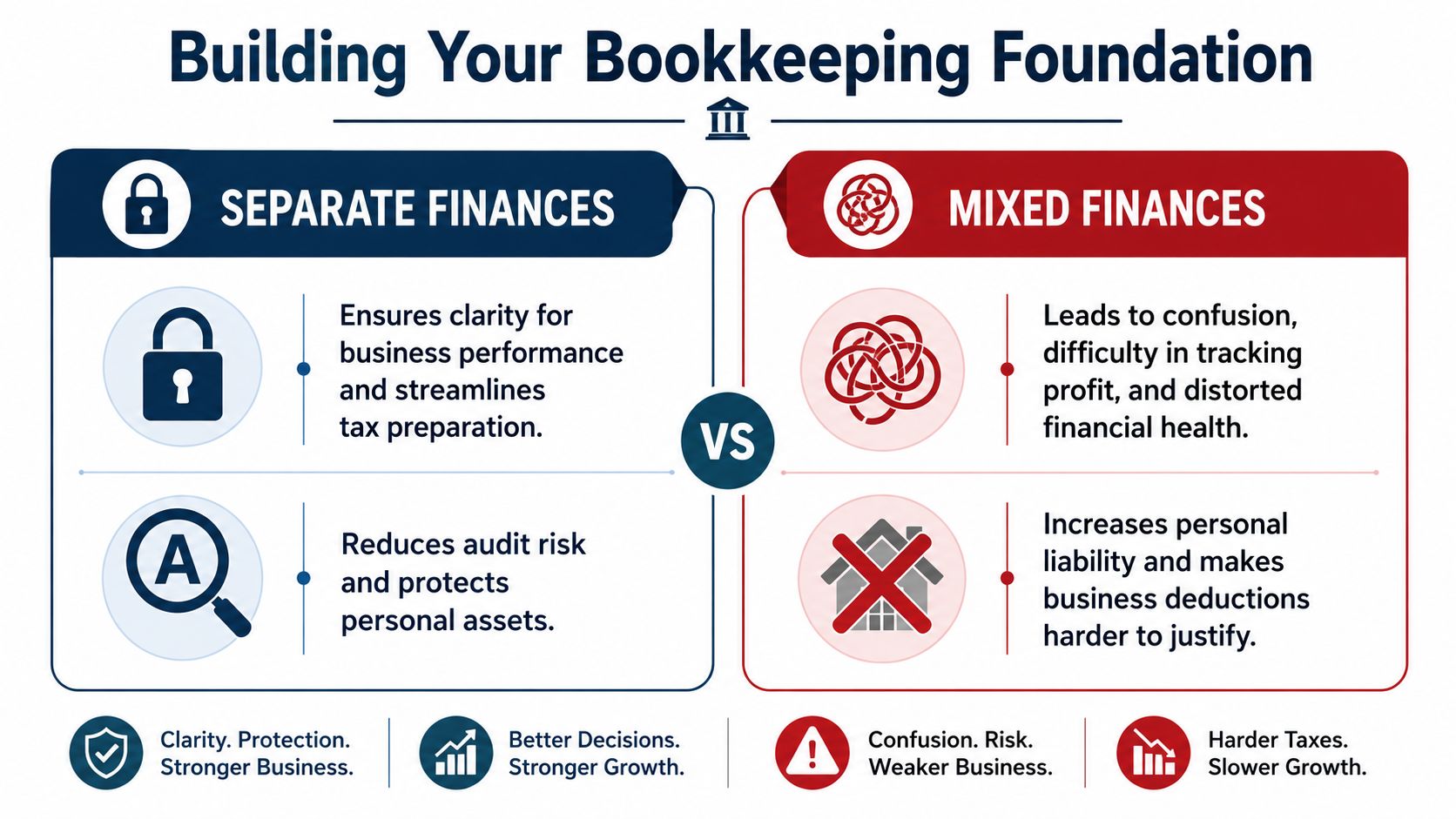
If you buy lunch for a client meeting, use the business card. If you buy groceries for home, use your personal card. Mixing them creates confusion fast. It becomes harder to defend deductions, harder to see profit clearly, and harder to understand whether the business stands on its own.
For a new consultant, this often starts with one checking account and one credit card used only for the business. For a contractor, it may also mean a business savings account for taxes or larger vendor payments. The setup is simple, but it saves hours later.
Mixed accounts don't just create bookkeeping problems. They create decision problems.
Pick your accounting method early
You also need to choose how the business records money.
Here's the simple version:
| Method | How it works | Best fit |
|---|---|---|
| Cash basis | Record income when money hits the bank and expenses when money leaves | Simpler businesses that want a straightforward system |
| Accrual basis | Record income when earned and expenses when incurred | Businesses that need a clearer long-term view of profitability |
Cash basis is easier to understand at first. If a client pays today, you record it today. If you pay the phone bill today, you record it today.
Accrual basis takes more discipline, but it shows a cleaner picture when timing matters. If you finish a big website project in June but get paid in July, accrual tells you the work belonged to June. For firms with longer projects, contracts, or tighter reporting needs, that matters.
If double-entry bookkeeping sounds intimidating, Professional Careers Training explains bookkeeping in a way that makes the logic easier to follow. And if you want a simpler explanation of how transactions flow behind the scenes, this guide on understanding journal entries helps connect the dots.
Build your first simple rules
Start with rules you won't argue with later:
- Use one bank account: All business income lands there. All business expenses leave there.
- Use one method: Don't switch between cash thinking and accrual thinking every month.
- Save proof as you go: Receipts, bills, and invoices need a home from day one.
- Name owner activity clearly: If you take money out, record it properly instead of burying it in random expenses.
Those are boring rules. They also fix a lot of chaos.
Choosing Your Tools and Setting Up Shop
Now the practical part. You need tools that match the way you run the business.
Modern bookkeeping infrastructure requires four essentials before you start: a dedicated business bank account, a chosen accounting method, a transaction tracking system, and scalable accounting software like QuickBooks or Xero, according to InvoiceFly's small business bookkeeping guide.
Compare software based on how you work
Plenty of owners pick software by price alone. That usually backfires. The real question is whether the tool fits your workflow.
A freelance designer may need basic invoicing, expense tracking, and bank feeds. A construction company may need job costing and payroll connections. A clinic may care more about clean expense tracking and reliable month-end reporting.
Here's a simple way to consider this:
- QuickBooks Online: Common choice when you want broad features, bank feeds, and room to grow.
- Xero: Good fit for owners who want a clean interface and solid day-to-day bookkeeping tools.
- Wave: Often appealing for very small operations with simpler needs.
If billing is a big part of your process, Suby billing insights are useful for thinking through invoicing software choices before you lock yourself into a tool.
Set up your chart of accounts the right way
The chart of accounts sounds technical, but it's just your list of categories. It decides whether your reports will be useful or useless.
A professional services firm might have categories like:
- Income from client work
- Software subscriptions
- Contract labor
- Advertising
- Office supplies
A trades business may need more detail:
- Labor
- Materials
- Equipment rental
- Vehicle expense
- Permits
- Subcontractors
If you throw everything into broad buckets like "miscellaneous" or "general expense," your reports stop helping. You won't know which costs are rising or which jobs are eating margin.
Choose for next year, not just this month
Software should fit the business you're becoming. A solo consultant can survive with a lean setup. A growing agency that plans to hire account managers needs stronger reporting. A contractor with crews in the field needs job-level tracking much earlier than most owners expect.
This is also where a lot of owners benefit from a checklist like this guide on how to choose accounting software. It helps you think past the monthly subscription fee and focus on reporting, payroll, invoicing, and growth.
Creating Your Bookkeeping Rhythm
The biggest bookkeeping mistake isn't laziness. It's delay. Owners wait until the books are a mess, then try to fix months of transactions in one sitting. That turns simple work into detective work.
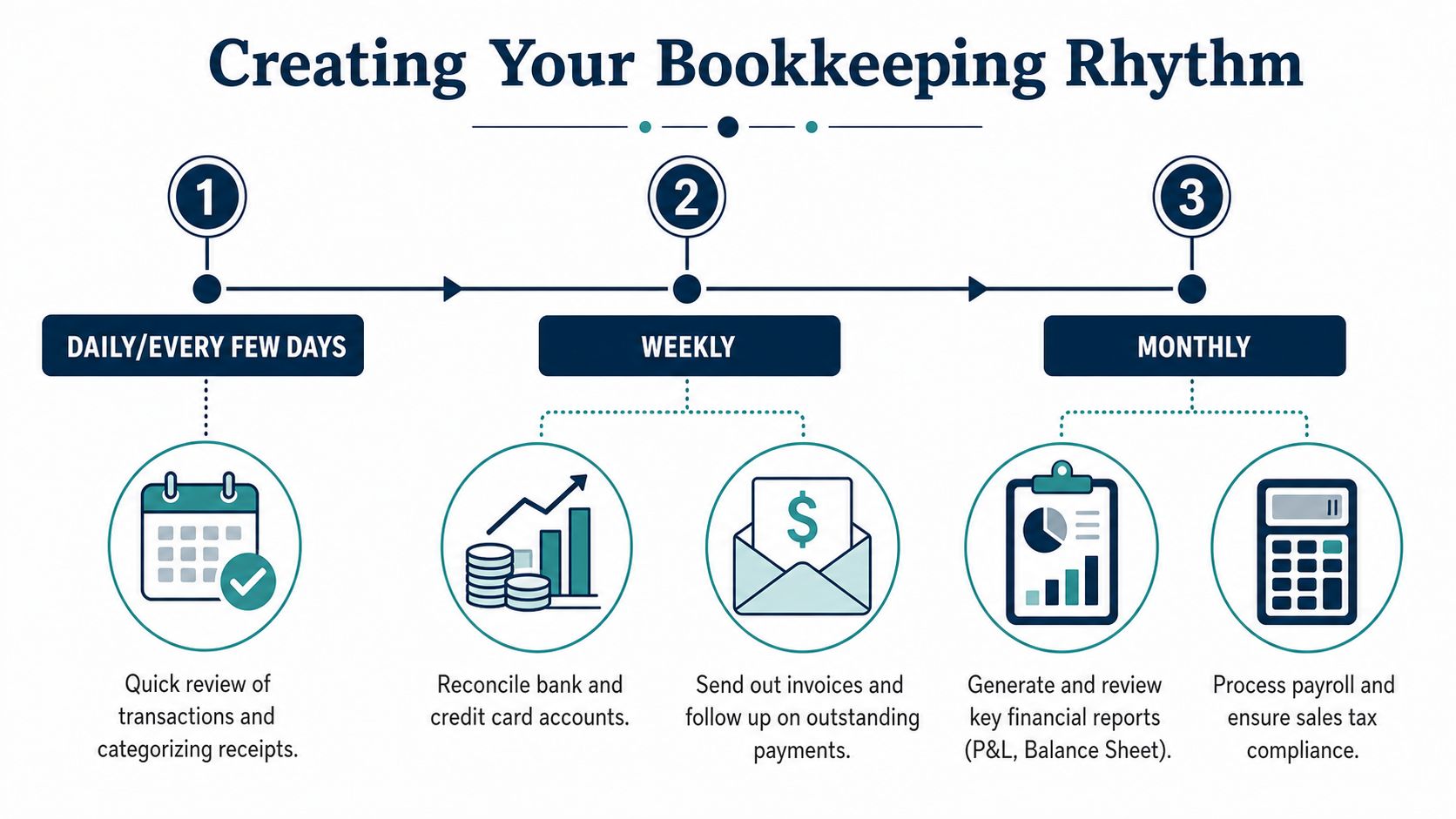
The IRS says daily recording is ideal, but a weekly or bi-weekly schedule is acceptable, and you need to consistently gather records like sales revenue, vendor bills, receipts, and payroll to keep accurate books, according to IRS Publication 583.
Daily or every few days
This part should be light. Not an ordeal.
Open your software, look at imported transactions, and categorize what came through. If a client paid an invoice, mark it to income. If you bought printer toner, post it to office supplies. If you paid for Canva, Zoom, or job materials, assign it where it belongs and attach the receipt if you have it.
For a one-person consulting business, this may take only a few minutes. For a busy electrical contractor, someone in the office may need to review cards, supplier charges, and crew-related purchases more often because volume builds up fast.
Weekly
A short weekly block keeps you from falling behind. The seven-day onboarding protocol described in KDA's bookkeeping process guide includes a recurring 30-minute weekly calendar block, plus monthly reconciliation and a rule to stop if discrepancies exceed $50. That's a smart discipline because forced balancing hides problems instead of solving them.
A solid weekly session usually includes:
- Categorize leftovers: Clean up anything the bank feed pulled in that still sits uncategorized.
- Attach backup: Add receipts, bills, or notes while the purchase is still fresh in your mind.
- Review invoices: Send new invoices and follow up on old ones before they age badly.
- Look at cash needs: Check upcoming bills, payroll, and tax payments.
The best bookkeeping routine is the one you can repeat when you're busy.
If you want to reduce manual admin around repeat tasks, GPT for Work's analysis on AI automation is worth reading for ideas on where automation tools can help with reminders, document handling, and routine office workflows.
Monthly
Month-end is where you confirm the books are real.
Reconciliation means matching your accounting records against the actual bank and credit card statements. If the statement says a payment cleared, your books should show it. If the books show a charge that never happened, you need to fix it.
A monthly close usually includes:
- Reconcile bank accounts
- Reconcile credit cards
- Review loan and payroll entries
- Check uncategorized transactions
- Run key reports
This is also the point where owners should learn what a proper month-end close looks like. It doesn't have to be corporate or complicated. It just needs to be consistent.
Common Bookkeeping Mistakes and How to Avoid Them
Most bookkeeping errors start small. A missed receipt. A payroll entry posted to the wrong place. A charge dumped into "ask my accountant." Then those small misses pile up and the reports stop telling the truth.
Mistake one: treating busy as profitable
This hits contractors, agencies, and service firms all the time. The calendar is full, the team is working, and cash is moving. That can feel like proof the business is healthy.
It isn't proof.
If you don't track income and costs by job, project, or client, you can stay busy while losing money on the work that fills your schedule. A remodeler may underprice change orders. A marketing agency may keep a retainer client who chews up staff time. A law office may offer flat-fee packages that look attractive but eat margin.
Mistake two: weak payroll integration
Payroll is one of the fastest ways to distort your books. Wages, taxes, benefits, reimbursements, and job allocation all need to land in the right places.
A 2026 report says 65% of construction and healthcare SMBs struggle to properly reconcile job-specific expenses because they lack training on integrating payroll with accounting software, according to Coursera's small business bookkeeping article. That makes practical sense. These industries often have overtime, split roles, site-specific labor, or non-standard pay setups that basic bookkeeping advice barely mentions.
When payroll isn't mapped correctly, job costs get blurred. Then pricing gets distorted because labor is one of the biggest costs in many service businesses.
If labor lands in the wrong place, every profitability report after that becomes less useful.
Mistake three: forcing the reconciliation
Some owners hit a mismatch and plug in a random adjustment just to make the books balance. That feels like progress, but it usually creates future confusion.
Better options:
- Trace duplicates: A vendor bill may have been entered twice.
- Check timing: A payment might have cleared after month-end.
- Review owner spending: Personal charges often hide here.
- Look at transfers: Bank transfers are easy to miscode as income or expense.
Mistake four: using bookkeeping only for taxes
Tax prep matters. But if that's the only time you look at the books, you miss the bigger value. You lose the chance to spot weak pricing, rising costs, or a growing cash gap while you still have time to respond.
From Numbers to Decisions Your Financial Story
Bookkeeping proves useful. The data entry work feeds reports. The reports answer business questions. That's the whole game.
78% of small business owners lack the financial literacy to connect bookkeeping data to decisions about pricing, hiring, and cash flow, according to the IOSR financial literacy research. That gap is why many owners keep books for tax filing but still feel unsure when it's time to make a real decision.
Profit and loss
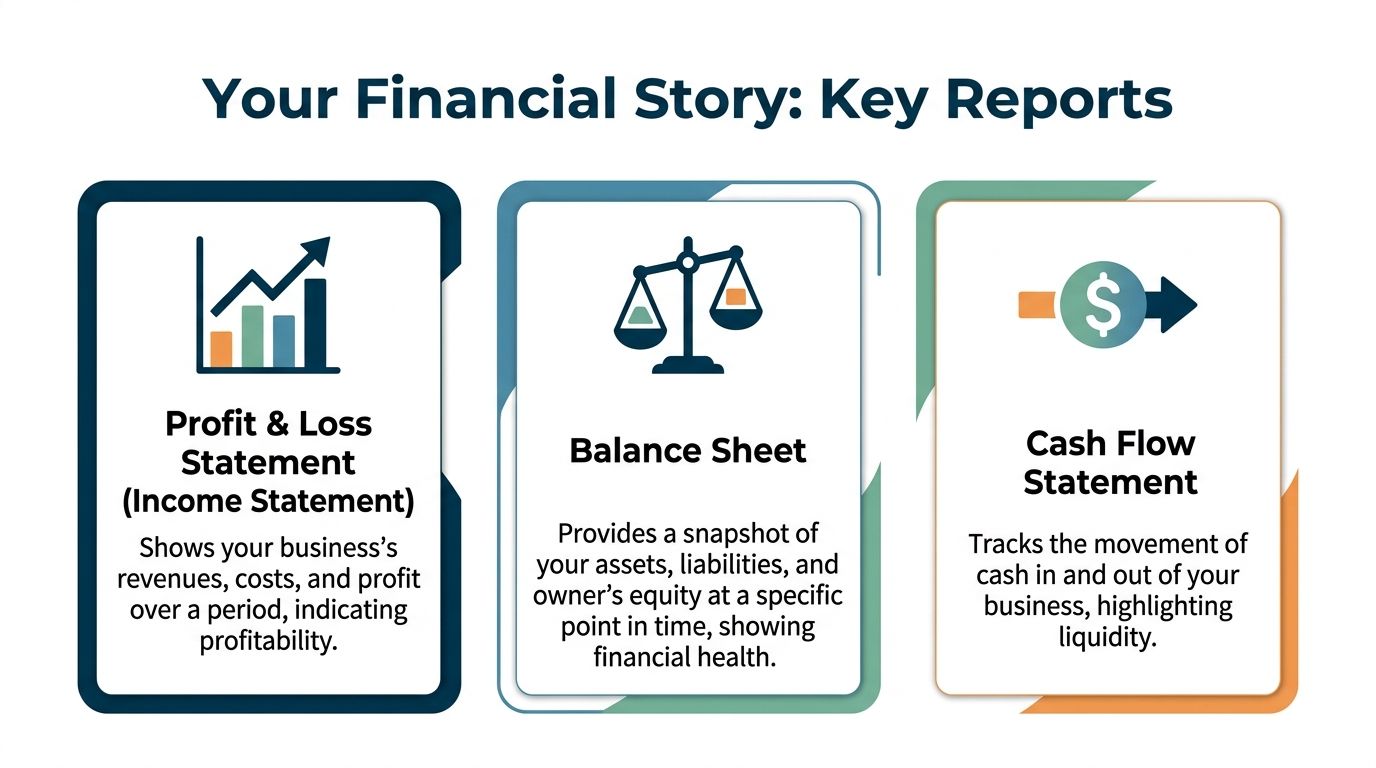
The profit and loss statement shows what you earned and what you spent over a period of time.
This is the report you pull when you're asking:
- Are my prices working?
- Did that new service line help?
- Are software costs creeping up?
- Did subcontractor spending wipe out margin?
For a photographer, this can show whether weddings are more profitable than brand shoots. For an IT company, it may show that one support package brings steady revenue while custom projects create more stress than profit.
Balance sheet
The balance sheet gives you a snapshot of what the business owns, what it owes, and what is left over as equity.
This is the report behind questions like:
| Question | Why the balance sheet matters |
|---|---|
| Can I qualify for financing? | Lenders want to see assets, liabilities, and overall financial position |
| Am I carrying too much debt? | The report shows obligations clearly |
| Do I actually own value in this business? | Equity helps answer that |
A healthy bank balance alone doesn't tell this story. You can have cash in the account and still carry liabilities that change the picture fast.
Cash flow
The cash flow statement answers a different question. Not "Am I profitable?" but "Can I pay what's due when it's due?"
That matters when profit on paper doesn't match money in the bank. A business can look good on a profit and loss report and still feel squeezed because clients pay late, payroll hits first, or loan payments stack up at the wrong time.
Good bookkeeping turns "I think we're okay" into "I know what this decision will do to cash."
A service firm thinking about a new hire can use these reports together. The profit and loss report shows whether margins support the role. The balance sheet shows the overall health of the business. Cash flow shows whether the business can absorb payroll before that new person starts producing revenue.
When you can read those reports in plain language, bookkeeping stops being back-office cleanup. It becomes a tool for pricing, hiring, investment, and growth.
If your books are behind, your reports don't make sense, or you want help turning financial data into better decisions, MyOfficeOps can help. Their team supports small and midsize businesses with bookkeeping, payroll integration, reporting, and advisory work that makes the numbers easier to use in real life.