
Outsourced accounting is pretty simple: instead of hiring a full-time person to handle your money, you hire an outside company of experts. Think of it like having a pro finance team ready to help whenever you need them, without paying for salaries, benefits, and extra office space.
What Are Outsourced Accounting and Bookkeeping Services?
Imagine you're trying to grow your business, but you're also stuck dealing with every single receipt, invoice, and payroll payment. It's a common trap for business owners. You're stretched thin, and it’s easy for a small money mistake to turn into a big, expensive problem. This is where outsourced accounting and bookkeeping services come in. You hand over those important but time-consuming money tasks to a team of outside pros.

This isn’t just a small trend; it's a smart way businesses are choosing to work. The global market for this is expected to reach $81.25 billion by 2030. That huge number shows that business owners are tired of dealing with in-house financial headaches. In fact, 37% of U.S. businesses already plan to outsource their accounting to cut costs and let their own teams focus on work that actually makes money.
It's More Than Just Crunching Numbers
Here's a simple way to think about it. Your bookkeeper is like a chef who carefully gathers and prepares all the ingredients—your daily sales and expenses. The accountant is like the restaurant owner who uses those ingredients to create a popular menu and run a successful business—your financial plan.
When you outsource, you don't just get one person. You get a whole team that can:
- Correctly record all the money coming in and going out.
- Manage your bills and send invoices to customers so you get paid.
- Prepare your monthly financial reports.
- Help you actually understand where your money is going.
To get the full picture, it helps in understanding what Business Process Outsourcing (BPO) is, since accounting is a big part of this idea.
In-House vs. Outsourced: A Quick Look
Choosing between hiring your own finance person and outsourcing usually comes down to cost, skills, and where you want to focus your time. Here’s a simple comparison.
| Feature | In-House Accounting | Outsourced Accounting |
|---|---|---|
| Cost | Fixed costs: salary, benefits, payroll taxes, training | Flexible costs: monthly fee for what you need, no extra overhead |
| Skills | Limited to the skills of the person you hire | Access to a full team (bookkeepers, accountants, CFOs) |
| Growth | Hard and expensive to add more help as you grow | Easily grows with your business |
| Tools & Software | You have to buy and manage all the software | The best software is usually included in the service |
| Your Focus | You spend time hiring, training, and managing someone | You can focus 100% on running your business |
| Risk | You're in trouble if they quit or make a mistake | The firm is responsible for being accurate and reliable |
The right choice depends on your business, but for most growing companies, the flexibility and expert help from outsourcing is a huge plus.
Why It's a Game-Changer for Small Businesses
For a growing business, trying to handle money in-house can drain your resources. You either do it yourself—taking time away from customers—or you hire someone, which adds a salary and other costs to your budget. Outsourcing cuts through all that.
The big idea is simple: You get to focus on what you're good at, knowing your finances are in expert hands and you have clear information to guide your decisions.
It’s a practical solution that gives you peace of mind. Instead of guessing, you get simple reports that tell you exactly how your business is doing. That clarity is so important for a small business where every dollar counts.
You can learn more about how this works with our guide on outsourced bookkeeping for small business.
Why Smart Businesses Are Outsourcing Their Finances
So, why are so many business owners handing over their finances? The biggest reason is simple: cost.
Hiring just one experienced accountant is expensive. When you add up their salary, benefits, insurance, and training, the true cost is often much higher than people realize.
Outsourcing flips that around. Instead of one expensive hire, you get a whole team of specialists—bookkeepers, controllers, and even top-level advisors—for a much lower price. You pay a set monthly fee for the exact amount of help you need.
Get Experts You Couldn't Afford to Hire
But it's about more than just saving money. It's about getting access to experts you probably couldn't afford to hire full-time. A good outsourced partner has worked with hundreds of businesses like yours. They know what works and, just as important, what doesn't.
I think about a local construction contractor I know. They were busy, but they had no idea which jobs were actually making them money. By outsourcing their accounting, they got simple reports that showed exactly where their profits were coming from. This let them change their pricing and make a lot more money.
That’s the real power of outsourced accounting and bookkeeping services. It’s not just about getting the books done; it’s about getting the clear view you need to run your business better.
This shift is a big deal. There's a huge shortage of accountants, with a predicted gap of 3.5 million skilled professionals by 2025. This makes hiring good people really hard, and 51% of finance managers say it's their biggest challenge. It makes sense that so many businesses are turning to outsourcing to find the talent they need without the hiring headaches.
Better Tools and Smoother Workdays
Top firms also bring great technology with them. They use the best cloud-based software, which means your financial information is always safe, correct, and available anytime. This gets rid of boring data entry and greatly reduces the chance of human error.
This makes your daily work much easier. Here’s what that looks like:
- No More Paper Mess: Receipts and invoices are scanned and saved online, so you can say goodbye to piles of paper.
- Faster Payments: Automatic systems can pay your bills and send invoices to customers, which is great for your cash flow.
- Clearer Information: You get simple dashboards that show you the health of your business at a glance.
By handing off these tasks, you're not just saving time; you're making your whole company run better. This is a key step when you want to learn how to improve operational efficiency in general.
Outsourcing your finances frees you to focus on what you do best: taking care of your customers and growing your business. Instead of being stuck in spreadsheets, you can lead with confidence, knowing your financial foundation is strong.
Finding the Right Level of Service for Your Business
Choosing an outsourced accounting service isn't an all-or-nothing deal. It's like picking the right tool for a job. You wouldn't use a sledgehammer to hang a picture, right? In the same way, the help your business needs today might be very different from what you'll need next year.
The best part about outsourcing is that it grows with you. These services aren't one-size-fits-all. They are like building blocks. You start with the basics and add more as your company gets bigger and your goals change.
Let’s break it down into the three common levels of service.
Level 1: Core Accounting and Bookkeeping
Think of this first level as the foundation of a house. Without a solid foundation, anything you build on top will be shaky. Core Accounting is that essential foundation for your business. It covers all the basic tasks that keep your company running and organized.
This level is all about being accurate and consistent. The goal is to correctly record what has already happened in your business to give you a clean, clear picture of your money.
Here’s what you usually get in a core package:
- Accurate Bookkeeping: Every sale, purchase, and payment is recorded and sorted correctly.
- Bills and Invoices: They make sure your bills get paid and you follow up with customers so you get paid on time.
- Bank Reconciliations: They match your records with your bank statements to catch any mistakes.
- Basic Financial Reports: They create your key reports, like the Profit & Loss (P&L) and Balance Sheet, so you can see where your money went.
This is the perfect starting point for new or small businesses that need to get organized, save time, and make sure their books are ready for tax time.
Level 2: Profit Optimization
Once your foundation is solid, you can start putting up the walls. This next level, Profit Optimization, is where you go from just recording the past to using that information to make smarter choices for the future. Your financial data stops being a boring report and starts telling you a story.
This is where outsourced accounting starts to really pay off. Your outsourced team goes from being a scorekeeper to a coach who helps you understand the "why" behind the numbers.
At this level, you get everything from Core Accounting, plus:
- KPI Dashboards: Simple, visual charts that track your most important numbers (Key Performance Indicators) like cash flow, profit, and how much it costs to get a new customer.
- Budgeting and Forecasting: They help you create a money plan for the next few months or year and then see how you're doing compared to that plan.
- Job Costing Reports: For businesses like construction or marketing agencies, this shows you which projects are making you the most money.
- Cash Flow Analysis: This helps you manage and predict your cash so you can avoid surprises.
Imagine you run a small doctor's office. A report at this level might show that one service you offer is much more profitable than others. That information can help you decide where to focus your marketing. That’s the kind of useful insight this level gives you.
Level 3: CFO and Advisory Services
Now we’re putting the roof on the house and decorating the inside. CFO & Advisory services are for when you're thinking about the next five years, not just next month. This is high-level, strategic help.
This diagram shows how these three levels build on each other, helping your business at every step.
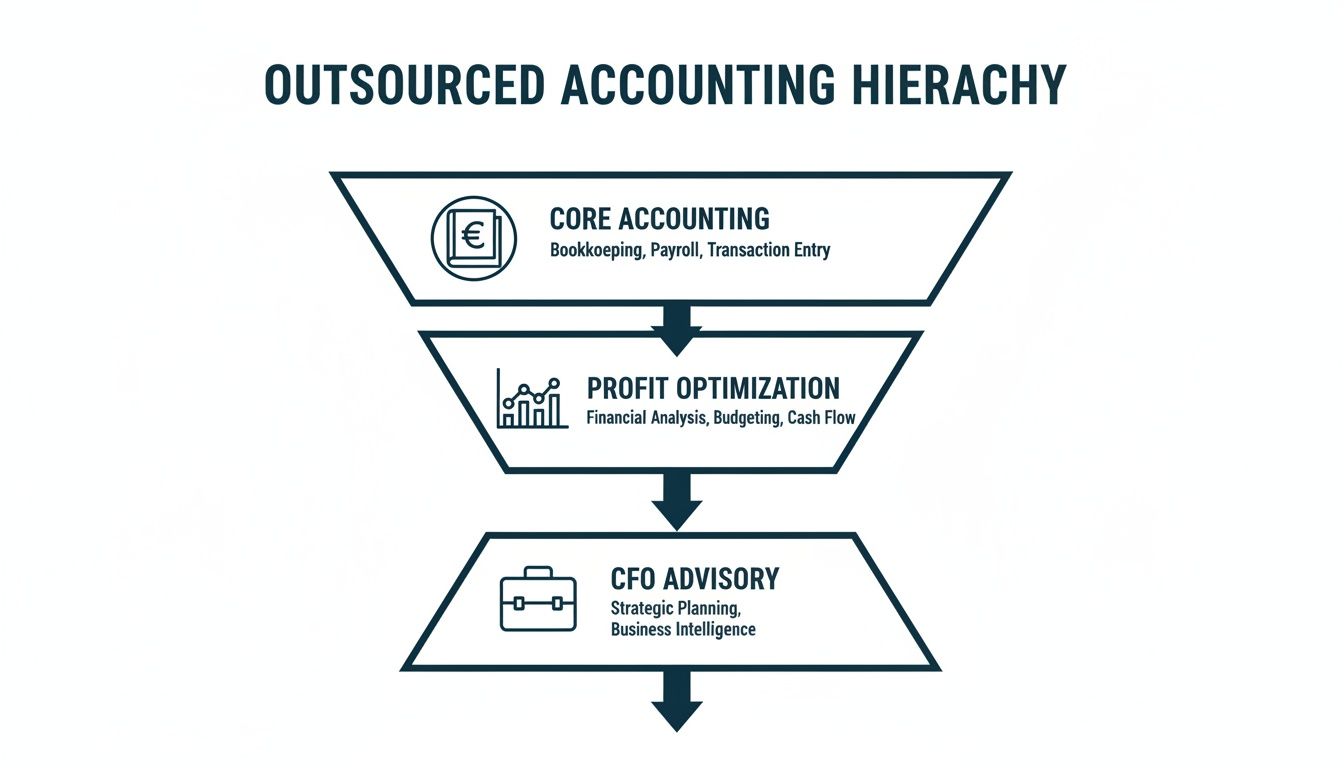
As the picture shows, each level gives you a deeper look at your finances, moving from basic record-keeping to planning for the future.
An outsourced or fractional CFO doesn't worry about the small, daily details. They focus on the big picture.
This is about making big moves. Think of a CFO as your financial co-pilot when you're planning a major expansion, getting ready to sell your company, or dealing with a tough economy.
Services at this level are custom-built for your biggest goals. This might mean creating financial plans for investors, guiding you through a merger, or making a long-term plan to increase your company's value. You get the wisdom of a top finance expert without the six-figure salary.
How to Choose the Right Accounting Partner
Hiring someone to manage your company’s money is a big deal. It’s as important as choosing a business partner. You’re looking for someone you can trust completely to help you run your business.
Getting this right is one of the best things you can do. So, what should you look for? It’s not just about finding someone who is good at math. You’re looking for a real partner who will be there to help you.
Look for Industry-Specific Experience
First, find a firm that understands your industry. The finances of a doctor's office are very different from a construction company. A general accountant might know the basic rules, but a specialist knows the game.
They’ve seen the common mistakes, know where to find opportunities, and understand which reports matter most to a business like yours.
For example, a firm that works with a lot of law offices will know how to track hours and project profits. Someone who only works with retail stores won't have that same experience. This special knowledge is a huge benefit.
Communication Is Everything
This might be the most important point. You need a partner who can explain money topics in plain English. If you leave a meeting feeling more confused than when you started, that’s a big red flag.
A good accounting partner should be like a coach. They should answer your questions without making you feel silly and give you reports you can actually use to make decisions.
Ask them directly about how they communicate:
- How often will we talk?
- Who will be my main contact person?
- Can you show me an example of your reports?
Your financial partner should give you clarity, not confusion. If they use a lot of jargon, they aren't the right fit. You need someone who helps you understand.
Ask About Their Process and Technology
A professional firm will have a clear process for everything. One of the first things you should ask is how they get you started. It should be a smooth, step-by-step process that makes it easy for you. A messy start usually means a messy relationship later on.
You also need to check their technology. Modern outsourced accounting and bookkeeping services use cloud software like QuickBooks Online or Xero. Your partner should be an expert in these tools. They should be able to connect your accounts safely, set up automations that save you time, and make sure you always have access to your financial data.
While many guides talk about IT, the ideas for choosing a strategic outsourcing partner are very similar. The right partner, in tech or finance, has good processes and knows their tools.
Consider the Value of a Local Partner
Finally, for businesses in areas like Greater Philadelphia or West Chester, a local partner can be a big plus. While you can work with anyone online, a local firm understands the regional market, state tax laws, and the local business community in a way an outsider can’t.
Having someone nearby who gets the local economy gives you an extra layer of insight. They know the challenges and opportunities in your area. This mix of industry knowledge and local experience can be very powerful.
How Technology Makes Modern Accounting Better
Modern outsourced accounting uses some smart technology, but that doesn't mean robots are taking over your money. It just means the human experts you hire have much better tools to do their jobs. This switch from slow, manual work to smart automation is a big deal for your business.

Think about it this way. Instead of a bookkeeper spending hours typing in every single receipt, AI-powered software can grab and sort that information automatically. This frees up your expert to focus on what really matters—like spotting a money trend or warning you about a cash flow problem before it gets serious.
This isn’t just a nice idea; it's how things are done now. A solid 71% of accounting professionals believe AI is changing the game by powering this kind of automation. It's also why 60% of older accounting contracts are being replaced as businesses look for partners who understand technology.
Cloud Software Puts Everyone on the Same Page
One of the biggest changes has been cloud accounting software like QuickBooks Online. Not long ago, your financial information was stuck on one computer in your office. If your accountant needed to see it, you had to email files back and forth, which was a mess.
Now, you and your outsourced team are always looking at the exact same, up-to-date numbers from anywhere. No more guessing.
This real-time access means:
- No More Surprises: You always know how your business is doing, not just at the end of the month.
- Faster Answers: Have a question? Your accountant can pull up the exact transaction and give you an answer right away.
- Better Teamwork: You, your bookkeeper, and your advisor can all work from the same numbers to make decisions together.
It turns your financial management from a report you look at once a month into a living part of your daily work.
From Messy Data to Clear Dashboards
All this technology leads to powerful information. The best outsourced accounting services don’t just give you a pile of confusing reports. They use tech to turn your raw financial data into something you can actually use.
This is where you get tools like Key Performance Indicator (KPI) dashboards. Think of a KPI dashboard like the dashboard in your car. It gives you a simple, visual look at your business's health at a glance.
Instead of a speedometer, you get vital signs like:
- Cash Flow: Is more money coming in than going out?
- Profit Margins: Are you making enough on each sale?
- Revenue Growth: How are you doing compared to last month or last year?
This visual approach cuts through the confusion and helps you make faster, smarter decisions every day. Seeing these numbers clearly is a key benefit of modern outsourced accounting and bookkeeping services. To see how this works, check out our guide on financial reporting automation.
Answering Your Questions About Outsourced Accounting
Deciding to hand over your company's finances can feel like a big step. It's normal to have questions. Here are some simple answers to the most common questions we hear from business owners.
Is Outsourced Accounting Only for Big Companies?
Not at all. In fact, small and growing businesses often get the biggest benefits from using outsourced accounting and bookkeeping services.
Think about it: big companies have the money to hire a whole finance department. For a small business, that’s just not possible.
Outsourcing levels the playing field. It gives you access to the same expert help—from daily bookkeeping to big-picture advice—at a price you can afford. You only pay for what you need.
This makes it a perfect fit for businesses in fields like professional services, healthcare, and construction, where every dollar needs to work hard. You get the power of a full finance team without the high cost.
Will I Lose Control of My Finances?
This is probably the number one fear we hear, and it makes sense. The good news? The reality is the exact opposite. A good outsourced accounting partner gives you more control by giving you a crystal-clear view of your finances.
Instead of being lost in spreadsheets and receipts, you get clean, simple reports that show you exactly what's happening with your money. You still approve all payments and make all the final decisions. You’re always in charge.
Think of your outsourced team as your co-pilot. They handle the complicated stuff and give you the accurate information you need to steer, but you’re always the one flying the plane. They provide clarity; you provide direction.
This partnership frees you from the daily money tasks so you can focus on the big decisions that only you, the owner, can make.
How Much Does Outsourced Accounting Cost?
The cost really depends on your company's size and how much help you need. There's no single price tag. Most firms offer different packages based on your situation.
- A basic plan for core bookkeeping (like recording transactions and checking accounts) might cost a few hundred dollars a month. This is great for a small business that just needs clean books.
- A more advanced plan that includes profit analysis, cash flow planning, and regular advice calls will cost more. This is for businesses ready to use their financial data to grow.
The key is to think about the value, not just the price. Compare the monthly fee to the real cost of a full-time employee (salary, benefits, taxes, office space). A great partner should help you find savings and growth opportunities that more than cover their own fee. Many business owners find that the service pays for itself.
What Is the Onboarding Process Like?
A professional firm should make getting started very simple. If the start feels messy, that's a big red flag. The process should be organized and make your life easier from day one.
While every firm is a little different, a good onboarding process usually follows a few key steps:
- Discovery Call: It all starts with a chat. The team will listen to you to understand your business, your current finances, and your biggest headaches. What’s keeping you up at night?
- Custom Plan: Based on that chat, they’ll create a plan just for you. This isn’t a one-size-fits-all deal; it’s a proposal that lists the exact services that will solve your problems.
- Seamless Transition: Once you agree to the plan, they get you set up. This means securely connecting to your bank accounts and software, cleaning up any past bookkeeping issues, and setting up a clear way to communicate so you always know who to talk to.
A firm like MyOfficeOps will handle all the heavy lifting during this stage. The switch should feel easy for you, allowing you to quickly see the benefits of clear financials so you can get back to running your business.
Ready to get the financial clarity you need to grow your business with confidence? The team at MyOfficeOps is here to help. We provide expert bookkeeping, accounting, and advisory services to businesses in Greater Philadelphia and beyond. Let's start a conversation about your goals. Visit us online to schedule your free discovery call.