
If there's one piece of small business accounting advice that trumps all others, it's this: open a separate bank account for your business. Seriously. It’s the single most important thing you can do. It helps you see where your money is really going, makes tax time way less painful, and keeps your personal money safe if the business gets in trouble. Everything else starts here.
Building Your Financial Foundation
Let's be real—you probably started your business because you love what you do, not because you wanted to be an accountant. But I've seen messy finances sink more businesses than I can count. Getting this first part right is your starting line, and we can skip the confusing words.
Think of your business money like building a house. You wouldn't build on soft sand, right? Same for your accounting. Picking the right tools from day one is like pouring a strong concrete foundation. It stops big problems from showing up later on.
Why You Absolutely Must Separate Your Money
Mixing your personal and business money is a fast way to make a huge mess. When you buy office supplies with the same card you used for groceries, it's almost impossible to know where your business money is actually going. That kind of mix-up means you miss out on tax deductions and have no idea how much cash your business really has.
A separate business bank account and credit card are the first two things you need. For a deeper dive on getting your records straight, learn how to track business expenses from the very beginning.
This isn't just about being neat, either. It’s about protecting yourself. If your business ever gets sued, keeping your money separate helps protect your personal stuff—like your home and car.
Keeping It Simple Is the Smartest Move
It’s no surprise that many business owners feel lost when it comes to accounting. Small businesses make up almost 90% of all companies in the world, but so many struggle with the basics. In fact, surveys show that 60% of small business owners feel they don't know much about accounting and are often doing it all by themselves.
The goal isn't to become a super accountant overnight. It's to build simple, regular habits that help you understand and control your money.
Start by learning the basics. To do that, check out our guide on small business bookkeeping basics to get into a good routine. Getting these first few steps right lets you get back to doing what you love—running your business.
2. Choose The Right Financial Tools For Your Business
Picking accounting software can feel like a chore. Every company says its product is the “best,” but what does that even mean for your business? Let's cut through the sales talk and get real.
The right tool for a builder is totally different from what a website designer needs. The builder has to track costs for every single job—wood, workers, permits—just to know if they made any money. The designer is dealing with client payments and project budgets, which is a whole different game.
Stop Chasing Features, Start Solving Problems
Before you even look at names like QuickBooks Online or Xero, take a step back and think about what you do every day. The goal isn't to get the software with the most shiny features; it's to find one that fixes your biggest headaches.
Here’s an easy way to think about it:
For Service Businesses (like lawyers or marketers): You need to track your time, send correct bills to clients, and manage project costs. You need software that makes it super clear which clients and projects are making you money.
For Project Businesses (like builders or developers): You live and die by job costing. Your software must be able to link every single cost—down to the last screw—to a specific project. This is the only way to see how much you're really making on each job.
The secret is to pick software based on how your business works. Don't pay for fancy inventory tools if you're a consultant, and don't try to run a construction company with a simple billing app. It just won't work.
Choosing Your Accounting Software: What Matters Most
To make this crystal clear, let's break down which features matter most for different types of businesses. Too many people get sold on features they'll never use, which is a waste of money and makes things more complicated.
| Feature | Why It Matters For a Service Business (e.g., Law Firm, Agency) | Why It Matters For a Project Business (e.g., Construction) |
|---|---|---|
| Time Tracking & Invoicing | A must-have. This is how you bill clients and see if projects are profitable. The easier it is to track time, the better your cash flow will be. | Important, but different. You're tracking worker hours as a cost for a job, not just to bill a client. The focus is on keeping costs down. |
| Project Budgeting | Essential. You need to set budgets for client work and track costs against them to protect your profit. | The whole game. Here, it’s called Job Costing. Every piece of material, hour of work, and outside contractor cost must be tied to a specific job budget. |
| Accounts Receivable (A/R) | Lifeblood. Getting paid on time is key. Good A/R tools with automatic reminders are super helpful. | Crucial, but complex. Often involves billing in stages. Your software needs to handle these special kinds of invoices. |
| Integration with Payroll | High Priority. You need to see how your labor costs affect the profit on each client or project. | Non-Negotiable. Labor is your biggest cost. The payroll system must connect perfectly to your job cost reports. |
This isn't about finding the "perfect" software. It's about finding software that does the most important things for your type of business really, really well.
Connection Is The Key To Clarity
One of the biggest time-savers I see is when clients get their systems to talk to each other, especially payroll and accounting. When they're connected, every time you run payroll, all the costs—wages, taxes, everything—automatically go into the right place. No more spending hours typing in numbers and making mistakes.
This isn't just about saving time; it's about getting a clear, fresh look at your money. A connected system is the starting point for good financial reporting automation, which can save you hours every month.
Using connected online tools is also linked to doing better in business. Research shows that when businesses use cloud software for many tasks—like bookkeeping and payroll—75% report making more profit. That number drops to just 39% when only one part of the business uses cloud tools.
As Xero's research shows, connecting your tools just makes sense. It means fewer mistakes, an easier workflow, and makes keeping clean books almost automatic.
Your Simple Monthly Financial Checkup
The phrase “month-end close” sounds like something big corporations do. In reality, it’s just a fancy way of saying, “Let’s tidy up our money stuff.”
If you let things pile up for months, you’ll have a giant, stressful mess to deal with at tax time. But a quick checkup each month keeps everything neat. More importantly, it gives you a calm, clear look at how your business is actually doing.
Think of it like balancing a checkbook. It’s a simple habit that helps you catch small problems before they turn into big ones. You might find a forgotten subscription that's been charging you for months or a bill a client forgot to pay. This little bit of financial housekeeping is some of the best advice I can give any business owner.
This simple picture shows how your main money tools—your accounting software and payroll—should work together to give you that clear view.
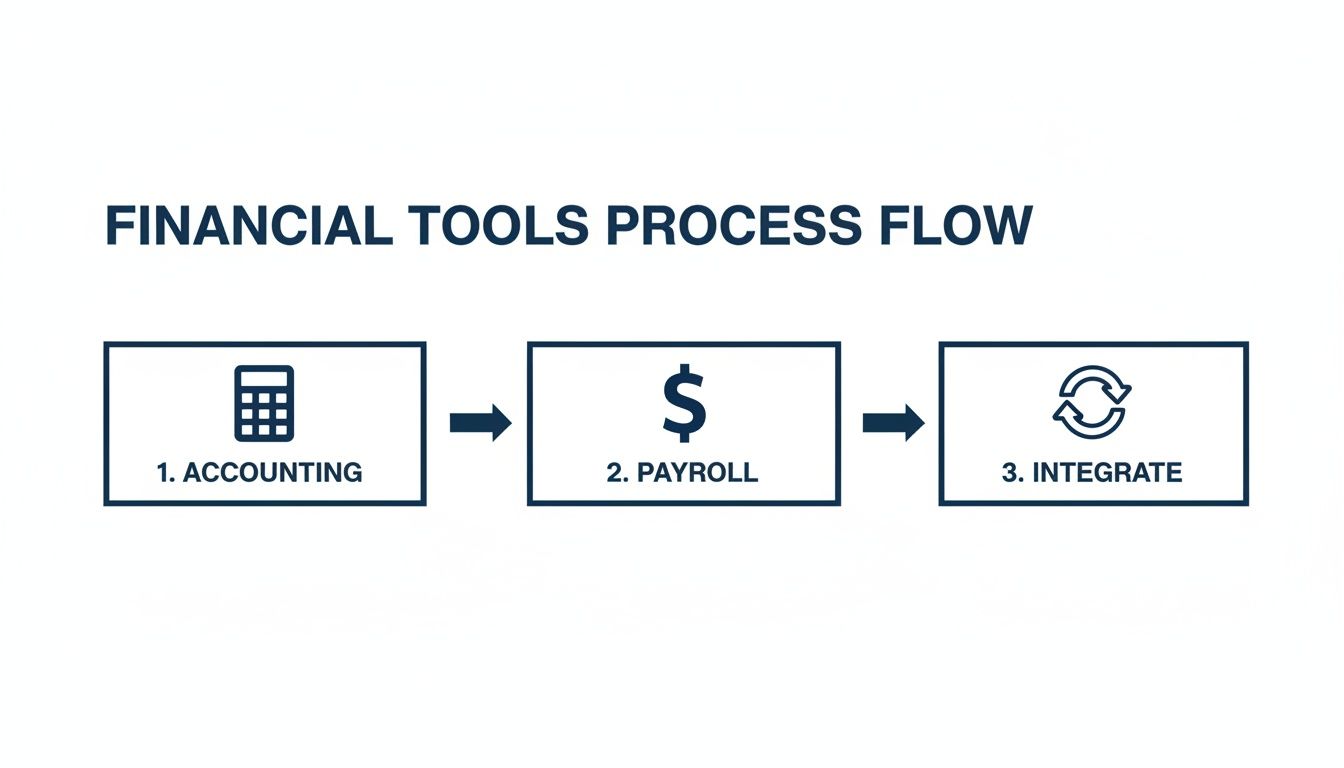
As the picture shows, connecting these systems is what makes it all work. It’s the final piece that makes your monthly checkup faster, easier, and more accurate.
Your Quick Monthly Checklist
To get started, you don’t need a complicated list of 50 things to do. Just focus on a few key tasks each month to make sure your numbers are right and are telling you the true story of your business.
Here's a simple checklist I give all my clients:
- Reconcile Your Bank Accounts: This just means making sure the list of transactions in your software perfectly matches your bank and credit card statements. It’s the best way to catch mistakes, weird charges, or things you forgot to enter.
- Categorize All Your Expenses: Go through everything you spent money on and make sure it’s in the right bucket (like "Office Supplies," "Marketing," or "Software"). This tells you exactly where your money is going.
- Review Unpaid Invoices: Take a good look at who owes you money. Who hasn't paid, and how late are they? This is when you send a friendly reminder email to those clients.
At the end of the day, this routine is about creating information you can trust. You can't make smart decisions for your business if the numbers you're looking at are messy or wrong.
Reviewing Your Key Reports
Once your accounts are tidy, it’s time to look at a couple of key reports. You don't need to be a money genius to understand them; you just need to know what to look for.
The two most important reports are your Profit and Loss (P&L) statement and your Balance Sheet.
Your P&L tells you if you made money for the month. The Balance Sheet gives you a snapshot of your company's overall financial health at one moment in time. For a closer look at how to read these, you can get more details about what is financial statement analysis in our other guide.
Taking just 30 minutes to review these helps you spot trends, like costs that are slowly going up or sales that are slowing down, so you can fix things before they become a big problem.
Using Your Numbers To Make Smarter Decisions

Your financial reports are more than just boring papers you give your accountant. Think of them as a map for your business. They tell you where you’ve been, where you are now, and can help you decide where to go next.
I know, staring at a spreadsheet full of numbers can feel like a lot. The good news is you don’t need a finance degree to get real value from them. You just need to know which few numbers to focus on.
This is where good small business accounting advice really helps. By focusing on a few key numbers, you can start making smarter choices based on facts instead of just guessing.
Focusing On The Numbers That Matter
Let's skip the complicated math for a minute and look at a few simple but powerful numbers. These are like the vital signs of your business, and tracking them helps you see what's really going on.
Here are a few to get you started:
- Gross Profit Margin: This tells you how much money you make from what you sell, before paying for things like rent or your own salary. If this number is going down, it might be a sign that your prices are too low or it's costing you more to do your job.
- Cash Flow: This is just the money moving in and out of your business. Positive cash flow means you have more coming in than going out—that's what you want. It's the lifeblood of your company.
- Customer Acquisition Cost (CAC): This number shows how much you spend, on average, to get one new customer. If you're spending $500 on ads to get a $300 client, that’s a big problem you need to fix.
The goal isn't to track dozens of things. It's to build a simple dashboard with 3-5 key numbers that tell you the story of your business in a single glance.
For a coffee shop owner, this might be tracking the profit on every latte. For a freelance designer, it could be watching how much profit they make on each project.
Tying Numbers to Real-World Actions
Knowing your numbers is one thing, but using them to make choices is where the magic happens. For example, if you spend a lot on marketing, you need to know if that money is actually doing anything. To use your numbers to make smarter choices, understanding what is Marketing ROI and how to measure it is key to seeing if your business is succeeding.
Let's look at a real example. I once worked with a small construction company that thought it was making good money. But when we looked at the numbers, we found a surprise: their big jobs were profitable, but their small repair jobs were actually costing them money.
By looking at their profit by job type, they were able to make a change. They raised their prices on the small jobs and focused on getting more of the bigger, profitable projects. This one change, all because of one key number, completely turned their business around in less than six months.
Improving Cash Flow And Finding Hidden Profit
Profit on paper is nice, but cash in the bank is what actually pays the bills, keeps the lights on, and helps you grow. It’s a tough lesson many business owners learn the hard way. A business can look very profitable in a report but still fail because it ran out of money.
This is where some of the best accounting advice comes in. It’s not about fancy financial tricks; it's about making small, smart changes that keep more money in your account. You have to be like a detective, looking for ways to improve your cash flow and find hidden profit you didn't even know was there.
Getting Paid Faster Is Your First Move
One of the quickest ways to get more cash in your business is to shorten the time it takes for customers to pay you. A sale isn't really done until the money is in your bank. If your invoices give clients 30 or 60 days to pay, you're basically giving them a free loan with your money.
Think about making your payment terms shorter. For a designer, this could mean asking for a 50% deposit before starting work. For a builder, it might mean billing for parts of the project as you finish them instead of waiting until the very end. These simple changes can make a huge difference in how fast you get paid.
Another easy win? Make it super easy for people to pay you. Add a "Pay Now" button to your email invoices that links to a payment site. The fewer steps a client has to take, the faster you'll get your cash.
Plugging The Leaks In Your Expenses
Every business has "profit leaks"—those small, regular costs that slowly drain your cash. These are the forgotten software subscriptions, the extra supplies sitting in a closet, or inefficient ways of working that waste materials. Finding and stopping these leaks can feel like finding free money.
I once worked with a catering client who was struggling, even though they were busy. We stopped looking at their food costs as one big monthly number and started tracking them for each individual event.
They quickly found they were losing thousands of dollars each month on perfectly good food that was being wasted. By ordering more carefully based on each event, they added nearly 15% to their profit without raising prices or getting a single new client.
This is a perfect example of how looking at the details can show you big opportunities. Start by looking at your bank and credit card statements each month, line by line. Ask yourself three simple questions about every expense:
- Do I still need this? (Do we really need three different project management tools?)
- Can I get a better price? (When was the last time we checked prices for insurance or office supplies?)
- Are we wasting anything? (Could we use fewer materials on job sites or have less food go bad in the kitchen?)
These might seem like small questions, but the answers can lead to big savings. Taking control of your cash flow and profit is all about doing small things regularly that add up over time. It's the kind of hands-on money management that separates struggling businesses from the ones that grow and succeed.
Getting Your Business Ready For The Future
Selling your business might feel like a far-off dream right now, but thinking about it today is one of the smartest things you can do. A business with clean, organized finances isn't just easier to run—it’s also worth a lot more to someone who might want to buy it someday.
This whole process is about getting your business "exit-ready." It's not about one big event; it's about building good money habits. These habits pay off big time, no matter what you decide to do later.
Think of it this way: you wouldn’t try to sell a messy, cluttered house and expect to get the best price. The same is true for your business. A buyer wants to see a clear story told by your numbers—proof that your business is stable and growing, not a shoebox full of messy receipts.
What Does "Exit-Ready" Actually Look Like?
Getting your finances ready for a sale isn’t something you do at the last minute. It’s about building a trustworthy history over time. Any serious buyer will want to look back several years to see how the business has performed.
This means you absolutely need:
- Several years of correct financial statements. This isn't just your Profit & Loss report. It also includes your Balance Sheet and Cash Flow Statement. They need to be consistent.
- Clean and detailed records. Every dollar of income and every single expense should be clearly sorted and explained. There shouldn't be any mystery charges.
- A history of steady profit. This is the best proof that your business works and can keep working for a long time.
A business that is ready to sell is also a business that is ready for anything. Whether you want to get a loan, bring on a partner, or just have peace of mind, clean books are your best asset.
It's About More Than Just Selling
Let's be clear: even if you plan to run your business for the next 30 years, doing this makes it stronger.
When your books are perfect, you can walk into a bank and ask for a loan with confidence. Why? Because the bank can clearly see your business is healthy without having to guess.
If you ever want to bring on a business partner, they’ll want to see exactly what they're getting into. Having everything organized from the start builds trust and makes your company a much better opportunity.
In the end, this kind of preparation protects your company's value for whatever comes next. It turns your business from just a job into a valuable thing you own.
Ready to build a business that's prepared for the future? The team at MyOfficeOps can help you get your books clean, optimize your profitability, and create a solid financial foundation for whatever comes next. Schedule a discovery call with us today.