
The accounts payable process is how your business keeps track of and pays the money it owes to others. Imagine it’s like managing your allowance. You have a list of things you need to pay for, like a video game or a snack. The process is just the system you use to know who you owe, how much, and when it's due, so everyone gets paid the right amount on time.
What Is Accounts Payable In Simple Terms?
Let’s say you own a coffee shop. You order milk from a dairy, coffee beans from a roaster, and paper cups from a supplier. When those things arrive at your shop, they come with a bill. In business, we call that bill an invoice.
The accounts payable (AP) process is everything that happens from the moment that invoice shows up to the moment the money leaves your bank to pay for it.
It’s the organized way you handle all the money your business owes for stuff it has already received. It’s not just about writing checks; it's a key job that keeps your shop running and your suppliers happy. A good AP process means you pay your bills correctly, every time.
Why Does This Process Matter So Much?
Without a good system for paying bills, things can get messy—fast. You might accidentally pay the same bill twice or, even worse, forget to pay one at all. This can lead to late fees and, more importantly, hurt your relationship with your suppliers. These are the people you count on to keep your coffee shop stocked.
A well-managed accounts payable process helps you:
- Avoid Late Fees: Paying on time means you don’t waste money on extra charges.
- Build Good Relationships: Suppliers like doing business with people who pay on time. It can even help you get better deals later.
- Prevent Mistakes and Fraud: A clear process helps you catch duplicate bills or wrong amounts before you pay them.
- Manage Your Cash: You’ll know exactly how much money needs to go out of your business and when.
This whole process is about tracking and control. Every bill you get and every payment you make gets written down in your company’s main financial notebook. You can learn more about this by checking out our guide on what is a general ledger. It’s the place where all your money information, including AP, comes together.
For broader insights into payment systems and expert perspectives that cover Accounts Payable, you can visit resources like payments-experts.com.
The Accounts Payable Workflow Step By Step
To really understand the accounts payable process, let's break it down into a few simple steps. Think of it like a line of dominoes—one action makes the next one happen until the final bill is paid.
Let’s pretend you run a restaurant. You order fresh vegetables every week. The AP process starts the moment those vegetables are delivered. It’s a careful sequence that protects your business from mistakes and keeps your kitchen going.
This simple diagram shows the three main stages: getting the invoice, managing it, and paying it.
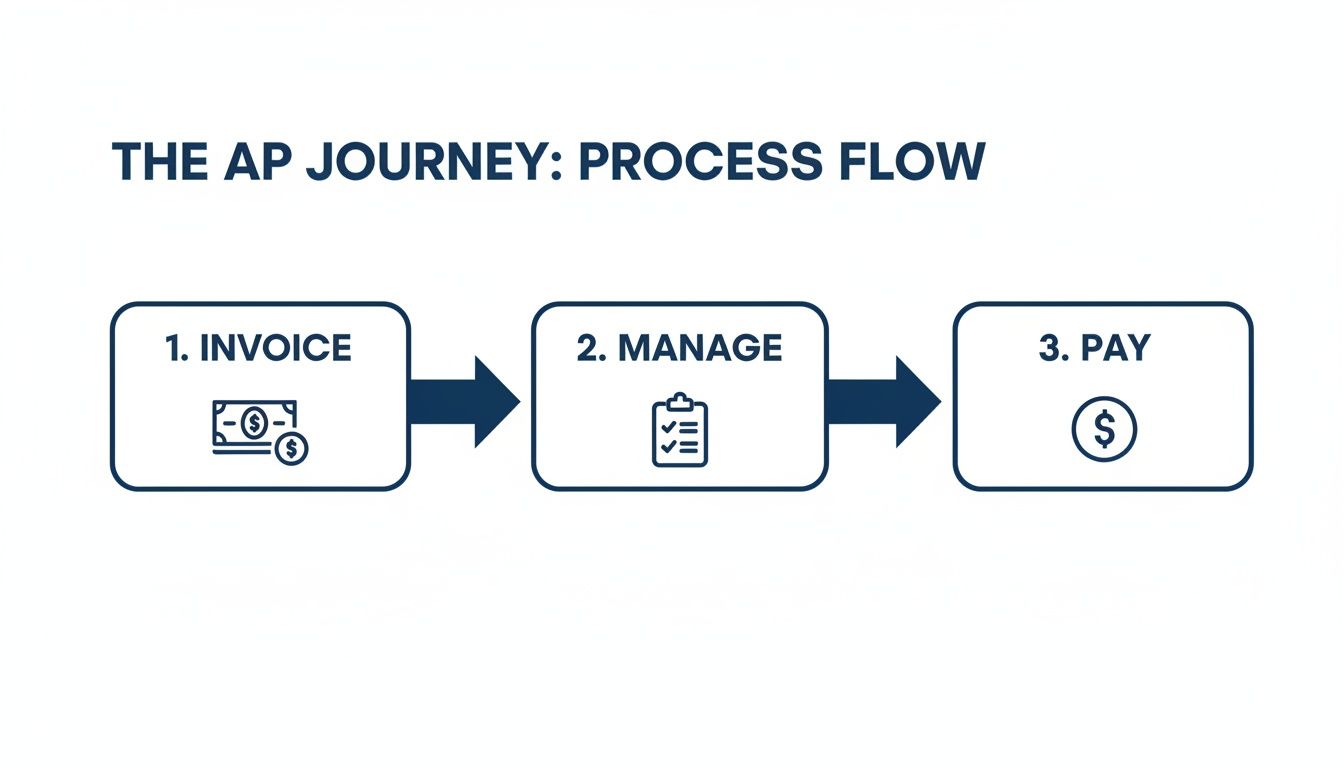
As you can see, every bill follows a clear path. This makes sure nothing gets lost and every dollar is checked before it leaves your account.
Step 1: Receiving and Checking the Invoice
The journey starts when an invoice arrives. This could be a paper bill from the delivery driver or an email from the supplier. For our restaurant, this is the bill for the vegetables.
But you don't just pay it right away. First, you or your bookkeeper checks to make sure it's correct. This is a really important step that people often skip when they’re busy.
You'll do a quick check, sometimes called a two-way or three-way match. Here’s what that means:
- The Invoice: This is the bill, saying what you bought and how much you owe.
- The Purchase Order (PO): This is the order you originally placed. Does the bill match what you asked for?
- The Receiving Report: This is proof of delivery. Did you actually get everything listed on the bill? For our restaurant, did all 50 pounds of tomatoes show up?
If all three things match up—the order, the delivery, and the bill—you know the invoice is good to go. This simple check stops you from paying for things you never ordered or never got.
Step 2: Getting the Invoice Approved
Once the invoice is checked, it needs a final "okay" before any money is paid. This is the approval step. In a small business, this might just be the owner giving a quick nod.
In our restaurant, maybe the head chef has to approve all bills for food, while the manager approves bills for new kitchen tools. The important thing is to have a clear rule about who can approve what.
This isn't about being a control freak; it's about being careful. A clear approval process makes sure that only real, confirmed business costs get paid. It’s your best defense against paying too much by accident or getting tricked by a fake bill.
Without this step, anyone could send in a bill and possibly get paid, which is a big risk. The approval confirms that the purchase was needed and that the business got what it paid for.
Step 3: Entering the Bill and Scheduling Payment
After getting the okay, the invoice is officially recorded in your accounting system. This is where the bill becomes a formal "payable" in your records, a step that keeps your financial information accurate.
Your bookkeeper will enter the key details:
- Supplier name
- Invoice number
- Amount owed
- Due date
Once it's in the system, you schedule the payment. You don't always have to pay it right away. In fact, managing when you pay bills is a smart way to handle your cash. If a bill is due in 30 days, you might schedule the payment for day 28. This keeps money in your account as long as possible while still paying on time.
Step 4: Making the Payment and Final Record-Keeping
The last step is to actually make the payment. This could be by check, a bank transfer, or a credit card. Once the payment is sent, the job is done.
Well, almost. The final action is to update your records to show the bill has been paid. This moves the money from "accounts payable" (money you owe) to "cash" (money you've spent).
This last step gives you a clean, accurate history of your money. When you look at your financial reports, you'll know exactly where your money went, who you paid, and when. This clean trail is super important for making budgets, doing taxes, and making smart decisions for your business.
Common Problems in Accounts Payable
Even the best businesses hit bumps in the road, and paying bills is often where small problems start. Without a good system, it can turn into a headache that costs you time, money, and your good name with suppliers.
Think of it like a leaky faucet. A single drip doesn't seem like a big deal, but over time it can cause a lot of damage. The same is true for AP problems. A small mistake here and a missed due date there can add up to big money trouble if you don't notice the signs.
Let's look at some common issues and how to tell if your own AP process has a leak.
The Mystery of Manual Errors and Duplicate Payments
We’ve all been there. You’re trying to do a dozen things at once, and a simple typo turns a $100.00 bill into a $1,000.00 payment. Typing in bill details by hand is the number one reason for these frustrating—and expensive—mistakes. When a person has to type things over and over, mistakes are bound to happen.
Another classic mistake is paying the same bill twice. A bill arrives by email, and then a paper copy shows up a week later. If you don't have a system to catch it, you might pay both. You’ve just given away free money, and getting it back is always awkward and takes time.
The real cost of a manual accounts payable process is more than just a few mistakes. It’s a constant drain on your time and energy that could be used to grow your business instead of just shuffling papers.
Research shows just how expensive this can be. The average cost to handle one invoice by hand is between $15 and $22.75. If a company deals with 1,000 invoices a month, that's over $15,000 spent just on the work to handle paperwork. When you learn that around 39% of manually handled invoices have mistakes, you can see how the costs quickly add up. You can explore more insights on the true expense of traditional AP methods to understand the full picture.
The Pain of Late Payments and Lost Invoices
Have you ever found a month-old bill buried under a stack of papers on your desk? It’s a terrible feeling. Lost invoices lead directly to late payments, which cause their own set of problems.
First, you get hit with late fees—which is like throwing money in the trash. Second, and more importantly, always paying late damages your relationship with your suppliers. They might start asking for payment upfront or, even worse, stop working with you completely.
Here are warning signs you have a late payment problem:
- You often get "overdue" emails from suppliers.
- Your team spends too much time on the phone explaining why a payment is late.
- You’re missing out on discounts for paying early that could save you money.
- Your business credit score is going down.
A healthy accounts payable process is predictable. If yours feels like you're always putting out fires, that’s a clear sign that something needs to change.
The Time Sink of Chasing Approvals
An invoice comes in, but the person who needs to approve it is out of the office. So, it just sits there. This kind of delay is a huge time-waster for any business. When your process depends on physically finding someone to sign a piece of paper, you create hold-ups that slow down the entire payment cycle.
This isn't just about paying late; it's about wasting your team's valuable time. Instead of working on things that help the business grow, they’re stuck playing detective, hunting down a manager for a simple "yes." This is a hidden cost that kills productivity and makes everyone frustrated.
Best Practices For A Smooth Accounts Payable System
After seeing all the ways paying bills can get messy, the good news is that fixing it isn't that complicated. It all comes down to building simple, regular habits.
These best practices are real steps any business owner can take right now to save time, avoid mistakes, and get a handle on their finances.
Think of it like taking care of your car. You don't wait for it to break down to pay attention to it. You get regular oil changes to keep it running well. The same idea applies here.
Establish Clear Rules And Roles
Your first step is to create a simple rulebook for how bills get paid. This is about making sure everyone knows their job. You need to decide who is allowed to approve different types of payments.
For example, a project manager might be allowed to approve any bill up to $500 for supplies right away. But anything over that needs the owner's signature. This creates a clear line of command and stops surprise spending.
This simple set of rules should answer three basic questions:
- Who can approve a payment? Name the specific people who can give the green light.
- How much can they approve? Set clear spending limits for each person.
- What's the backup plan? Decide who takes over when the main person is on vacation.
Writing these rules down gets rid of confusion and creates a predictable system that everyone on your team can follow. It’s the foundation for an organized accounts payable process.
Go Digital And Centralize Everything
If you're still dealing with stacks of paper bills, you're making things much harder than they need to be. Switching to a digital system is one of the best changes you can make. And no, you don't need to buy expensive, complicated software to start.
It can be as simple as creating a special email address—like bills@yourcompany.com—where all suppliers send their invoices. Just like that, you have one central place to manage everything. No more lost papers or bills getting buried in someone's inbox.
The goal is to create one source of truth. When every invoice, approval, and payment record is in the same digital place, you get rid of the risk of paying for the same thing twice and get a clear view of what you owe.
From that central inbox, you can use your accounting software to track each bill from the moment it arrives until it's paid. This digital trail makes it easy to see the status of any bill at a glance, so things don't fall through the cracks.
Create A Consistent Payment Schedule
Stop paying bills randomly as they come in. That approach is messy and makes it impossible to manage your cash. Instead, set a regular schedule for processing and paying your bills.
Many small businesses find that paying bills once a week works perfectly. For example, you could make every Tuesday "Bill Pay Day."
Here’s what a simple weekly schedule might look like:
- Monday: All new invoices from the past week are entered into the system.
- Tuesday: The business owner reviews and approves all pending payments.
- Wednesday: The approved payments are sent out.
This routine creates a rhythm. You know exactly when money is going out, and your suppliers learn when to expect their payments. It turns a chaotic daily task into a calm, weekly habit—a key part of a healthy accounts payable process.
Keep Communication Open With Your Vendors
Finally, remember that your suppliers are your partners. Keeping a good relationship with them can save you a lot of trouble.
If you know a payment might be late, don't just ignore their emails. A quick, honest phone call can make a big difference. Let them know what’s happening and when they can expect payment. Most suppliers are reasonable and will appreciate you being upfront.
Good communication builds trust, which can lead to better payment terms or better service when you need it. A friendly relationship is often your best tool for handling the occasional money crunch.
How AP Automation Simplifies Your Workflow
When you hear "automation," you might think of expensive, complicated software for huge companies. But for your accounts payable process, it's much simpler. It’s about using technology to do the boring, repetitive tasks that take up your time, so you can focus on work that actually grows your business.
Instead of having someone manually type every detail from a paper bill into your accounting software, automation tools can do that work for you. They can read a bill, pull out the important info like the supplier name and amount, and get it ready for your approval with just a click.
This technology changes everything. It takes the most boring parts of paying bills off your plate, freeing you and your team from the slow work of typing in data.
The Old Way Versus The New Way
Let’s imagine you run a marketing agency. You work with freelance writers, designers, and software companies, which means a steady flow of invoices every month.
The Old Way (Manual Process):
- Invoices arrive by email, you print them, and they start to pile up.
- Someone on your team manually types the details from each bill into a spreadsheet. It’s slow, and mistakes happen.
- That stack of paper then waits for you to look it over and sign it.
- Once approved, your bookkeeper either writes and mails checks or logs into the bank to pay each bill, one by one.
The whole process is slow and full of chances for error. A typo could send the wrong payment amount, or a bill could get lost, leading to a late fee.
The real problem with a manual accounts payable process isn't just that it's slow—it's that it keeps you stuck working in your business instead of on your business. Every hour spent on data entry is an hour not spent finding new clients.
The New Way (Automated Process):
- Suppliers email invoices to a special address, where software automatically reads them and pulls out all the data. No more typing.
- The system instantly checks the invoice against your original order and points out anything that doesn't match.
- You get a notification on your phone or computer to approve the payment with a single click.
- Once you approve it, the system gets the payment ready to go out on the scheduled date. Simple.
This is a huge change. The time spent on manual work shrinks from hours to minutes, mistakes nearly disappear, and you get a clear, real-time view of your expenses. This is also a big step toward financial reporting automation, since clean, accurate data from your AP process leads to better reports.
The Real Impact of Saving Time
The time you save with automation isn't just a small bonus; it’s a game-changer. Studies show that a shocking 63% of AP teams spend more than 10 hours a week just processing invoices. By using accounts payable software, businesses can reduce their invoice processing time by an average of 62%, cutting the cycle from about 21 days down to just 8. You can learn more about these AP automation trends and see the data for yourself.
For our marketing agency example, that's real time the owner can now spend on sales calls or a project manager can use for client work. This is how a smoother accounts payable process helps you improve cash flow and grow your business.
When To Consider Outsourcing Your Accounts Payable
After looking at all the ways to fix and automate your accounts payable process, you might still have one big problem: you or your team still have to manage it. For many busy business owners, the best solution is to just… not do it at all.
Sometimes, the smartest move is to let an expert handle it. This is where outsourcing comes in. Think of it like deciding you’re tired of mowing your own lawn and hiring a professional landscaper. They have the right tools and expertise to do it perfectly, freeing up your time.
Outsourcing your AP means you get an expert team handling everything for you, but without the cost of hiring a full-time employee.
How Outsourcing Your AP Process Actually Works
When you work with a firm like MyOfficeOps, we basically become your accounts payable department. The goal is to make the whole process invisible to you, so you can focus on running your business, not chasing bills. The process is simple and designed to give you back your time.
Here's a quick look at how it works:
- A Dedicated Bill Inbox: We set up a special email address for you, like
bills@yourcompany.com. All you have to do is tell your suppliers to start sending their invoices there. - We Do the Heavy Lifting: Our team takes every invoice that arrives in that inbox and uses technology to process it. We grab all the important data, check it for accuracy, and get it into the system.
- You Approve from Anywhere: When a bill is ready for payment, you get a simple notification. With just a click, you can review and approve it from your computer or phone—no paperwork needed.
This isn’t just about getting bills paid. It’s about building a system that gives you complete control without needing your constant attention. We make sure everything is paid on time, every time, and give you clear financial reports so you always know where your money stands.
The Real Benefit Is Peace of Mind
The biggest benefit of outsourcing isn’t just the hours you get back; it’s the peace of mind. You no longer have to worry if a bill got lost, if a late fee is coming, or if you accidentally paid for something twice.
You can relax knowing a key part of your business is being handled correctly by professionals who do this all day, every day.
This is about more than just convenience. It’s about putting a professional-grade financial system in your business that protects your cash, strengthens your supplier relationships, and frees you up to focus on growth.
Think about all the time you currently spend managing bills and answering vendor questions. Now, imagine all of that time being handed back to you. That’s the real value a partner provides. For a deeper look, our guide on outsourced accounting for small business explains how this approach can benefit your entire financial operation.
Many businesses look for outside help to get more efficient. For instance, some explore options like virtual assistants for accounts receivable to manage the money coming in. Using a similar strategy for accounts payable—the money going out—offers the same great benefits of expert support and simple workflows, letting you get back to what you do best.
Common Questions About Accounts Payable
Even with a clear process, a few questions always come up. That’s normal. Here are some of the most common things business owners ask about accounts payable, answered in simple terms.
What Is The Difference Between Accounts Payable And Accounts Receivable
Think of it like a two-way street for your company's money. It’s a concept that confuses a lot of people, but it's pretty simple once you see it this way.
Accounts Payable (AP) is all the money your business owes other people. It’s the stack of bills waiting to be paid for things like rent or supplies you’ve already used. This is money going out.
Accounts Receivable (AR) is all the money that other people owe your business. It’s the stack of invoices you’ve sent to your customers for products you’ve sold or services you’ve provided. This is money coming in.
How Often Should My Business Pay Its Bills
The goal is to create a predictable routine. Trying to pay bills every single day as they show up is a recipe for chaos. You'll spend all your time reacting instead of managing.
For most small businesses, setting aside one day each week to handle and pay all approved bills is the best way to go. This creates a rhythm, helps you manage your cash more accurately, and makes sure nothing gets missed.
Picking a consistent day—like every Tuesday morning—turns a frantic chore into a planned system. It stops those last-minute rushes to avoid late fees and helps your suppliers know when to expect their payments.
When Should A Small Business Outsource Accounts Payable
It’s usually time to think about outsourcing when managing bills starts taking up too much of your time. If you find yourself constantly dealing with late fees, getting surprised by "overdue" notices, or just feel like you're drowning in paperwork, that’s a big red flag.
Honestly, outsourcing often makes more financial sense than hiring a dedicated person in-house, especially for a growing business. You get instant access to an expert team and a solid process, freeing you up to focus on what you're best at: growing your business.
If you're tired of chasing invoices and want to reclaim your time, the team at MyOfficeOps can manage your entire accounts payable process for you. Learn how we can give you peace of mind and financial clarity.