
Imagine you're building a Lego masterpiece for a friend. You'd want to know how many bricks you used, right? You’d count the special pieces, the regular ones, and maybe even how long it took you.
That’s pretty much what job costing in construction is, but for real buildings instead of Lego. It's simply a way to keep track of everything you spend on a single project.
So, What Is Construction Job Costing?
At its heart, job costing means you track every single dollar spent on one specific job. Instead of dumping all your business expenses into one big pile, you assign each cost—from a box of nails to a forklift rental—to the exact project it was for.
This gives you a crystal-clear picture of whether you actually made money on that job.

Think of it like this: every project gets its own piggy bank. When you buy lumber for the Miller family's new deck, the money comes out of the "Miller Deck" piggy bank. When your crew spends a day building that deck, their pay gets noted in that same piggy bank.
This isn't just for picky bookkeepers; it's a tool for survival. Costs for things like wood and labor are always going up. In fact, nonresidential construction costs have climbed 6.60% in just one year, and materials alone jumped 7.0%, according to the Mortenson Construction Cost Index.
If you’re not tracking costs for each job, those price hikes are quietly eating up your profits.
Why Go to All This Trouble?
Without job costing, you’re flying blind. You might feel like you're making money because there's cash in your business account, but you have no idea which jobs are your big winners and which ones are secretly costing you.
This is a key part of smart accounting for construction companies.
Here’s what job costing really does for you:
- See Your Real Profit: Know exactly how much you made (or lost) on every single job.
- Bid Smarter: Use real numbers from old jobs to make your prices for new jobs more accurate.
- Catch Problems Early: See if you're spending too much on labor or materials before it gets out of hand.
General Accounting vs. Job Costing
How is this different from the normal accounting you already do? Think of it this way: general accounting is like looking at your whole company from a helicopter. Job costing is like using a magnifying glass on one single project.
| Feature | General Accounting | Job Costing |
|---|---|---|
| Focus | How the whole company is doing | How much money one project made |
| Timeframe | Looks at a month, quarter, or year | Looks at the entire life of one job |
| Detail | Big picture (e.g., total labor cost for the month) | Super detailed (e.g., labor cost just for the Smith's bathroom remodel) |
| Main Use | Paying taxes, bank loans | Bidding, managing projects, seeing what's profitable |
You need both, but they do very different things. You can't make smart decisions about a single project just by looking at your company's overall bank balance.
Why Job Costing Is Your Secret Weapon
Let's imagine two builders.
Builder A finishes a job, looks at his bank account, and thinks, "Nice, there's more money in there than before. I guess we did okay." It’s just a gut feeling.
Builder B uses job costing. She knows she made exactly $15,250 in profit. She also knows her labor cost was 5% more than she planned because of some overtime, but she made up for it by finding a great deal on decking materials.
Who do you think will be more successful next year?
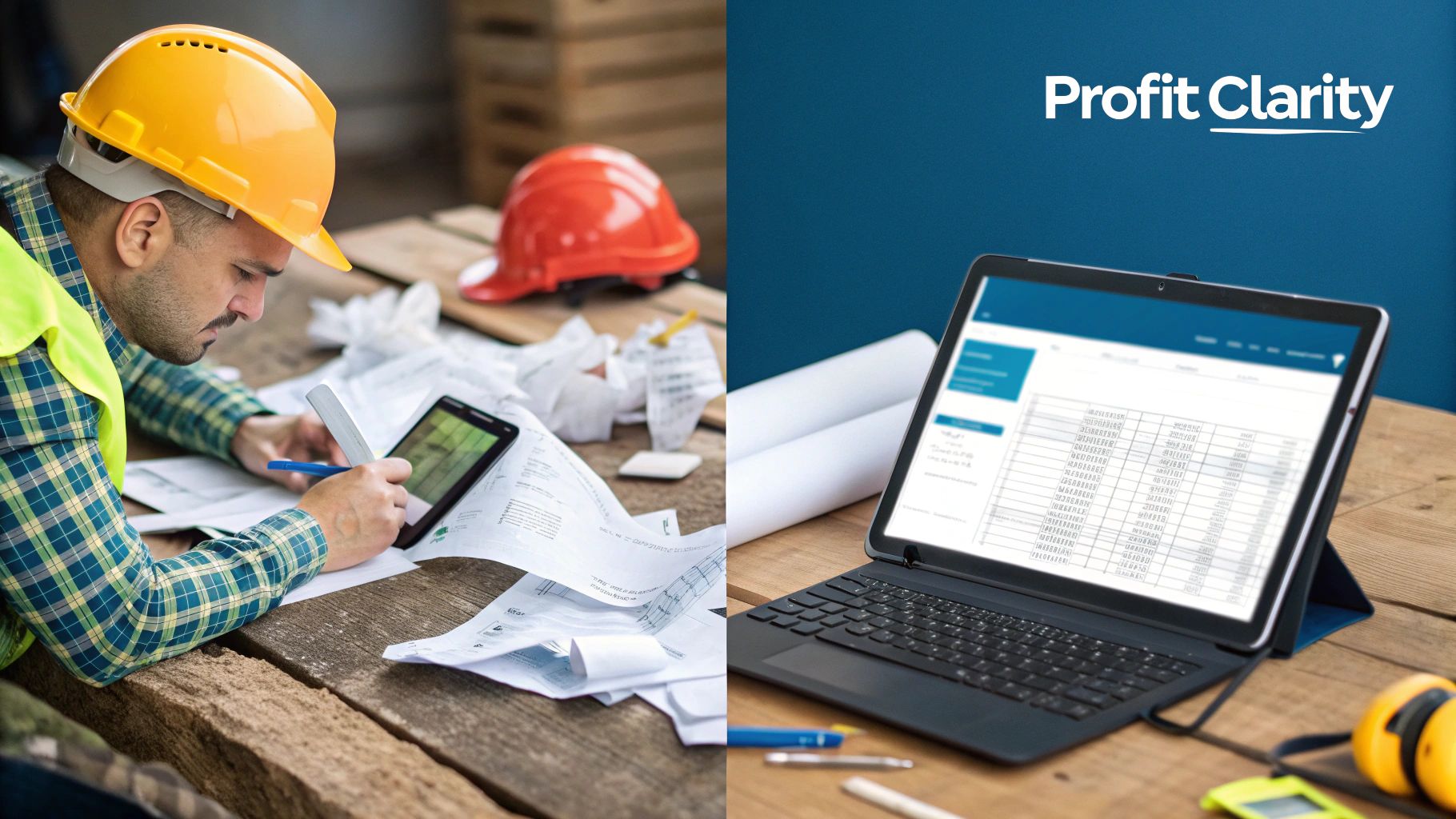
Job costing isn't just about counting money after the fact. It's about making smarter decisions every day. It turns a messy pile of receipts into a clear map for growing your business.
Create Smarter Bids and Win More Work
When you know exactly what past jobs cost, bidding on new work stops being a guessing game. You can look up a similar project and see precisely what you spent on wood, concrete, and labor. This helps you create a price that's low enough to get the job but high enough to make a good profit.
By tracking your spending, you can figure out where to save money. This means happier customers and more profit for you.
Without this history, you're probably doing one of two things:
- Bidding Too High: You add a bunch of extra money "just in case," and other builders with better numbers win the job.
- Bidding Too Low: You give a cheap price to win the work, only to realize halfway through that you're not making any money—or even losing it.
Spot Problems Before They Sink a Project
Think of job costing as your project's smoke detector. By comparing what you're actually spending to your plan, you can spot trouble early.
For example, you see that you've used 75% of your lumber money, but you've only built 50% of the frame. That’s a big red flag. Maybe some wood was wasted, or maybe the price went up. Whatever it is, you can deal with it now, not when you get a surprise bill at the end.
This kind of control is vital for protecting your profit. It's the difference between you telling your money where to go, or your money disappearing without you knowing why. This is a core part of good construction cash flow management.
In the end, job costing shows you which types of projects make you the most money, so you can focus on doing more of that profitable work.
Understanding The Three Main Cost Buckets
To do job costing right, you need to know where every dollar goes. It’s like sorting your laundry—you put socks in one pile and shirts in another. Every single expense on a construction job fits into one of three buckets.
Getting this sorting right is the key. It’s what shows you where your money is really going on each job.
Direct Costs: The Obvious Stuff
Direct costs are the easiest ones. These are the things that physically become part of the project. If you're building a house, the wood, concrete, drywall, and windows are all direct costs.
The pay for the crew actually building the house also goes in this bucket. Basically, if a cost is tied to one specific project and only that project, it's a direct cost.
For example, keeping track of labor is super important because it's usually your biggest expense. And it's not getting any cheaper—the average pay for construction workers went up 4.1% last year to $36.79 an hour.
Indirect Costs: For the Job, But Not in the Job
Next up are indirect costs. These are a little trickier. They are costs that are needed for a specific job but aren't actually part of the final building you hand over to the customer.
Think about these:
- Equipment Rentals: Renting a backhoe just for the "123 Main Street" job.
- Job Site Extras: A portable toilet or temporary power for one job site.
- Project Manager's Pay: The salary for the person managing that one specific project.
These costs only exist because of the project, but you can't see them in the finished house. When you use different types of contracts, like cost-plus building contracts, knowing exactly what fits in this bucket is really important.
Overhead: The Cost of Being in Business
Last is overhead. These are the shared costs you have to pay just to keep your business running, whether you have one job going or ten. They don't belong to any single project.
Overhead costs are what keep the lights on in your office and the gas in your trucks. You have to account for them to know if a job really made money.
This bucket includes things like:
- Office rent
- Insurance for your business
- Pay for your office staff (like a bookkeeper)
- Advertising
- Accounting software
Because these costs help your whole business, you have to add a small, fair piece of them to each job to get a true profit number. Keeping these costs organized is key, which is why a good what is a chart of accounts is so important.
A Simple Job Costing Example: A Deck Project
Okay, enough talk. Let's see how this works with a real-world project. I’ll walk you through a common job: building a new backyard deck. We'll use simple numbers to show you that job costing isn't scary—it's just organized tracking.
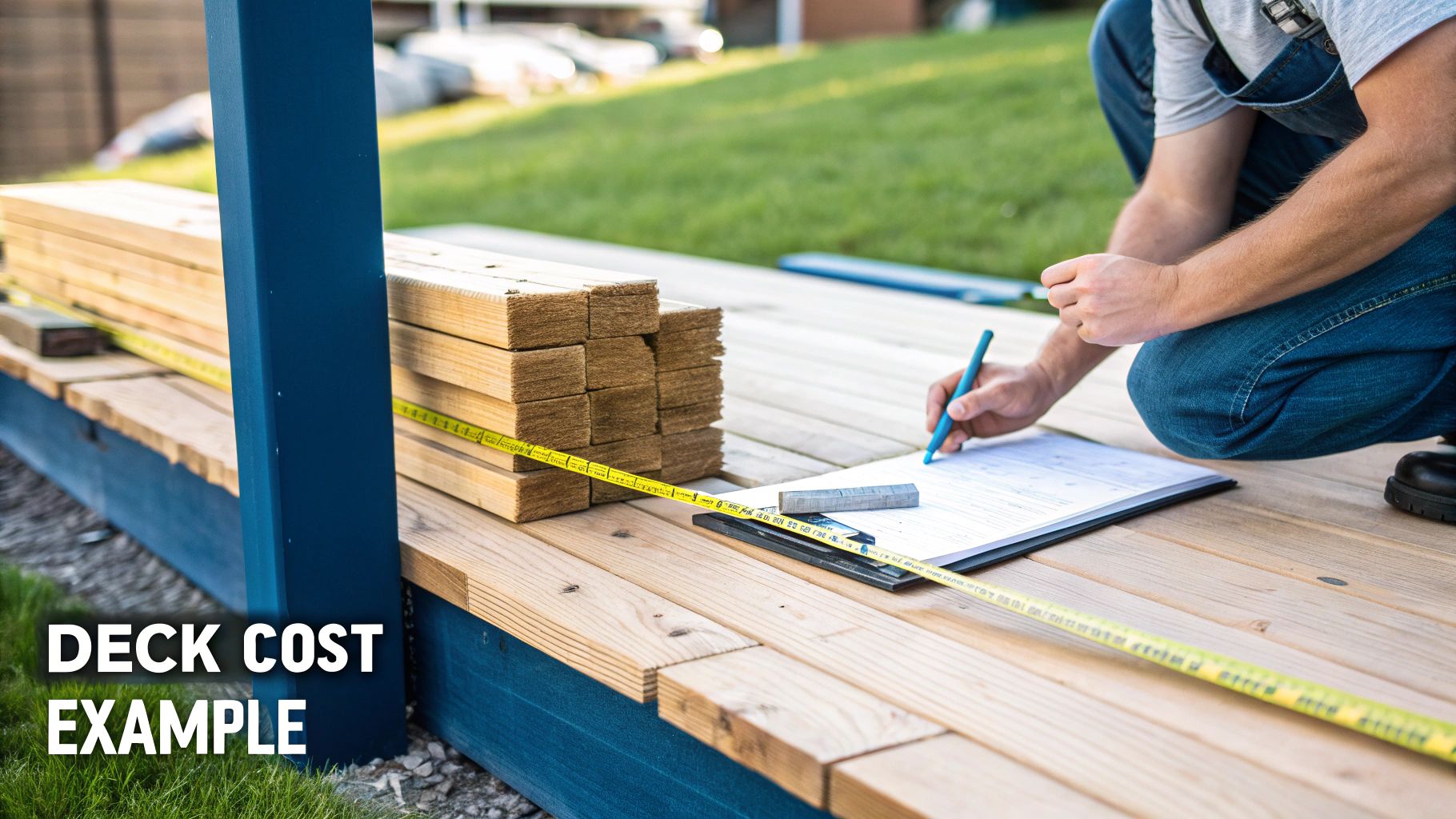
Let's say you told the customer the deck would cost $15,000. Now, the real work starts: tracking every penny you spend to see if you actually made a profit.
Step 1: Add Up the Direct Costs
First, we gather all the direct costs—the materials that become the deck and the people who built it. These are the easy ones.
Direct Materials:
- Decking & Lumber: $5,200
- Concrete: $350
- Screws & Bolts: $450
- Railings: $1,500
Direct Labor:
- Lead Carpenter (80 hours @ $45/hr): $3,600
- Helper (60 hours @ $25/hr): $1,500
Add it all up, and our total direct cost is $12,600. That's the main cost of the deck, but we're not done yet.
Step 2: Add the Indirect Costs
Next, we look at the indirect costs. These were for this specific job but aren't part of the finished deck.
For this project, let's say we had one:
- Auger Rental (for digging post holes): $200
This brings our running total to $12,800. It's easy to forget small costs like a one-day rental, but they add up.
Step 3: Add a Slice of Overhead
Now for the step a lot of people miss. Your business has costs that keep the doors open—office rent, truck insurance, etc. This is your overhead.
To get a true profit, you have to assign a fair share of that overhead to this deck project. A common way to do this is to figure out your overhead as a percentage of your total sales.
Let's say your company's overhead is 10% of your total income.
- Overhead for this job ($15,000 Project Price x 10%): $1,500
Adding overhead isn't optional if you want to know your real profit. It's the step that turns a hobby into a real business.
Step 4: Figure Out the Final Profit
We're at the finish line. Now we just do the math.
Here’s the final breakdown:
- Total Direct Costs: $12,600
- Total Indirect Costs: $200
- Allocated Overhead: $1,500
Add these together to get your Total Job Cost:
$12,600 + $200 + $1,500 = $14,300
Finally, compare this total cost to what you charged the customer.
- Customer Price: $15,000
- Total Job Cost: $14,300
Actual Profit = $700
Because you tracked everything, you know for a fact that this job made you $700. No guessing. Now you can use this information to bid your next deck job even better.
Common Job Costing Mistakes to Avoid
Even experienced builders can make simple mistakes that mess up their numbers. Think of this as a friendly heads-up to help you avoid the common traps that can drain your profits.
Getting job costing right is about good habits. A small mistake here and a forgotten cost there can turn a good job into a so-so one. Let's make sure you don't learn these lessons the hard way.
Using Old Material Prices
This is a classic profit-killer. You bid on a new job using last month's prices for wood. But prices change fast. Using old numbers is a great way to price a job too low and lose money before you even start.
Material costs can swing wildly depending on where you are. For example, while the national average might not seem scary, the price of reinforcing steel shot up 8.1% in just a few months recently, according to the RLB Construction Cost Report.
Mixing Up Cost Buckets
Another easy mistake is putting an expense in the wrong bucket. It might not seem like a big deal to call a special tool rental for one job "overhead." But if you keep doing that, you won't have a clue which of your jobs are actually profitable.
When you mix up costs, you can't see which jobs are your real money-makers. You might think a project was a huge success, but its real costs were just hidden in your company's general expenses.
Here are a few common mix-ups I've seen:
- Forgetting Small Stuff: Not tracking things like boxes of screws, saw blades, or fuel for a generator. They feel small, but they add up.
- Ignoring Rework: Forgetting to track the time and materials used to fix a mistake. That's a real cost of the job and has to be counted.
- Guessing at Overhead: Just picking a random percentage for overhead instead of figuring out a real number based on your actual business costs. This is where profits often go to hide.
By watching out for these common slips, you can make sure your job costing is accurate and gives you a true picture of how your business is doing.
Putting Job Costing Into Action Today
Knowing how job costing works is one thing. Actually using it in your business is another. The good news? You don't need a huge, complicated system to get started. Starting simple is almost always the best way.
The first step is often just picking the right accounting software. Many programs are made just for construction. A simple start could even be a shared spreadsheet or a basic app that lets your crew track their hours and expenses on their phones.
Getting Started the Right Way
I get it. Starting a new system can feel like one more thing to do. If setting this all up yourself sounds like a headache, you're not alone. This is where getting some help can make a huge difference.
- Focus on What You Do Best: Let someone else set up the financial system. That way, you can focus on building and keeping your customers happy.
- Avoid Expensive Mistakes: A pro can make sure everything is set up right from the start, so you don't have a big mess to clean up later.
- Get Clear Answers Faster: Skip the frustrating part of trying to figure it all out yourself. Get straight to the reports that show you where your money is going.
Job costing helps you track where your money goes, but it also shows you where you can save money. You can find more ideas in these strategies to reduce construction costs without compromising quality.
Your job is to build great things, not to be a bookkeeping expert. A good job costing system should make your life easier, not harder.
At MyOfficeOps, our team specializes in setting up simple financial systems for construction businesses like yours. We handle the setup and keep things running, so you get the financial clarity you need without the stress. If you're ready to stop guessing and start knowing your numbers, we should talk.
Frequently Asked Questions About Job Costing
Starting something new always brings up questions. Here are some quick answers to the common things builders ask about job costing.
Can I Start Job Costing with Just a Spreadsheet?
Yes, absolutely. For a small business or someone just starting, a good spreadsheet is a great first step. The most important thing is just to be consistent and track everything.
But as your business grows, you'll find spreadsheets get messy and are easy to make mistakes in. When that happens, moving to real accounting software will save you a ton of time and give you much better information.
How Often Should I Check My Job Costs?
Don't wait until the job is done. By then, it's too late to fix a problem. Looking at your costs compared to your plan every week is a great habit.
This quick check-in lets you see if, for example, your labor costs are getting too high. You can then make a change before it eats up all your profit. For really big projects, some people check key costs every single day.
What's the Biggest Mistake People Make?
The most common mistake is not being detailed enough. Just having a budget item called "materials" isn't helpful. You need to know you spent $5,200 on lumber, $350 on concrete, and $450 on fasteners.
The real power of what is job costing in construction comes from the details. The specific numbers are what help you see exactly where your money goes, which is the key to making better, more profitable bids in the future.
Your job is building great things, not getting buried in spreadsheets. If you want crystal-clear financials without the headache, the team at MyOfficeOps can build and manage a job costing system that works for you. Let's get your numbers dialed in. Find out how we can help at https://myofficeops.com.