You’ve been there. You create a solid estimate, the client signs off, and the project starts. But by the time you send the final bill, the numbers don’t add up. The project cost way more than you planned.
That painful gap between your budget and the final cost is a cost overrun. It's one of a construction business's most common and frustrating problems.
What Are Construction Cost Overruns
Think of your project budget like a plan for a road trip. You map the route and figure out the cost of gas, food, and hotels. A cost overrun is like the unexpected stuff—a flat tire, a surprise detour that uses extra gas, or the hotel being full, forcing you to get a more expensive room.
In construction, these “flat tires” are everywhere. The price of wood suddenly goes up. A worker doesn't show up, messing up the schedule. A client decides they want to move a wall after it’s already built. These aren't just small problems; they can hurt your company’s bottom line.
Why Small Overruns Become Big Problems
A small cost overrun on one job might not seem like a big deal. A few hundred dollars here, a thousand there. But what happens when it happens on every job? These small, steady leaks can sink a business.
I’ve seen this happen with many small and midsize contractors. A pattern of cost overruns leads to:
- Lost Profits: A job you bid to make a 15% profit can quickly shrink to 5%, or even become a loss you have to cover.
- Cash Flow Problems: Unexpected costs for materials or labor mean you need cash now. If you don't have it, the project can stop, you might miss payments, and your whole business can be in trouble.
- A Bad Reputation: Projects that go over budget often finish late. This leaves you with unhappy clients who won't hire you again or recommend you to others.
This is a huge issue in the industry. One report showed that $2.5 trillion in construction projects worldwide might be lost due to uncertainty. In the last year, construction leaders said they lost an average of 13.7% from their projects. This shows how quickly profits can disappear without good financial control.
Learning to control these financial leaks isn't just about saving money on one project. It’s about building a strong business. Understanding things like risk and insurance in construction is a key part of that. It helps make your company healthy for the long run, so you can confidently take on new work and grow.
The Top 5 Hidden Reasons Your Construction Budget Is Breaking
Cost overruns rarely happen because of one big mistake. It’s usually a slow leak—a few small, hidden problems that drain your budget bit by bit.
Let's look at the five common reasons a construction project’s finances get into trouble.
The path from a good budget to a money-losing job is faster than most people think.
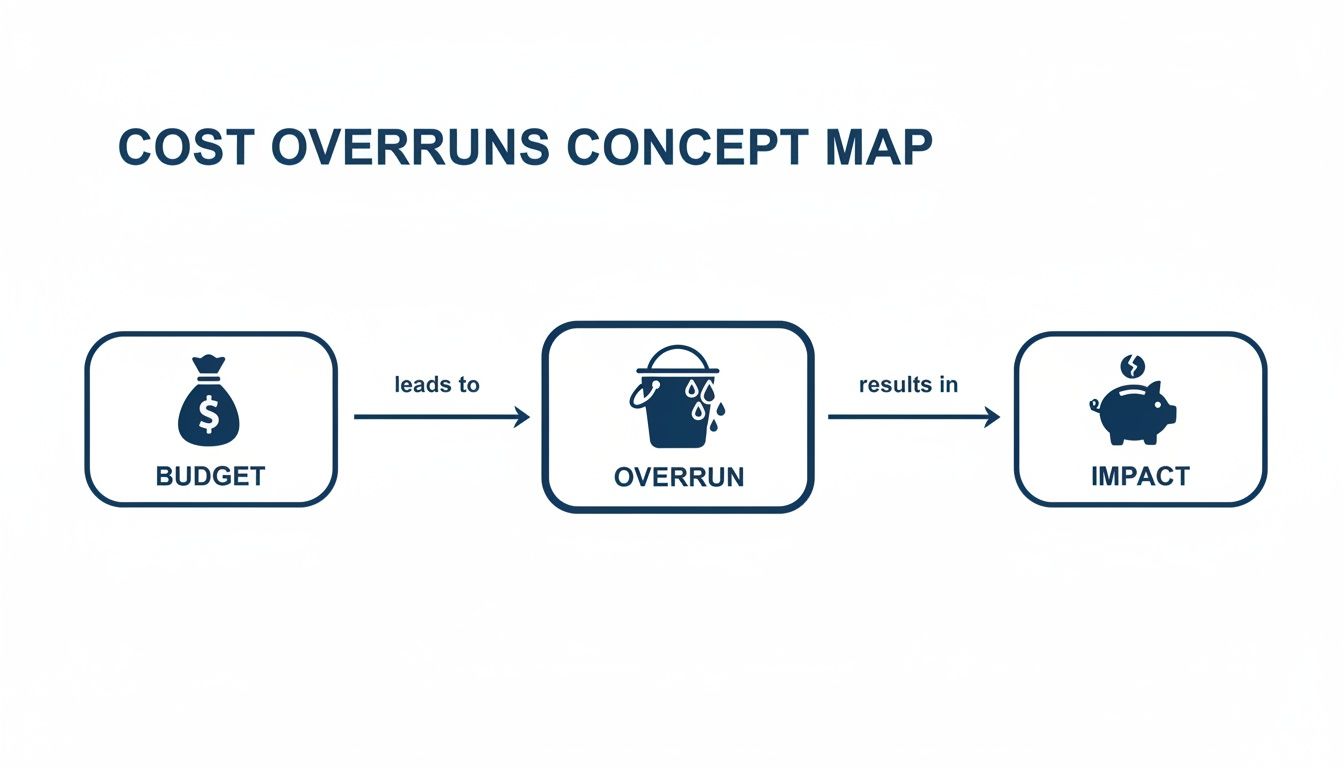
What starts as a solid plan can quickly turn into a leaking bucket. That broken piggy bank isn't just a picture; it’s a real hit to your company's cash and future.
To help you spot these profit killers, here are the most common causes and what they look like on a job site.
Common Causes of Cost Overruns and Their Impact
This table shows the real-world problems that cause budgets to break. These aren't just ideas; they're the everyday things that eat away at your profit.
| Cause | Simple Explanation | Example Impact |
|---|---|---|
| Bad Estimates | The first price you gave was too low because you missed some costs or used old prices for materials. | Bidding a deck job and forgetting that wood prices went up 25%, which instantly makes the job lose money. |
| Scope Creep | The client keeps asking for "small" extra things that weren't in the contract, without a formal price change. | Adding three "simple" electrical outlets and better tiles without adding it to the bill. This adds $2,500 in work and materials you don't get paid for. |
| Supply Chain Issues | Material prices go up after the contract is signed, or deliveries are very late. | The steel beams for a building are delayed by six weeks. You have to pay your crew for doing nothing and change the whole project schedule. |
| Subcontractor Problems | A key worker is late, does a bad job, or doesn't show up, which causes more delays for everyone else. | Your plumber is a week late. That means the drywall team can't start, which pushes back the painters, and you might get fined for finishing late. |
| Poor Scheduling | The project plan is bad. Teams get in each other's way, or materials show up at the wrong time. | Drywall is delivered before the building is sealed from rain. It gets wet and ruined, so you have to buy it all over again at your own cost. |
Each of these problems might seem small on its own. But when they happen together, they can ruin even the best-planned project. Let's look at each one more closely.
1. Inaccurate Estimates
This is when a project is set up to fail from the start. A price that’s too low might win you the job, but it’s a sure way to lose money.
For example, I once saw a contractor agree to a fixed price for a kitchen remodel. His estimate didn't account for the long wait time for custom cabinets or the extra work needed in an old house with crooked walls. By the time he found the mistake, it was too late. He was locked into the price.
Every hour his team worked and every dollar he spent on materials pushed him further into a loss. A bad estimate can ruin an entire project.
2. Scope Creep
You know how it goes. The client says, "While you're here, could you just…?" That’s scope creep. It’s the slow addition of tasks that weren't in the original plan.
A single request might seem small. Maybe it's adding a few lights or changing a paint color. But if you don't have a formal "change order" to add the new work and its cost to the bill, you end up doing more for the same money. For example, a client on one of my projects asked to change from standard tile to a fancy mosaic. It seemed like a small change, but it added two extra days of labor and a few thousand dollars in material costs that weren't in the budget.
This is a serious problem. Cost overruns can double a project's budget. One study found that over 60% of big energy projects go way over budget, some by as much as 102.5%. This happens on smaller jobs every day. The same study showed that 73% of project leaders said rising material costs were a big reason for overruns. You can learn more by reading the full findings on project investment risk.
3. Supply Chain Surprises
Your bid is based on today's material prices. But what if the cost of copper, concrete, or steel shoots up after you've signed the contract? You have to pay the higher price.
Imagine you bid a job based on steel prices from two months ago. When you go to order the steel, a new fee or a factory shutdown has made the price jump 20%. On a big order, that kind of surprise can wipe out your profit instantly.
4. Subcontractor Problems
Your project is only as strong as its weakest link. Often, that weak link is a subcontractor who isn't reliable. When your framing crew is a week late or the HVAC team does a bad job, it causes delays and extra work for everyone.
If the plumbers are behind, the drywall team can't work. Then the painters are delayed. Then the flooring installers. Each day of delay costs you money in overhead, frustrates your own crew, and puts you at risk of missing your deadline—which often means you have to pay a penalty.
5. Poor Scheduling
A project schedule is the plan that keeps your workers, materials, and subcontractors in sync. When that plan is bad, you get chaos.
If materials show up before the site is ready, they can get damaged, stolen, or just be in the way. If you have the electricians and plumbers trying to work in the same small bathroom at the same time, nobody gets anything done. In construction, bad scheduling means wasted time, and wasted time is always wasted money.
How to Spot Overruns Before They Drain Your Bank Account
You can’t fix a problem you can’t see. Managing a project without watching the numbers is like driving without a dashboard—you have no idea how fast you're going or if you're about to run out of gas.
Spotting cost overruns in construction projects early is the only way to stop them from getting out of control and erasing your profit.
The warning lights on your car’s dashboard don’t mean the engine has exploded. They are early warnings telling you to pull over and check the oil before something bad happens. In construction, these warning lights are called Key Performance Indicators (KPIs).
KPIs are just simple numbers that give you a quick health check on your project. You don't need to be a math expert to use them. They are your best defense against financial surprises.
Using KPIs as Your Project Dashboard
Let's look at a few of the most important gauges on your project's dashboard. These are the "check engine" and "low fuel" lights for your job site.
Here are a few important ones to watch:
- Budget Variance: This is the simplest one. It’s the difference between what you planned to spend and what you’ve actually spent. If it's a negative number, that's a red flag.
- Cost to Complete (CTC): This number predicts how much more money you’ll need to finish the project. It answers the question, "Do I have enough money left in the budget to finish?"
- Earned Value: This tells you if you're getting your money's worth. It compares the work you’ve actually finished to the money you’ve spent.
These aren't just fancy terms; they are real-world tools. If your Budget Variance is -$10,000, that’s a signal to find out where that money went. Did wood prices go up? Did you pay for extra overtime?
Job Costing: The Secret to Knowing Your Numbers
So, how do you get these numbers? The answer is an accounting method called job costing.
Job costing is the process of tracking every dollar—for labor, materials, and subs—and linking it to a specific job. It’s like giving each project its own bank account so you can see exactly where the money is going.
Without job costing, all your costs get mixed together. You might know you spent $50,000 on lumber last month, but you have no idea which of your three jobs used how much. This makes it impossible to know which jobs are making money and which are losing it.
Imagine you're building three different houses. Job costing is like giving each house its own shopping list and its own receipts. At the end, you can see exactly what each one cost, down to the last nail.
To learn more, check out our guide on what job costing in construction really means and how to set it up.
Putting It All Together
Let's use a real-world example. Say you're halfway through a kitchen remodel with a total budget of $40,000. Your job cost report shows you've already spent $25,000.
You might think you’re just a little over budget. But then you look at your "Earned Value," and it shows that only 40% of the work is actually done. This is a huge warning sign. You've spent over 60% of your budget but are not even halfway finished.
This is the moment to step in. You can look at the job cost reports to find out why. Maybe the cabinets were more expensive than you thought, or the plumber had unexpected problems that took extra time.
By catching this now, you have a chance to fix it. You can talk to the client, create a change order, and get the project’s finances back on track before you lose all your profit. This is about using simple numbers to make smarter decisions.
How to Prevent Cost Overruns in Construction Projects
Knowing why cost overruns happen is one thing. Actually stopping them is what keeps you in business. Here are real-world ways to protect your profits.
Think of your company’s cash as a bucket of water. Every cost overrun—a bad estimate, a surprise bill, an extra task from a client—is another hole in that bucket. The more holes, the faster your cash and profit drain away. It’s time to patch those holes.
Create Strong Contracts and Change Order Processes
Your best defense is a strong contract. The contract is the rulebook for the project. It has to be very clear about what you are building and, just as important, what you are not building. A fuzzy plan is an invitation for money problems.
Your contract must also have a strict process for handling changes.
A change order isn't a bad thing; it’s a tool for being clear. It's a simple paper that notes a change from the original plan, states the new cost, and gets the client’s signature before you do the extra work. This turns a possible argument into a professional agreement.
Without a formal change order process, you get "scope creep"—those little "while you're at it" requests that slowly drain your budget. By writing down every change, you make sure you get paid for all your work.
Master Smarter Estimating and Bidding
A project can be won or lost when you submit your price. If your estimate is wrong, you’ve agreed to lose money from the start. Good estimating isn't just about winning the job; it's about winning a profitable job.
Here are a few ways I’ve seen successful contractors create better estimates:
- Use Current Prices: Never use old material prices. Call your suppliers for today's prices before you finalize a bid.
- Add a Buffer (Contingency): Things will go wrong. That's just how construction is. A smart budget includes a contingency fund—usually 5-10% of the total project cost—to cover surprises without losing your profit.
- Review Past Projects: Use your own job cost reports to learn. Where were your old estimates right? Where were they wrong? Did a job take longer than planned? Did you forget to budget for renting extra equipment?
Good bids protect you from starting in a financial hole. For more tips on saving money, you can look at these strategies on how to reduce construction costs and save your budget.
Get Smart with Scheduling and Procurement
Your project schedule is the script everyone on site follows. A bad schedule creates chaos and wastes time and money. Also, how and when you buy materials (procurement) can greatly affect your costs.
This is even more important with rising costs. Global construction costs are expected to go up by 2-7% in 2026, with the USA seeing around a 4% increase. With 62% of company leaders saying supply chain problems are a big challenge, timing your material purchases is key. You can learn more about these trends driving global construction costs.
Focus on these two areas:
- Better Scheduling: Use simple tools to plan a smart order of work. Don't schedule the plumber and the electrician in the same small bathroom on the same day. A good schedule makes work flow smoothly, which saves you time and money.
- Smart Buying: Don't buy materials right when you need them. Plan ahead. Can you lock in a price for wood today before it goes up next month? Can you order items that take a long time to get, like custom windows, months in advance to avoid long delays?
Take Control of Your Cash Flow
Finally, and most importantly, you have to be the boss of your own cash flow. It’s the lifeblood of your company. Cost overruns attack your cash, but good cash management is your best defense. This means knowing how much money is coming in, how much is going out, and when.
Think of it like this: if you have a big bill for materials due on Friday but your client’s payment won't arrive until next Tuesday, you have a cash flow problem. Good construction cash flow management helps you see these problems coming so you can plan for them.
By using clear contracts, better estimates, smart scheduling, and good cash flow management, you’re not just plugging one hole in the bucket. You are building a stronger company that can hold onto the profits you work so hard to earn.
How a Financial Partner Can Be Your Best Defense
You’re an expert at building things. Your days are spent on job sites, managing crews, and solving problems—not stuck in spreadsheets. This is a common story, and it's where many construction businesses start losing money without even realizing it. This is where the right help can make a huge difference.
Trying to manage your company's money without clear numbers is like flying a plane in a storm without any instruments. You’re just guessing and hoping you land safely. A bookkeeping and advisory partner gives you that instrument panel and an expert to help you navigate.
Your Financial Co-Pilot for Construction Projects
Let's be real: tracking every dollar spent on every job is a full-time job. When you're busy with multiple projects, it's easy for small costs to be missed. But those small misses can turn into big cost overruns.
A financial partner is like your co-pilot. While you focus on flying the plane—building great projects—they watch the instruments. They make sure you have the real-time information you need to avoid trouble.
This partnership does two main things:
- Clean Bookkeeping (The Instruments): This gives you the clear, correct numbers you need to see what’s happening in your business. It's your fuel gauge, your altitude meter, and your engine warning light.
- Financial Advice (The Navigator): This helps you understand what the numbers are telling you. It's the expert in the next seat saying, "We're using fuel faster than we planned on this job; let's change course before it becomes a problem."
Clean Bookkeeping Gives You Clear Instruments
Good bookkeeping is the foundation of a healthy construction business. It’s not just for doing taxes once a year. It's about having information right now that shows you the financial truth of every project.
Think about it: a shocking 25% of construction companies go out of business after just two or three bad projects. This happens because they can't see the financial problems adding up in real-time. Clean bookkeeping shines a light on these problems before they become fatal.
With a partner handling your books, you get:
- Accurate Job Costing: You’ll finally know exactly how much each job costs in labor, materials, and subcontractors. No more guessing which jobs are making you money and which are losing it.
- Up-to-Date Financial Reports: You get simple reports that are easy to read. They show your profit and loss, your cash flow, and how your spending compares to your budget.
This isn't about creating more paperwork. It's about turning confusing numbers into a simple dashboard you can understand quickly.
Financial Advice Helps You Navigate the Storm
Having the numbers is one thing; knowing what to do with them is another. This is where an advisory partner, or fractional CFO, becomes your navigator. They help you use that financial information to make smarter decisions that boost your bottom line.
For example, your job cost report might show that labor costs on a project are 20% higher than you planned. Your bookkeeper gives you that number. Your advisor helps you figure out why. Is it extra overtime that wasn't tracked? Is a worker being less productive? Did you calculate your labor costs wrong in the first place?
This guidance is practical. It helps you answer the tough questions that decide if your business will just survive or actually grow. For a closer look at how this works, you can find valuable insights in our article on CFO services for small businesses.
This kind of partnership helps you stop reacting to problems and start building a more predictable and profitable business.
Frequently Asked Questions About Cost Overruns
We’ve talked a lot about cost overruns in construction. But you probably still have some questions. It’s one thing to talk about ideas, but it's another thing to use them on a real job site.
Let’s get straight to the questions I hear most often from contractors like you.
What’s the Real Reason Small Contractors Go Over Budget?
For most small contractors, it’s a mix of two things: a bad initial estimate followed by no process for handling changes. This can kill your profit before you even put up the drywall.
Think about a job you did recently. Maybe you bid it low to win, using last month’s material prices. You were already on thin ice. Then the client asks for a “small” change, like better faucets. You agree right away to be nice.
Without a formal change order, you just paid for that upgrade yourself. Do that a few more times, and a job you thought would make a 15% profit is now a job you’re paying to finish.
How Do I Budget for Things I Can’t Predict?
You can’t predict the future, but you can plan for it. The best way is to build a contingency fund into every project budget. This isn't a secret stash of money; it's a professional tool for managing risks.
A good rule is to set aside 5% to 10% of the total project cost for surprises. On a $100,000 project, that's $5,000 to $10,000 set aside for things like:
- A sudden jump in wood prices after you sign the contract.
- Needing to rent a machine you didn't plan for.
- Finding hidden water damage behind a wall that needs to be fixed.
The key is to be open about it. Tell your client the contingency is there to protect the project from delays and budget problems. If you don't use it, you can give it back to them. This builds a lot of trust.
This one step changes the conversation from, "We have a big problem," to, "It's a good thing we planned for this."
My Project Is Going Over Budget. What’s the First Thing I Do?
The moment you think a project is losing money, you have to act. Don't just hope it gets better. It won't. Your first move is to stop and investigate.
Right away, you need to:
- Look at Your Job Cost Reports: Where is the extra cost coming from? Is it materials? Labor hours? A certain subcontractor? A good report will show you the leak.
- Compare to Your Original Bid: Look at your estimate and compare it line by line with your actual costs. Did you budget 40 hours for framing, but your crew has already worked 60? Did you bid $5,000 for plumbing, but the bill was $7,000? Find the exact difference.
- Find the Main Cause: Once you know what’s over budget, you have to find out why. Was it a change the client asked for but you didn't write down? Was your first guess on labor time just too low? Did a supplier send the wrong materials, forcing you to do extra work?
Only after you have a clear answer can you take action. That might mean sending the client a change order, having a tough talk with your crew, or changing your schedule. Acting fast is the only way to stop a small leak from sinking the whole ship.
Is It Really Worth It to Buy Software to Track Costs?
Yes. One hundred percent. Trying to manage job costs on spreadsheets and notebooks today is like trying to build a house with just a hammer and a handsaw. It's messy, slow, and full of mistakes that will cost you money.
Think about this: studies show that projects managed with paper and pen have a budget overrun rate as high as 75%. That’s not a business risk; that’s just a bad bet.
Investing in simple construction software isn't a luxury; it's a basic need for doing business today. It pays for itself almost right away. Here’s why:
- Real-Time Information: You see you're going over budget on framing today, not a month from now when it's too late.
- Fewer Mistakes: Software gets rid of typing errors that can slowly eat away at a project’s profit.
- Smarter Future Bids: The software becomes your own library of data. When you bid your next job, you're not guessing. You're using real numbers from your past projects to create a much more accurate—and profitable—estimate.
The right software gives you the financial tools to run your company like a business, not just a series of jobs.
Feeling overwhelmed by tracking every dollar and trying to prevent cost overruns on your own? You don’t have to. At MyOfficeOps, we act as your financial co-pilot, handling the detailed bookkeeping and providing the clear reports you need to see problems before they start. Let us give you the financial clarity to focus on what you do best—building great projects. Schedule your free discovery call with MyOfficeOps today.