A good construction profit margin calculator isn't some fancy software—it's a simple way to see what you really make on a job. It cuts through the noise. It takes the money you brought in (your revenue) and subtracts all the costs, showing you your real profit. This is how you start bidding smarter and actually grow your business.
So, how do you know what you're really keeping? It starts with understanding two key numbers: gross margin and net margin. Each one tells you something different, and both are super important for your business.
Gross Margin vs Net Margin: What You Really Keep
This table breaks down the two most important profit numbers in construction. It shows what each one tells you about your company’s money.
| Metric | What It Measures | Why It Matters for Contractors |
|---|---|---|
| Gross Margin | Profit from a single job, before you pay for things like office rent. (Revenue – Direct Job Costs) | Shows if your bids are priced right and if your crew is working well. A low gross margin means the job itself wasn't profitable, even before paying for your office or truck. |
| Net Margin | Profit from your whole business after every single bill is paid. (Revenue – ALL Costs) | This is your real bottom line. It tells you if your company is actually making money after paying for everything, from office rent to truck insurance. This number shows if your business will last. |
In short, gross margin tells you if you're making money on the job site. Net margin tells you if your business is making money. You need to track both to get the full story.
Why Is My Construction Profit Margin So Hard to Track?

Let’s be honest. You finish a big job, the final check clears, but when you look at your bank account, the number just feels wrong. That profit you were counting on? It’s just… not there. If this sounds familiar, you’re not alone. It’s one of the most common and frustrating problems contractors face.
This feeling of "where did the money go?" happens because construction profit is a moving target. It’s not usually one big thing that goes wrong; it's a dozen small things that quietly eat away at your bottom line.
The Silent Profit Killers
Think about your last project. Did the price of lumber suddenly jump mid-job? Did a small concrete pour take two guys a full day instead of the four hours you budgeted? These are the silent profit killers.
They often look like normal daily problems, but they add up fast:
- Surprise material costs: A sudden price hike from a supplier can wipe out a chunk of your profit before you even notice.
- Labor overruns: A task that takes longer than planned is one of the quickest ways to watch your profit shrink.
- Unbilled change orders: The client asks for "just one more thing," and in the rush to keep them happy, you forget to do the paperwork. Those small favors become big losses.
I once worked with a contractor who landed a huge custom home project. It was the biggest job of his career, and he thought he was going to have a record year. But when it was all over, he was shocked to find he’d barely broken even.
He was so focused on being busy and managing the build that he lost track of the small details. A few unbilled changes, unexpected labor delays, and a spike in drywall prices turned his dream job into a financial nightmare.
This story teaches a big lesson: being busy is not the same as being profitable. The construction industry is known for its super-thin margins. In fact, the average net profit margin is expected to be around 5-6% in 2025. This means for every $100 you bring in, you might only keep about $5 after all expenses are paid.
This is why having a clear, simple system for tracking your numbers is so important. A good construction profit margin calculator isn't just about doing math; it’s about taking control. It forces you to look at every single cost, from the big-ticket items down to the small, forgotten expenses that bleed you dry. It helps you see exactly where your money is going on each job, so you can stop guessing and start making decisions based on real information.
To learn more about how these numbers impact contractors—and why many accountants at firms like Aladdin Bookkeeping suggest aiming for 8-10% to build a stronger business—it's worth looking into the details. Without a clear view of your numbers, you're just working hard, not smart.
Gathering Your Numbers for an Accurate Calculation
Any construction profit margin calculator, whether it's a spreadsheet you made or some fancy software, is only as good as the numbers you put into it. It’s the classic "garbage in, garbage out" problem. If your numbers are wrong, your profit calculation will be a fantasy.
Getting these numbers right is where the real work starts. We need to go beyond just adding up lumber and labor. We have to find the true, all-in costs of a project—especially the ones that are easy to forget.
Start with Direct Job Costs
These are the costs you can point to and say, "That expense was for that specific job." They are the most obvious costs, but they also have a lot of parts that can trip you up.
For any project, you have to track:
- Materials: Every 2×4 and sheet of drywall is obvious. But what about the stuff that gets used up? The saw blades, concrete ties, and boxes of screws. They add up.
- Labor: This is a big one, and it’s not just the hourly wage you pay your crew. You have to include labor burden—things like payroll taxes, workers' comp, and insurance. That guy you pay $30 an hour might actually cost your business closer to $45-$50 an hour. If you miss that, you’re already losing money.
- Subcontractor Fees: The full amount you pay your electrician, plumber, roofer, and any other trades you hire for the job. No exceptions.
- Equipment Rentals: That lift, mini-excavator, or concrete saw you rented just for this project.
- Permits and Fees: Every city permit, inspection fee, and other official charge tied directly to getting the job done.
Getting these direct costs right is the first step to knowing your numbers. The whole process is called job costing, and it’s one of the most important skills for any profitable contractor. For a deeper look, check out our guide on what job costing in construction really means and see how it can completely change your business.
Don't Forget Your Indirect Costs (Overhead)
This is where most contractors get into trouble. Indirect costs, or overhead, are all the expenses that keep your business running, whether you have five jobs going or none at all.
Think of your overhead as a slow leak in a tire. You might not notice it day-to-day, but it’s always draining your money. You have to account for it.
Every single project you do must pay for its fair share of your company's overhead. If it doesn't, you are basically paying to do the work.
Common overhead costs include:
- Office or shop rent
- Utilities (power, internet, phone)
- Truck payments and insurance
- General liability insurance
- Salaries for office staff (including you!)
- Marketing and advertising
- Bookkeeping or accounting fees
To use a construction profit margin calculator the right way, you have to figure out how much of this overhead to "charge" to each job. We'll walk through exactly how to do that next.
Handle the Tricky Items
Finally, there are a few things in construction accounting that can throw your numbers way off if you don't track them right.
Change Orders: When a client adds or changes something, it's not a favor—it's a change to the contract that needs a new price. Every change order must be written down, priced, and signed. If you do the work without that, you're just giving away free labor and materials.
Retainage: This is the money held back by the client until the project is 100% finished. It’s part of your total contract price, so it counts toward your final profit, but you won't see that cash for a while. You have to track it as money owed, but don't count on it for this month's payroll.
Once you have all these numbers gathered and organized, you finally have what you need. Now you're ready to plug them in and see what your real profit actually looks like.
How to Calculate Your Real Job Profit Margin
Alright, let's do the math. You’ve gathered all your numbers—direct costs, overhead, and those tricky change orders. Now for the part that actually tells you if you made any money. We’re going to walk through the calculation together, nice and simple.
To make this real, we’ll use a kitchen remodel project. This is the kind of job contractors do every day. Let's say you quoted the client and the final contract price was $50,000. That's our revenue, the top-line number we'll start with.
Finding Your Gross Profit First
The first step is to find your Gross Profit. I always tell people to think of this as their "on-the-job" profit. It's a quick check to see if the project itself made money before you pay for your office rent or truck insurance.
The formula is simple:
Total Job Revenue – Direct Job Costs = Gross Profit
Let's use the numbers from our kitchen remodel. We know the revenue is $50,000. After tracking every receipt and timesheet, your direct costs were:
- Materials: $18,000
- Labor (including burden): $12,000
- Subcontractors (plumber, electrician): $7,000
- Permits & Fees: $1,000
- Equipment Rental (dumpster): $500
That brings your total direct job costs to $38,500.
Now, we do the math: $50,000 (Revenue) – $38,500 (Direct Costs) = $11,500 (Gross Profit)
That $11,500 is your gross profit. Getting this right is a huge first step. In fact, a good understanding of how to compute gross profit is the key to understanding your business's money.
If you want to see that as a percentage, you just divide the gross profit by your revenue. We have another article that dives deeper into calculating your gross margin percentage if you want to learn more.
Calculating Your True Net Profit
Your gross profit is a great start, but it’s not the money you can take home. Every job you do has to help pay for the business's general expenses—the overhead we talked about earlier. This is where we find your Net Profit, which is the truest measure of a project's success.
First, we need to assign a fair share of your company's overhead to this job. Here's a simple way to do it:
- Add up your total company overhead for the year (rent, insurance, admin salaries, etc.). Let's say it's $100,000.
- Now, look at your total expected sales for the year. Let's say you're on track to bring in $1,000,000.
- Divide your total overhead by your total sales: $100,000 ÷ $1,000,000 = 0.10, or 10%.
This 10% is your overhead rate. It means for every dollar a job brings in, ten cents has to go towards keeping the lights on for the whole company.
Next, we apply that rate to our kitchen remodel:
$50,000 (Job Revenue) x 10% (Overhead Rate) = $5,000
So, this kitchen remodel is responsible for covering $5,000 of your company’s overhead.
Finally, we can calculate the real net profit:
Gross Profit – Job's Share of Overhead = Net Profit
$11,500 – $5,000 = $6,500
After paying for every board, screw, and hour of labor, and covering its share of the business's bills, this project left you with $6,500 in true, spendable net profit.
Your net profit margin is 13% ($6,500 ÷ $50,000). This is the number that really tells you if your business is healthy. It’s what pays for growth, new tools, and bonuses, and it gives you a safety net for the slow months.
Visualizing Your Job Costs
You can't make a profit if you don't know what you're spending. It sounds simple, but it’s where most contractors get into trouble. This chart shows the main types of costs you have to gather before you can trust any profit calculation.
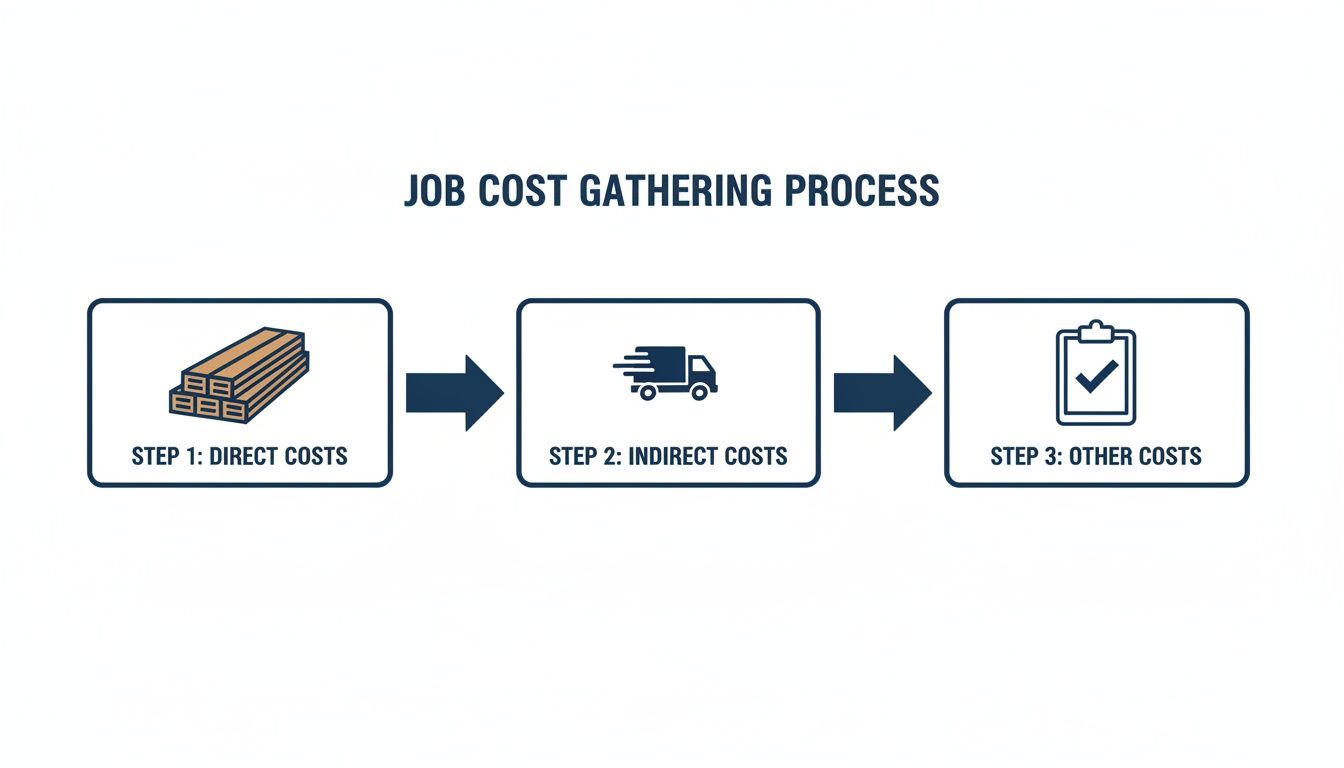
As you can see, getting an accurate number means looking past the obvious stuff like lumber and labor. You have to account for the indirect and office costs that drain your bank account just as surely as a trip to the supply house.
To make this whole process a lot easier, we put together a simple spreadsheet you can download. It’s a ready-to-use construction profit margin calculator—just plug in your own numbers to see your real profit in seconds.
[Link to Your Downloadable Profit Margin Calculator Spreadsheet]
Common Mistakes That Quietly Kill Construction Profits
Knowing your profit margin is one thing; protecting it is another. I’ve seen so many good contractors fall into the same traps that quietly drain their bank accounts.
These aren't big, dramatic problems. They’re the small, silent leaks—the thousand tiny cuts that can sink a business over time. They often start with good intentions, like wanting to win a bid or keep a client happy, but they almost always end in frustration and missing money.
Let's walk through the biggest mistakes I see so you can spot them before they do real damage.
Pricing Jobs on a Gut Feeling
This is the most dangerous habit in construction. You’ve done jobs like this a dozen times, so you think you "just know" what it's going to cost. You pull a number out of thin air, skip the detailed estimate, and send the bid.
The problem is, your gut doesn't remember that lumber went up 8% last month. It doesn't factor in your new guy's learning curve. And it doesn't account for a small change in the building code.
A bid based on a feeling is a gamble. You're betting your company's health on it. Hard numbers are the only way to bid for profit, not just to keep the crew busy.
If you find yourself constantly bidding low just to win work, it's time to review how to bid construction projects with a focus on making money. Winning a job you lose money on isn't a win; it's a loss.
Sloppy Change Order Tracking
It all starts with that famous line: "Hey, while you're here, could you just…?" A client asks for a "small" change, and you agree on the spot to keep things moving. You tell yourself you'll do the paperwork later.
But "later" often becomes "never." The work gets done, you forget to create the change order, and you've just given away your time, your crew's labor, and your materials for free.
Every single change, no matter how small, needs a written change order that the client signs before the work begins. This isn't about being difficult; it's about being a professional. It must clearly state the new work and the added cost.
Without that signed paper, you have no power when it's time to collect payment. This one habit can easily be the difference between a profitable job and one that loses money.
Forgetting About Hidden Costs
You always remember the big things—the lumber, the drywall, your crew's pay. But what about all the little things? These "invisible" costs eat away at your profit from the inside.
I see these get missed all the time:
- Warranty Calls: You have to build a cushion into every job to cover callbacks. If you don't budget for it, every warranty repair comes directly out of your pocket. It's a guaranteed expense.
- Specialty Tool Rentals: I had a client who built decks. He took on a custom project and forgot to include the three-week rental for a special auger in his bid. That one mistake cost him nearly $2,000 of his profit.
- "Consumable" Materials: Think about saw blades, drill bits, painter's tape, caulk, and plastic sheets. A single roll of tape is cheap, but over a three-month job, these supplies can easily add up to hundreds or even thousands of dollars.
These mistakes are simple, which is why they're so easy to make. The solution is just as simple: be disciplined. Use a checklist for every estimate. Follow your process every time. And use your construction profit margin calculator for every single job. Stop guessing and start knowing where every dollar is going.
Practical Ways to Improve Your Profit Margins

This is where the real work begins. Once you have a clear, honest picture of your numbers from a construction profit margin calculator, you can finally start making smart moves to make them better. This isn't about cutting corners or doing bad work. It’s about working smarter, not just harder.
The construction industry has seen margins slowly climb from 5.9% in 2018 to around 7.1% in 2024, but let's be real—that's still very tight. To really do well, contractors are finding ways to be more efficient. Efficiency is the new name of the game.
Get Strategic with Suppliers and Bids
The first place to look for extra profit is often in your costs and how you get jobs. Small changes here can make a big difference on every single job you do.
- Negotiate Better Rates: Don't just accept the first price your supplier gives you. Build good relationships, and most importantly, pay your bills on time. If you're known as a reliable contractor who pays fast, you have more power to ask for better prices or discounts.
- Create More Accurate Bids: Stop guessing. Use the information from your past jobs to build new estimates. If you know a certain type of project always has labor overruns, you need to build that into your next bid. Being accurate protects your profit from day one.
We had a client, a deck builder, who realized after looking at his reports that he was always underbidding railings. It seemed like a small part of the job, but it was costing him thousands every year. By adjusting his bids by just 5% on railings alone, he added a full percentage point to his company’s net profit.
Dial In Your Operations
How you run your business day-to-day is just as important as how you price your jobs. A messy operation will always leak money, no matter how good your bids are. One of the best things you can do for your profit is to find ways to improve how you work.
A few key areas to focus on include:
- Document Every Change Order: Make this a firm rule. Every single change gets a written, priced, and signed change order before the work starts. This one habit alone can save a small business thousands in losses.
- Minimize Rework: Rework is a profit killer. It means you’re paying for labor and materials twice for the same task. Use simple quality checklists and make sure everyone in the field and office is on the same page to get things done right the first time.
- Consider Renting vs. Buying: That new excavator looks great, but do you really need it sitting around for six months of the year? Renting special equipment can free up a lot of cash and get rid of maintenance costs, which directly boosts your available money.
Focus on Your Most Profitable Work
This might be the most powerful tip of all. Not all jobs are created equal. Once you start tracking your profit on each job, you'll quickly see a pattern.
I worked with a general contractor who thought his big, flashy kitchen remodels were his moneymakers. They were high-dollar jobs that looked great in his portfolio. But after we ran the numbers, we found his net margin on those complex jobs was a tiny 4% because they were complicated and had demanding clients.
Meanwhile, his "boring" basement finishing jobs were consistently making him 15-18% profit. They were simpler, faster, and had fewer surprises. This was a game-changer. He immediately shifted his marketing to get more basement projects. His sales stayed the same that year, but his take-home profit nearly doubled.
By using the information from your own projects, you can stop chasing every lead and start focusing on the work that actually grows your business.
Frequently Asked Questions About Construction Profit
Even with a perfect calculator, the same questions pop up over and over. It's only natural. Managing the money in a construction business can feel like trying to nail Jell-O to a wall.
I've had hundreds of conversations with contractors about their numbers. Here are the most common questions that keep them up at night, along with the straightforward answers you need to get back in control.
What Is a Good Profit Margin for a Small Construction Company?
This is the big one. Everyone wants to know what "good" looks like. While you'll hear that the industry "average" net profit margin is around 5-6%, you should never, ever aim for average.
A truly healthy, resilient construction company should be shooting for 8-10% net profit or more.
Why the push for a higher number? That extra buffer is everything.
- It's what lets you breathe during the slow winter months instead of panicking about payroll.
- It's the cash you need to invest in a new excavator or software that makes your crew more efficient.
- It’s how you confidently hire that superstar PM you’ve been trying to recruit.
- It’s the freedom to finally say "no" to nightmare clients and bad-fit jobs.
Think of it like this: a 5% margin is just surviving. A 10% margin is thriving. It's the difference between constantly chasing cash and confidently planning your next big move.
It’s also true that this target can shift depending on your trade. A GC juggling massive, complex projects might operate on a tighter margin than a specialty electrician or plumber, who can often command higher rates for their specific expertise. The real key is knowing your numbers and relentlessly working to improve them.
How Often Should I Calculate My Profit Margins?
If you're waiting until tax time to see if you made money, you've already lost. By then, it's ancient history, and you can't do a single thing to change the outcome. You need to get into a regular rhythm of checking your numbers.
Here’s a simple schedule that works for most contractors I know:
- After Every Single Job: The moment a project wraps and you've collected that final check, run the numbers. Use a construction profit margin calculator to get an immediate post-game analysis. This gives you instant feedback on how well you estimated and managed the work.
- Every Single Month: Pull a company-wide profit and loss statement. This is where you spot the trends. Are your material costs creeping up across the board? Is your fuel bill getting out of hand? A monthly check-in is your early warning system.
- Every Quarter: Take a step back for a deep-dive analysis. Are you on track to hit your annual goals? Are kitchen remodels consistently more profitable than bathroom additions? This is where you make strategic decisions that guide your sales and operations for the next 90 days.
This kind of regular review turns a reactive, stressful chore into a proactive, empowering habit. You stop discovering massive losses six months too late and start steering your business with real-time data.
Why Am I Always Busy but My Profits Are Low?
This is easily the most frustrating problem a contractor can have. Your phone is ringing off the hook, your crews are working flat out, and you’re putting in 60-hour weeks. By all accounts, you feel successful, but your bank account is telling a completely different story.
Here’s the hard truth: being busy is not the same as being profitable. If you feel like you're spinning your wheels, it almost always comes down to one of these three profit killers.
- Your Bids Are Too Low: This is the number one culprit, hands down. You might be pricing jobs on "gut feel" or deliberately underbidding just to win work. Let me be clear: winning a job where you can't make money is far worse than not winning it at all.
- You Aren't Tracking Your True Costs: You remember the lumber and the drywall, but what about the hidden costs? The box of screws, the fuel for that extra trip to the supply house, the porta-potty rental? These "little" things bleed you dry, silently erasing thousands from your bottom line.
- Your Overhead Is Eating You Alive: The cost of keeping the lights on—your truck payments, your insurance, your shop rent, your own salary—has to be paid for by the gross profit from your jobs. If you haven't accurately calculated your overhead and built it into every single bid, you're essentially paying for the privilege of working.
If this sounds painfully familiar, it's time to hit pause and investigate. Go back and analyze your last five completed jobs. Did you actually make the profit you planned for? If not, where did the money go? The answers are waiting for you in the numbers.
Running a construction business is tough, and you don’t have to figure it all out on your own. If you’re tired of guessing and want crystal-clear financials that actually help you make decisions, the team at MyOfficeOps is here to help. We turn your messy numbers into a clear roadmap for profitability.
Schedule your discovery call with MyOfficeOps today and start building a more profitable business.