
You log into QuickBooks. Revenue looks decent. The phone is ringing. Your team is busy. But you still feel uneasy because the bank balance doesn’t match the story you’re telling yourself.
I’ve sat with a lot of owners around West Chester, King of Prussia, and Philly who say the same thing: “We’re busy, so we must be doing okay.” That’s not how profitability works. Busy businesses fail all the time. So do businesses with strong sales.
If you want to know how to know if your business is profitable, stop guessing from your checking account, stop using top-line revenue as your scoreboard, and stop trusting a messy P&L. Profitability is something you measure on purpose. And if you measure it the right way, you can see what’s working, what’s draining you, and what needs to change now.
Profitability Starts with Clean Books Not Guesswork
Before you calculate anything, you need numbers you can trust. If your books are behind, miscategorized, or missing pieces, every profit decision you make is shaky. I don’t care how smart you are or how good your sales are. Bad books lead to bad calls.
Think of your financials like the dashboard in your truck or car. If the gas gauge is broken and the speedometer sticks, you wouldn’t drive to Pittsburgh and hope for the best. Your books work the same way.

Know the three reports that matter
You don’t need an accounting degree. You do need to understand these three reports in plain English.
Profit and Loss statement
This is your report card for a set period. It shows revenue, expenses, and what’s left over. If you want to know whether last month or last quarter made money, this is the first place to look.
Balance Sheet
This is a snapshot of what you own, what you owe, and what’s left for you. It tells you if the business is carrying too much debt, sitting on unpaid invoices, or leaning on credit to stay upright.
Cash Flow Statement
This shows where cash came from and where it went. It matters because a business can show a profit on paper and still run short on cash.
Practical rule: If your books aren’t current and reconciled, don’t trust the profit number yet.
What clean books actually look like
Clean books don’t mean “my office manager entered some stuff.” Clean books mean the reports are current, the accounts are reconciled, and the expenses are posted to the right places. That last part matters more than owners realize.
A lot of owners would benefit from reviewing a few crucial small business accounting tips before they start chasing margin problems. The basics still matter. If the basics are off, the analysis will be off too.
Here’s the standard I use with clients:
| Report | What I want to see | Why it matters |
|---|---|---|
| P&L | Current and categorized correctly | Tells you if operations are producing profit |
| Balance Sheet | Bank, loan, and credit accounts reconciled | Shows whether the business is stable |
| Cash Flow | Matches real cash movement | Helps prevent surprises |
If you need a simple starting point, this guide on bookkeeping for small business owners lays out what should be in place before you start making profit decisions.
Most owners don’t have a profit problem first. They have a visibility problem first. Fix that, and the profit picture gets clearer fast.
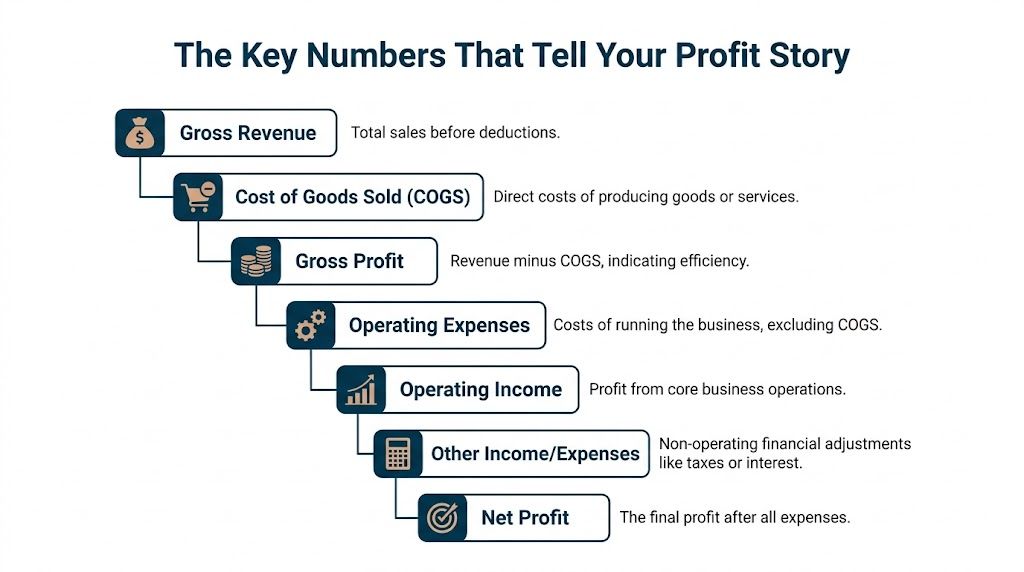
The Key Numbers That Tell Your Profit Story
You open your P&L, see sales are up, and still feel like something is off. I see that in owner meetings all the time around West Chester and Philly. Revenue looks busy. The bank account and the stress level say otherwise.
That’s why I don’t start with net income alone. I want to see where profit gets created, where it gets squeezed, and which clients, services, or projects are carrying too much weight for too little return.
Gross profit tells you if the work is worth doing
Gross profit is revenue minus direct costs. Those direct costs should include the costs tied to delivering the work. For a consultant, that may be billable labor. For a contractor, it usually includes field labor, materials, and subcontractors.
The formula is straightforward:
Gross Profit Margin = (Revenue – Cost of Goods Sold) / Revenue
This is the first number I check because it answers a blunt question. Does the actual work make money before rent, admin payroll, insurance, software, and everything else hit the P&L?
If gross profit is weak, more sales can make your life worse.
For professional service firms, gross margin targets vary widely based on labor model and delivery costs. ServiceTitan’s guide to gross profit margin notes that many service businesses aim for gross margins in a broad range that often lands between 30% and 70%. The right target depends on how much labor you carry in-house, how much work you subcontract, and how disciplined your pricing is.
Averages only get you so far. You need to break this number down by client, service line, or project. I’ve seen firms with an acceptable company-wide gross margin that were losing money unnoticed on one “good” client for months.
Operating profit shows whether the business model works
Operating Profit Margin = (Operating Income / Revenue) × 100
I care about this number because it shows whether the business can support itself after both direct costs and overhead. It strips out the noise and forces you to deal with how the operation runs.
A healthy operating margin gives you room to absorb mistakes, slow months, and bad estimates. A thin one means one pricing miss, one overstaffed job, or one sloppy scope can wipe out the month.
Greenwood CPA’s explanation of operating profit margin says small businesses in professional services, healthcare, and construction often target 10% to 20%, while anything below 3% can signal an unsustainable setup.
If your operating margin is light, do not start hacking random expenses. Start with the big levers. Review pricing, labor efficiency, write-offs, and the mix of work you sell. Then track a few key performance indicators for small business so you can see which part of the operation is dragging profit down.
Net profit tells you what actually stayed
At the bottom of the P&L is net profit margin.
Net Profit Margin = (Net Income / Revenue) × 100
This measures what is left after all expenses, interest, and taxes. It’s the number owners usually ask about first. Fair enough. It matters. But by itself, it does not tell you what to fix.
According to Xero’s guide to profitability ratios, a 5% to 20% net profit margin is often healthy for small and midsize businesses, depending on the industry. Service firms often push for the higher end. Construction and other lower-margin models may land lower and still be viable.
Here’s the simple math. If your business brings in $10,000 in revenue and keeps $2,000 after all expenses, your net profit margin is 20%.
Good number. Still not enough.
I want to know which part of the business produced that result. One project can prop up a weak month. One underpriced service can hide inside an otherwise decent quarter.
Read these numbers in order
Use the full path down the P&L.
- Strong gross profit, weak operating profit usually means overhead, admin load, or poor internal efficiency is eating the gain.
- Weak gross profit usually points to pricing, labor creep, material waste, bad estimating, or the wrong mix of work.
- Decent operating profit, weak net profit usually means debt costs, taxes, or other non-operating expenses are pulling down the final result.
If you want a quick answer, check net margin.
If you want to run a better business, study gross, operating, and net profit together, then cut the numbers by client, service, and project. That’s where money-makers and money-losers become apparent.
Uncovering Your Break-Even Point to Make Smarter Decisions
You hire an employee, sign the lease, add the software, and tell yourself sales will cover it. A few months later, revenue is up, stress is up, and you still cannot tell whether that decision made the business stronger. I see this all the time with owners around West Chester and Philly. The missing number is usually break-even.
Break-even tells you how much work you need to sell before a decision starts paying for itself. That makes it one of the most practical tools you have when you are pricing jobs, adding staff, opening space, or testing a new service line.
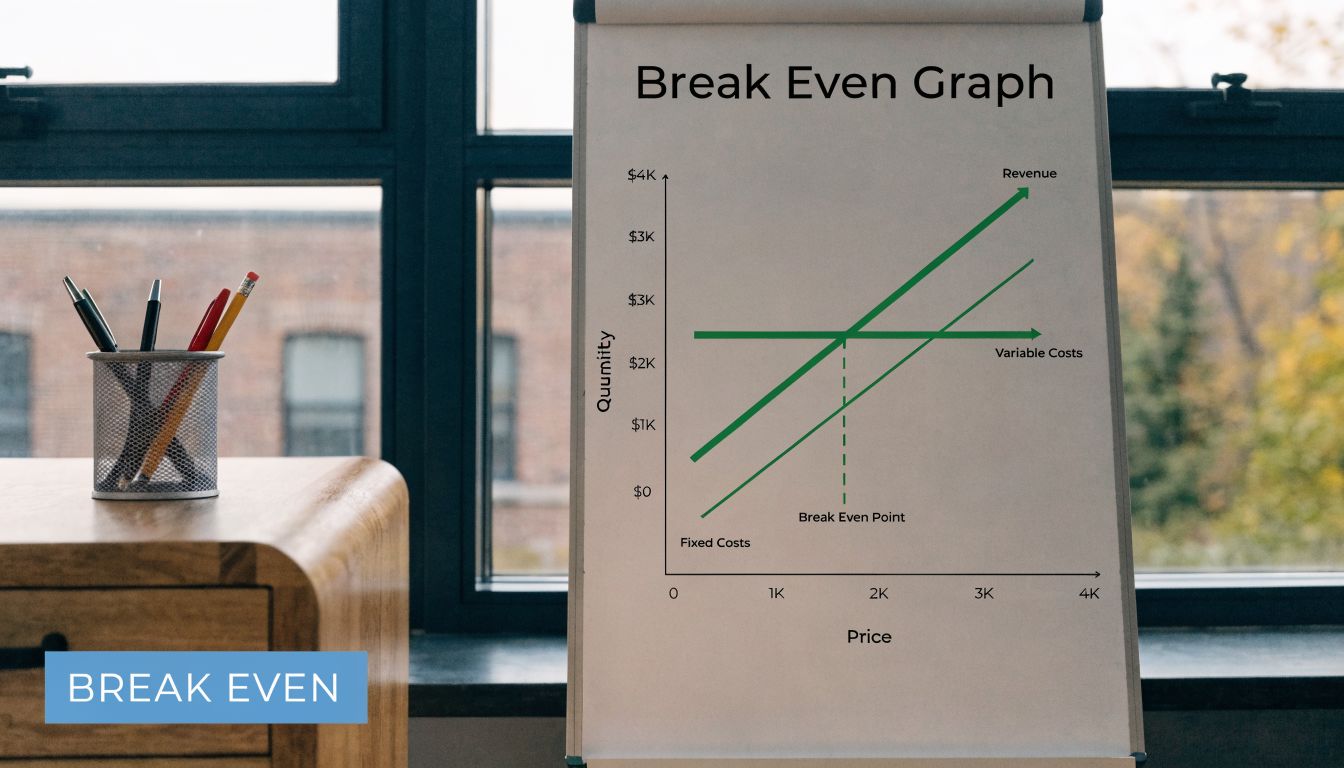
Here is the formula:
Break-Even Point = Total Fixed Costs / (Sales Price Per Unit – Variable Cost Per Unit)
Say you run a therapy practice, contractor shop, or consulting firm and want to add one employee. Before you make that move, calculate how many sessions, jobs, or billable hours that hire must produce just to cover payroll, benefits, software, and support costs. If the answer feels unrealistic, the hire is early, the pricing is wrong, or the role needs a different structure.
The math is simple. Cost classification is where owners get sloppy.
Rent, admin payroll, insurance, and core software usually belong in fixed costs for the period. Materials, subcontractors, sales commissions, and job-specific labor usually belong in variable costs. Mix those up and your break-even target gets distorted. Then you start chasing a sales goal that looked reasonable in a spreadsheet and never had a chance in real life.
I also want you to go one step further than the standard formula. Do not stop at one company-wide break-even number. Calculate it by service, by client type, or by project model whenever you can. That is how you spot the key money-makers and the work that keeps the team busy but never creates enough margin.
Use break-even analysis like this:
Pull fixed costs into one clean monthly number
Include the overhead that stays in place whether you sell one more job or not.Estimate variable cost accurately
Use actual direct labor, materials, subcontractors, merchant fees, and other sale-specific costs.Use the final selling price
Use what customers pay after discounts, not the number from your proposal template.Run separate break-even numbers for your main revenue streams
One service may break even fast. Another may need far more volume than your team can handle.Stress-test the decision
Lower the price a bit. Raise labor or material cost a bit. If the model falls apart that easily, the decision is weak.
If you need help with the margin piece, read this explanation of what is contribution margin in accounting. If you want a practical walkthrough of the formula itself, this guide on how to calculate your break-even point is a useful reference.
Use break-even before you commit to growth, not after. It will help you decide whether to raise prices, cut a service, restructure a role, or walk away from work that looks busy but does not carry its weight.
Why 'Profitable' on Paper Can Still Mean No Cash
This one confuses good owners every year. They show a profit on the P&L, but they’re still nervous about payroll. They feel like something is broken. Usually, nothing is broken. They’re just looking at profit and cash as if they’re the same thing.
They’re not.
A consulting firm can finish a large project, send a big invoice, and record the revenue right away. On paper, that month looks strong. But if the client pays later, the cash still hasn’t landed in the bank.
Profit is not the same as money in the account
Your P&L tracks income and expenses according to accounting rules. Your bank account tracks cash. Those two things often move on different timelines.
That gap matters most in businesses with longer payment cycles. Construction firms, agencies, medical practices, and consultants run into this all the time. The work is done, the invoice is sent, and the owner still has to cover payroll, rent, and vendors before the customer pays.
What to watch besides the P&L
If you’re trying to figure out how to know if your business is profitable, don’t stop at the profit number. Look at whether the business creates cash in a reliable way.
Your operating margin still matters here. As noted earlier, operating profit margin measures core business efficiency, and for many small businesses in professional services, healthcare, and construction, 10-20% is a healthy range while below 3% is a warning sign, based on the earlier benchmark source.
But even a decent operating margin won’t save you if receivables sit too long or if every dollar gets tied up before you collect it.
A helpful companion resource is this guide on how to calculate your break-even point from MetricMosaic, Inc. Break-even tells you how much work you need. Cash flow tells you whether the timing of that work keeps you alive.
A profitable business can still create cash stress. Owners get in trouble when they ignore the timing gap.
When I review a company’s numbers, I want to see both. I want a business that earns profit and turns that profit into cash without drama. If one of those is missing, you’ve got work to do.
Finding the Hidden Profits and Losses in Your Business
Most owners stop too soon. They check whether the whole business made money, then move on. That’s not enough. The underlying answer often sits under the surface, inside one service line, one customer group, or one project type.
Things get interesting because the biggest client in the room is not always the best client in the room.

The client that looks good but isn’t
Take a law firm, agency, or IT company. One client brings in a lot of revenue. Everyone loves seeing their invoices go out. But that same client calls constantly, asks for rush work, pushes back on bills, and pulls senior staff into issues that aren’t scoped.
On the P&L, that client helps revenue. In reality, that client may be draining profit.
That’s why I push owners to review profitability by:
- Client
- Service line
- Project or job
- Department
- Location or channel, if that matters in your business
Allocate the real costs
Activity-based costing comes in. Don’t let the name scare you. It just means assigning overhead and support time where it belongs.
If your admin team spends hours managing one difficult account, that cost should be attached to that account. If one project eats up extra meetings, corrections, scheduling, and collection effort, that project carries more cost than the invoice alone suggests.
According to Ramp’s profitability analysis guide, 20-30% of customers that look profitable at first can lose money once all costs are allocated. The same source notes that the top 20% of customers can generate 150% of profits, while the bottom 30% can destroy 50% of profits through high servicing costs.
The fastest way to improve profit isn’t always to sell more. Sometimes it’s to stop protecting bad revenue.
Questions worth asking this month
Don’t overcomplicate this. Start with a short list.
| Question | Why it matters |
|---|---|
| Which clients need the most hand-holding? | High support can wipe out margin |
| Which services create the least stress and strongest margin? | Those are often worth selling more of |
| Which jobs look big but tie up the team? | Revenue can hide poor return |
| Which customers pay slowly or argue every invoice? | Profit tied to collection headaches is weaker profit |
One option for this kind of review is bringing in a bookkeeping and advisory partner that can tag data, build dashboards, and separate results by client or project. MyOfficeOps does that kind of work for small and midsize businesses that need clearer reporting, especially when standard bookkeeping alone isn’t enough.
If you never slice profitability below the company level, you’ll keep feeding parts of the business that shouldn’t grow.
Your Go-Forward Plan for Lasting Profitability
You’ve seen this before. Sales look decent, the team is busy, and your bank balance still feels too tight for how hard everyone is working. That’s usually not a sales problem. It’s a reporting and discipline problem.
Lasting profitability comes from a simple routine. Review the numbers every month, then make one or two clear decisions while the month is still fresh.
Company totals are only the starting point. If you stop there, you miss the full picture. The owners I work with around West Chester and Philly usually find the same thing once we sort the books properly. A few clients, services, or projects carry the business, and a few others drain profit.
According to this review of overlooked profitability analysis opportunities, a PwC survey found that many U.S. construction firms misjudge profitability because they fail to track project-level overhead. The same review says businesses that segment customers can improve margins when they measure results by customer group instead of only at the company level.
A helpful monthly check-in
Block 30 to 45 minutes each month. Pull the same reports every time. Review them in the same order.
Net profit margin
If it stays below the healthy range discussed earlier, fix pricing, cut waste, or both.Operating margin
If it slips, look at labor efficiency, overhead growth, and whether you’re selling too much of the wrong work.Cash movement
Check receivables, payables, and payroll timing. Profit on paper does not cover payroll if cash is late.Client, service, or project performance
Find out what produces solid margin and what creates noise, rework, and low return.
Review your numbers monthly while the details are still easy to explain. Delay turns small leaks into standard operating procedure.
Here’s how I’d use what you find.
If gross margin falls, review pricing and direct costs first. If operating margin falls, trim overhead and fix staffing efficiency. If cash keeps lagging behind profit, tighten billing and collections. If one client or service line keeps taking extra time, reset the price, narrow the scope, or stop offering it.
Do not wait for a dramatic turnaround. Strong profitability usually comes from boring habits done on time.
A healthy business does more than generate revenue. It keeps enough after labor, overhead, delays, and client friction are fully counted. That is the bar.
If your books are current but you still can’t clearly tell which clients, services, or projects make money, it may be time for a second set of eyes. MyOfficeOps works with small and midsize businesses around Greater Philadelphia to clean up reporting, track the right numbers, and turn confusing financials into practical decisions on pricing, cash flow, hiring, and profit.