
Outsourced small business bookkeeping usually costs $300 to $2,000 per month. The actual answer depends on how much activity runs through your business, how complex your books are, and whether you're paying only for monthly work or also for cleanup, payroll, and reporting.
If you're a business owner in Philly or West Chester, you've probably had this moment already. You look at one quote that seems cheap, another that seems way too high, and you wonder if anyone is pricing the same thing.
They usually aren't.
Bookkeeping cost works a lot like home repair. One person says they'll “fix the problem” for a low monthly fee. Another asks more questions first. How old is the system? Was it maintained? Are there hidden issues behind the wall? The second quote often sounds more expensive, but it may be the only one that reflects the complete task.
That's how small business bookkeeping cost should be looked at. Not just as a monthly fee, but as the total cost of keeping your numbers accurate, useful, and ready for decisions. If your books are late, messy, or missing key details, you don't just pay for bookkeeping. You pay again in cleanup, tax stress, bad cash flow calls, and time lost chasing answers.
Why Is Figuring Out Bookkeeping Cost So Hard
Most owners don't struggle because they can't read a price sheet. They struggle because bookkeeping gets sold with labels that sound simple.
“Basic bookkeeping.” “Monthly bookkeeping.” “Done-for-you books.”
Those phrases hide a lot.
A solo consultant with one bank account and a handful of monthly expenses isn't buying the same thing as a contractor juggling payroll, vendor bills, customer invoices, and job-level tracking. Both might hear the word “bookkeeping,” but the workload is completely different.
The same service name can mean very different work
One widely cited 2025 benchmark puts small-business bookkeeping at $300 to $2,000 per month, with basic plans around $300 to $500, standard plans at $600 to $1,000, and advanced packages at $1,000 to $2,000+. That same guidance also notes hourly billing commonly falls around $40 to $100 per hour, and some small businesses budget 1% to 3% of revenue for bookkeeping and accounting services, depending on scope and complexity, according to this pricing guide on bookkeeping costs in 2025.
That wide range frustrates owners, but it makes sense once you stop treating bookkeeping as one fixed product.
Practical rule: If two providers give very different quotes, don't ask “Who's cheaper?” first. Ask “What work is each quote actually covering?”
Philadelphia businesses often feel this sooner
Around Greater Philadelphia, a lot of small businesses hit complexity fast. A professional service firm adds payroll. A healthcare practice needs cleaner reporting. A contractor needs job-level visibility. A real estate business adds entities or properties. The books stop being a simple list of income and expenses.
That's usually when bookkeeping shifts from “just keep me tax-ready” to “help me understand what's happening every month.”
When that shift happens, cost gets harder to compare because you're no longer buying data entry alone. You're buying timeliness, clean reconciliations, reporting, and confidence in the numbers.
Here's the plain truth. Figuring out bookkeeping cost is hard because the sticker price rarely tells you the full cost of ownership.
What Really Drives Your Bookkeeping Cost
Think about hiring movers. The price isn't based on the word “moving.” It depends on how many boxes you have, whether there's a piano, how far the truck has to go, and whether someone has to carry furniture down a tight apartment stairwell.
Bookkeeping works the same way.
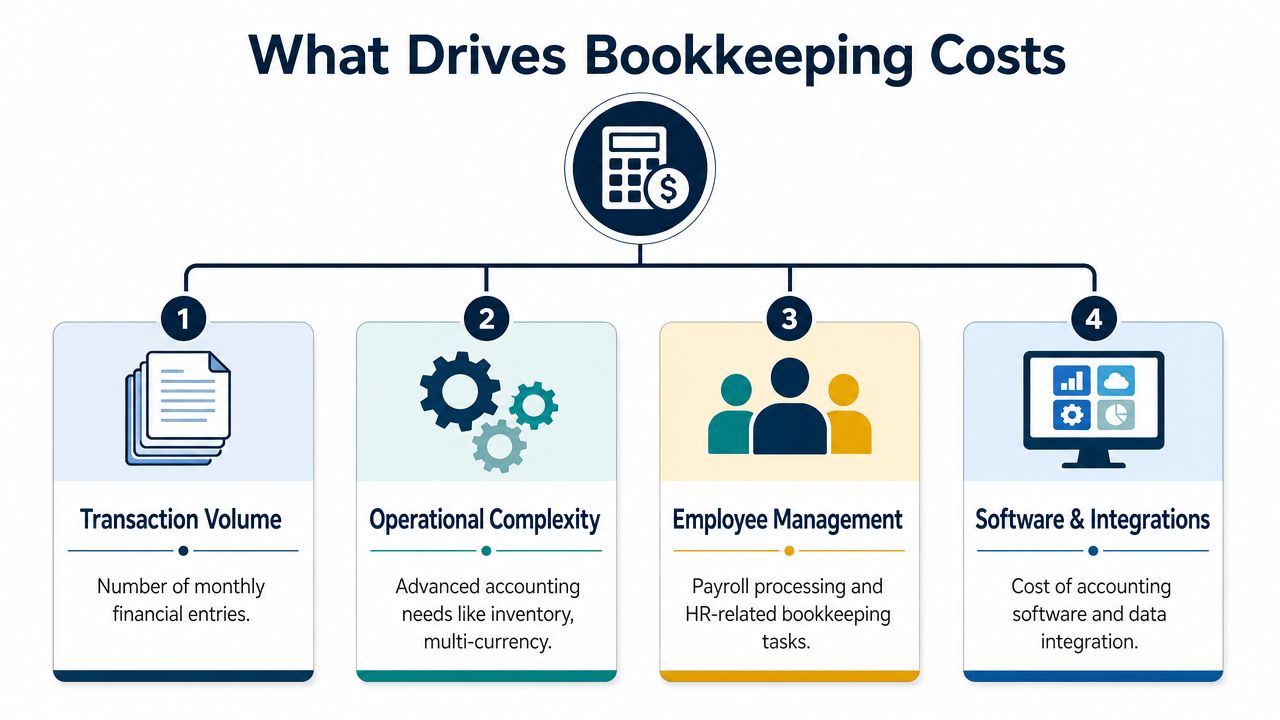
Transaction volume changes the workload first
The more transactions you have, the more sorting and matching someone has to do.
Neutral market benchmarks place basic outsourced bookkeeping around $200 to $400 per month, but extra bank or credit card feeds, class or location tracking, and month-end adjustments all add reconciliation time. The same benchmark notes that payroll often adds $100 to $300 monthly, as explained in this overview of the factors that affect bookkeeping costs.
A coffee shop, a digital agency, and a consulting firm might all bring in similar revenue. But if one has far more transactions, tips, card deposits, and payment processors, the books take more work. Revenue alone doesn't tell the story.
Complexity matters more than many owners expect
Two businesses can have the same number of transactions and still need very different levels of bookkeeping.
A simple setup might involve one checking account, one card, and basic monthly categorizing. A more complex setup can include:
- Multiple accounts: Several bank and credit card feeds mean more reconciliations and more chances for errors.
- Class or location tracking: If you want to see profit by department, office, service line, or project, someone has to code transactions with that in mind.
- Adjustments at month-end: Prepaids, loans, reimbursements, and balance sheet cleanup all push work beyond simple entry.
If you're fuzzy on where bookkeeping ends and broader financial support begins, this guide on what a bookkeeper does for a small business lays out the day-to-day responsibilities in plain English.
Payroll and add-ons are the piano in the moving truck
Payroll sounds like one extra line item. It usually isn't.
Once payroll enters the picture, you've got wage entries, tax liabilities, timing issues, reimbursements, and account mapping. Add accounts payable, accounts receivable, inventory, or multi-entity reporting, and the work moves into a different lane.
Cheap bookkeeping quotes often assume a very narrow scope. The minute you ask for payroll support, better reports, or help untangling a balance sheet, the real price shows up.
Software and reporting shape the final bill
Owners sometimes think software should make bookkeeping nearly free. Software helps a lot, but it doesn't replace judgment.
Bank feeds can import data. They can't reliably explain why a transaction hit the wrong account, why a loan balance doesn't tie out, or why gross profit looks off this month. If you need management-ready reports, cash flow visibility, or someone to spot problems before tax time, that's more than simple software oversight.
That's why the true driver of small business bookkeeping cost isn't the label on the service. It's the amount of thinking and cleanup your books require every month.
Comparing Common Pricing Models
Once you know what drives the work, the next question is how you'll be billed for it, as the pricing model shapes your risk.
One model creates surprise invoices. Another gives predictable monthly cost. Another puts the work on payroll inside your company.

Hourly billing works best for narrow jobs
Hourly pricing can make sense when the work is limited or irregular. Maybe you need catch-up help, a short-term cleanup, or someone to reconcile a problem month.
The upside is flexibility. You pay for actual time spent.
The downside is uncertainty. If your books are messier than expected, your bill grows with every hour. That's hard for owners who need stable monthly overhead.
A related lesson shows up in other back-office services too. If you've ever compared outsourced billing support, this article on choosing your billing partner is useful because it shows how pricing can look simple up front while scope and exceptions change the actual cost later.
Flat monthly fees are popular for a reason
A flat monthly retainer is easier to budget. You know what's due, and you can plan around it.
Recent market guidance points to a shift toward subscription-style bookkeeping because owners prefer predictability and because many providers now package recurring work that way, as discussed in this small business bookkeeping cost breakdown.
That said, flat fee doesn't always mean all-inclusive. Some packages cover reconciliations and standard monthly reports but leave out cleanup, payroll support, catch-up months, or controller-level review. Many owners get tripped up by this. They compare one flat fee to another without checking scope.
In-house hiring is the most expensive option for many small firms
Hiring someone internally can make sense when bookkeeping is a daily operational need. If invoices, collections, payroll, and vendor management are constantly moving, an in-house person can become part of the rhythm of the business.
But owners often underestimate the cost.
QuickBooks' 2026 guidance says the average U.S. bookkeeper salary is $57,537, cites a Bureau of Labor Statistics median pay of $49,210 per year in 2024, and estimates about $3,516 per month for a hired bookkeeper before software and overhead. The same guide notes outsourced virtual bookkeeping services commonly fall in the $300 to $1,500 per month range, based on QuickBooks bookkeeping cost guidance.
Here's a simple side-by-side view:
| Model | Good fit | Main benefit | Main risk |
|---|---|---|---|
| Hourly | Cleanup, one-off help, limited scope | Flexible | Surprise bills |
| Flat monthly | Ongoing bookkeeping | Predictable budgeting | Scope exclusions |
| In-house employee | High daily workload | Internal access and control | Highest total cost |
Which model usually works best
For most small and midsize businesses, a flat monthly structure is the easiest to manage. It gives cost predictability and usually fits normal recurring bookkeeping better than hourly billing.
For very small businesses with low activity, hourly can still work if the scope is tightly defined.
For growing companies with constant internal needs, in-house may eventually make sense. But that's usually later than owners think.
The best pricing model is the one that matches how often your business creates bookkeeping work, not the one with the lowest starting number.
Ballpark Bookkeeping Costs for Businesses in 2026
You don't need a perfect number on day one. You need a reasonable budget range that helps you judge whether a quote makes sense.
For 2026 planning, the cleanest benchmark is still the broad market range already discussed. One cited 2025 guide places small business bookkeeping at $300 to $2,000 per month, with basic plans around $300 to $500, standard plans at $600 to $1,000, and advanced packages at $1,000 to $2,000+. It also notes that an in-house bookkeeper can cost over $40,000 to $65,000 annually when salary and benefits are included, according to this bookkeeping services pricing reference.
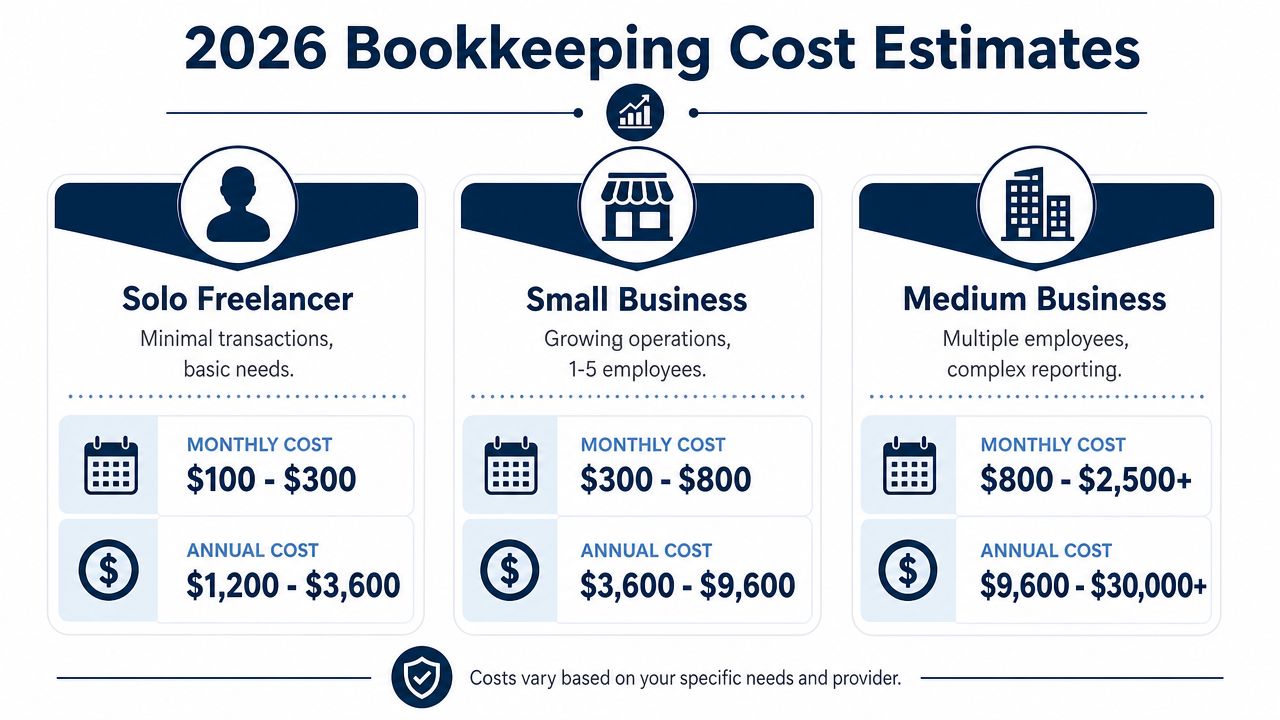
Solo owner or freelancer
If you run a simple service business, your books may stay near the lower end of the market.
That usually means a straightforward setup. Fewer accounts. Limited monthly transactions. No payroll. Basic monthly reporting.
This type of business often fits comfortably into a basic plan. But if your books are mixed with personal transactions, or you've fallen behind, the low monthly number may not reflect the total first-year cost.
Small business with a team
Here, pricing often moves into the middle range.
A business with employees usually needs more than transaction coding. Payroll activity, owner draws, reimbursements, customer invoices, vendor bills, and cleaner month-end processes all increase the work. Professional service firms, local practices, and trades businesses often land here.
For Philly-area owners, this stage matters because it's where “good enough” bookkeeping often stops being good enough. Once you're managing hiring decisions, lease costs, and tighter cash flow, you need books you can trust before the month is long gone.
Growing company with more moving parts
A more advanced package usually applies when the business needs detailed reporting or has added operational complexity.
Examples include multiple entities, inventory, class tracking, project or job visibility, larger payroll needs, or regular management reporting. This is common for construction firms, healthcare groups, and multi-location operations.
A provider may still call this bookkeeping, but in practice it often includes heavier review and decision support. That's why the range climbs.
A simple way to budget locally
For Greater Philadelphia and West Chester businesses, use the market bands as your starting point, then adjust for your real workload:
- Basic range: Good for simple monthly books and limited complexity
- Standard range: Fits businesses with team members, more accounts, and regular reporting needs
- Advanced range: Applies when reporting, structure, or workflow are more involved
Local competition may give you several quote options. That's helpful, but don't mistake a crowded market for apples-to-apples pricing. In this area especially, firms vary a lot in how much review, communication, and advisory support they include.
The right benchmark isn't “What does bookkeeping cost?” It's “What does bookkeeping cost for a business shaped like mine?”
The Hidden Cost of Cheap Bookkeeping
Cheap bookkeeping can feel like a win for about three months.
The monthly fee is low. The dashboard looks clean enough. Nobody is asking too many questions. Then tax season shows up, or cash gets tight, or a lender wants numbers, and the cracks finally show.
That's when the cheap option gets expensive.
Low monthly fees often leave work undone
A lot of low-cost offers are built around the easiest version of your books. They assume clean bank feeds, clean categorization, no backlog, no strange transactions, and no real need for insight.
Real businesses rarely stay that neat.
NerdWallet notes that cleanup work is often billed separately, and some providers charge $1,000+ for prior-bookkeeping or onboarding cleanup in its guide to bookkeeping pricing and cleanup costs. That matters because many owners compare only the monthly fee and miss the setup or correction cost sitting behind it.
Bookkeeping debt is real
I think of bad bookkeeping as a kind of debt. You may not get the bill right away, but it keeps building.
Maybe transactions are miscoded for months. Maybe bank accounts aren't properly reconciled. Maybe payroll entries never hit the books correctly. Maybe nobody notices that a balance sheet account has been wrong for half the year.
Eventually someone has to stop, unwind the mess, and fix it. That bill often lands at the worst possible time.
Bad books don't just create cleanup fees. They create bad decisions. Owners hire too soon, cut the wrong expense, or think cash is stronger than it is.
The first-year cost is what matters
If one provider charges a lower monthly amount but leaves you with a separate onboarding project, recurring corrections, and extra tax-time cleanup, that wasn't the cheaper option. It was just the cheaper ad.
Look at the full picture:
- Monthly service fee: What are you paying every month?
- Onboarding or cleanup: Is catch-up work included, or billed separately?
- Corrections later: If the books need rework, who pays for that time?
- Decision quality: Are you getting numbers you can effectively use?
A growing Philly business feels this fast. If you're trying to decide when to hire, whether to raise prices, or how much cash is really free, weak bookkeeping has a cost even when no invoice says so.
The cheapest monthly quote can absolutely be the most expensive choice.
How to Reduce Costs and Evaluate Providers
A Philly owner gets a bookkeeping quote for a low monthly fee, signs fast, and feels good for about two months. Then the provider starts asking for missing statements, charging extra for old transactions, and closing the books three weeks late. The monthly fee did not change. The actual cost did.
Lower the work before you negotiate the price
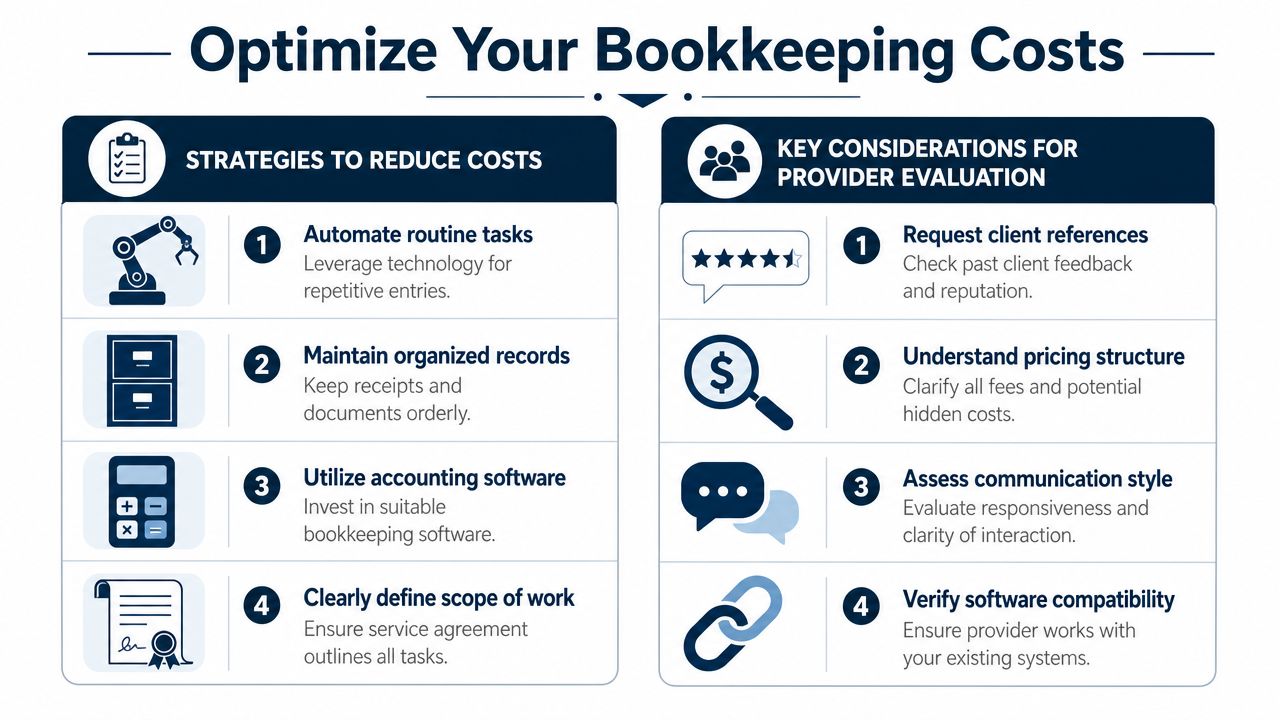
Owners usually save more by reducing mess than by pushing for a discount. Clean inputs lead to fewer hours, fewer questions, and fewer month-end surprises.
A few habits make a real difference:
- Keep business and personal spending separate: Mixed accounts create coding problems and review time you still end up paying for.
- Use one accounting system consistently: Side spreadsheets and duplicate tools force someone to reconcile two versions of the truth.
- Send documents on time: Late bank statements, loan statements, and payroll reports slow the close and create avoidable back-and-forth.
- Automate the repetitive parts: If payables are growing, automation can cut data entry and reduce approval bottlenecks. For that side of the workflow, DigiParser's AP automation insights are useful for seeing where software can save admin time without creating more oversight problems.
Small process fixes often beat fee negotiations.
Ask better questions before you sign
Flat monthly pricing can work well, but only if the scope is clear. Many problems start when an owner assumes payroll support, catch-up work, vendor bill entry, or custom reporting are included and the provider does not.
Ask direct questions:
| Question | Why it matters |
|---|---|
| What exactly is included each month? | You need to know whether reconciliations, reports, payroll coordination, and review are part of the fee. |
| What gets billed separately? | Cleanup, historical catch-up, 1099 prep, and special projects can change the annual cost fast. |
| At what point does the price increase? | Many firms raise fees once transaction count, accounts, entities, or service needs cross a threshold. |
| How quickly do you close the books? | If reports arrive too late, you cannot use them to make hiring, purchasing, or cash decisions. |
| Who does the work and who reviews it? | A lower rate with no review layer can cost more later if errors sit for months. |
If you want a clearer picture of what outsourced support can include, this guide to outsourced bookkeeping for small business is a useful starting point. For another view on fixed-fee bookkeeping and how scope limits tend to work, indinero's bookkeeping pricing overview shows how providers often separate baseline monthly work from add-on services.
Know what good fit looks like
Price matters. Fit matters more.
A solo consultant with one bank account does not need the same setup as a Philly contractor juggling job costs, payroll, subcontractors, and retainage. A creative agency that invoices in stages has different pressure points than a medical practice dealing with payroll complexity and steady monthly overhead. The right provider understands the patterns in your books before they become problems.
One option in that middle-to-growth range is MyOfficeOps, which provides bookkeeping, payroll integration, financial analytics, and advisory support for small and midsize businesses.
The most important factor is fit. Ask whether the provider has experience with your industry, your software, and your pace of growth. Ask how they handle a messy month, not just a clean one.
A good provider keeps the books current and gives you numbers you can trust before you make the next hire, sign the next lease, or squeeze cash flow too tightly.
Your Books Are an Investment Not an Expense
When owners talk about bookkeeping, they often start with price. That's normal. Cash matters.
But the better question is value.
Clean books help you see if you can afford a hire. They help you catch margin problems early. They help you stop guessing about cash flow. They make tax season easier because you're not rebuilding the year under pressure.
That's why I tell owners to think about bookkeeping the same way they think about payment systems, payroll, or insurance. You don't want mystery fees, vague scope, or preventable surprises. The same mindset behind avoiding hidden fees in business payments applies here too. The lowest headline number isn't always the clearest or the safest choice.
Good bookkeeping gives you clarity. Clarity helps you make better decisions. Better decisions usually cost less than cleaning up avoidable mistakes later.
If you want a clearer handle on your own bookkeeping cost, MyOfficeOps can help you look at the full picture, not just the monthly fee. A good next step is a simple conversation about your transaction volume, payroll, reporting needs, and whether any cleanup is already hiding in the background.