
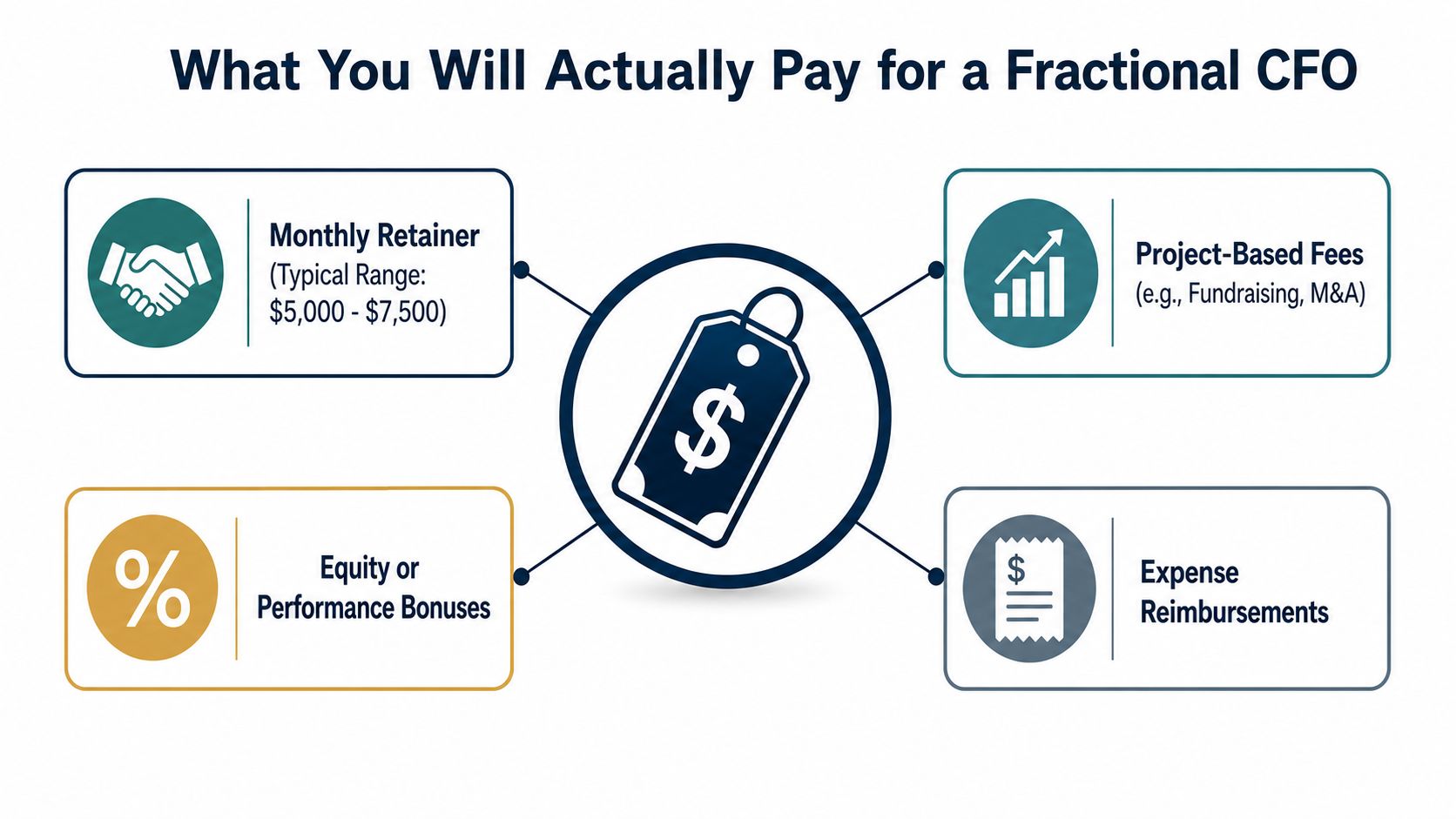
Most fractional CFOs charge between $175 and $450 per hour, with most small and midsize businesses paying a monthly retainer between $5,000 and $7,500. That range usually buys ongoing senior financial guidance, not bookkeeping, and the question is how many hours and deliverables sit behind the quote.
You may be looking at a proposal after a difficult month. Revenue is growing, but cash still feels tight. Your accounting team can tell you what happened, yet nobody can clearly explain what happens next. The proposal lands, and the monthly fee feels large enough to question but small enough to wonder whether you're getting real CFO support.
The price becomes easier to judge once you translate it back into senior financial time. A light engagement may involve a limited number of hours for cash planning and reporting review. A heavier one may include forecasting, board materials, lender work, pricing decisions, and management meetings. This guide connects the bill to the work, so you can size the engagement instead of guessing.
What You Will Pay for a Fractional CFO
An owner of a $4 million-revenue manufacturer opens a fractional CFO proposal. The quote is $5,000 to $7,500 per month. Three questions follow immediately: Is the fee fair, inflated, or too low to deliver meaningful support?
Published market ranges put fractional CFO hourly pricing at $175 to $450. For small and midsize businesses, the common monthly retainer falls between $5,000 and $7,500, according to the Eagle Rock CFO's 2026 industry report. Broader monthly pricing runs from about $3,000 to $15,000 or more, based on scope, seniority, and business complexity, as outlined in OpsFi's fractional CFO cost guide.
Those ranges are useful only after you connect them to the work. A recurring advisory engagement, a financial model, a fundraising package, and a transaction review can each demand a different number of senior CFO hours. Compare the deliverable, deadline, review process, and expected involvement before comparing the fee.
Start with hours, not the sticker price
Ask the provider to show the expected monthly hours. A $6,000 retainer has a different value at 15 hours than at 30 hours. Confirm whether the fee includes meetings, preparation, email access, report production, and work assigned to other team members.
Use this four-part review:
- List the outcomes. Identify the decisions the CFO must improve, such as cash planning, lender reporting, margin review, or fundraising preparation.
- Separate recurring work. Distinguish monthly reporting and forecast updates from one-time projects.
- Estimate the workload. Match each deliverable to the time needed for preparation, analysis, meetings, and follow-up.
- Set the boundaries. Confirm the process and additional cost when a transaction, financing process, or cash crisis requires more hours.
The common $5,000 to $7,500 monthly band usually buys a defined engagement, not unlimited access. A broader scope can reach $15,000 or more per year above the common annualized band, based on the ranges summarized by Eagle Rock CFO. Choose the smallest engagement that solves the business problem and leaves enough senior time to finish the work properly.
What a Fractional CFO Really Does
A fractional CFO turns financial records into operating decisions. A bookkeeper keeps transactions organized and records accurate. The CFO uses that information to decide whether you can hire, raise prices, borrow, invest, or slow spending.
The role is closer to a retained attorney than a traditional accounting clerk. You bring in the CFO for judgment calls, lender negotiations, board preparation, fundraising strategy, pricing reviews, cash planning, and scenario analysis. They may not work from your office every day, but they should understand the business well enough to challenge assumptions and explain the financial consequences of a decision.
That judgment is the product you are paying for. A full-time executive carries a much larger commitment. One market source places an all-in full-time Series B CFO cost at $350,000 to $500,000 or more, while a fractional arrangement gives a growing business access to senior help without taking on that full payroll commitment.
The work should show up in visible outputs
A useful engagement leaves behind materials your team can use. Typical outputs include:
- Management dashboards: A clear view of revenue, cash, margin, working capital, and other operating measures.
- Rolling forecasts: A forward-looking view for planning hiring, spending, debt payments, and investment.
- Board materials: Reports and explanations that keep directors focused on decisions rather than financial confusion.
- Fundraising support: Financial models, investor questions, use-of-funds planning, and preparation for diligence.
- Pricing reviews: Analysis of customer, service, or product profitability before you change prices.
- Lender support: Cash projections, covenant information, and a consistent financial story for the bank.
These outputs also reveal how much senior time the engagement requires. A dashboard may take little time to read but substantial time to assemble, reconcile, interpret, and discuss. Ask how the CFO will turn the analysis into decisions, and whether meetings, preparation, follow-up, and revisions are included.
A strong monthly report should help answer, “Can we afford this hire?” and “Which service line is making money?” If the engagement only repeats what your accounting system already shows, you may be buying controller support rather than CFO leadership.
For a practical example of reporting a finance leader might review, see this CFO report example from MyOfficeOps. The format matters less than whether the report produces a better decision.
The Three Pricing Models Explained
Fractional CFO fees usually follow three structures: hourly billing, monthly retainers, and project pricing. Choose based on the work in front of you. A narrow assignment calls for hourly billing, recurring leadership needs fit a retainer, and a defined deliverable supports project pricing.
Hourly work fits a defined problem
Hourly rates commonly range from $175 to $450 (Eagle Rock CFO's 2026 market report). Use this structure for a focused assignment, such as reviewing a lender presentation, building a fundraising model, or supporting a quality-of-earnings process.
You pay for the time used and can end the engagement when the assignment is complete. The tradeoff is an uncertain final bill. Scope changes, extra meetings, or repeated revisions add hours quickly, so set an estimate and approval point before work starts.
Retainers buy continuity
A monthly retainer suits owners who need ongoing financial leadership. Market summaries commonly place monthly pricing around $5,000 to $10,000, with broader observed ranges of $3,000 to $15,000 or more (OpsFi's cost guide). Another pricing guide places many engagements between $5,000 and $10,000 per month (The CFO Index's 2026 pricing guide).
The fee buys reserved senior time, not a vague promise of availability. Confirm how many hours are included, whether meetings and preparation count, whether unused hours expire, and how additional work gets approved. A retainer is a poor deal when the contract leaves those points unclear.
Projects work when the finish line is clear
Project pricing sets a fixed fee for a defined result. It works when you know the outcome you need but do not require a continuing monthly relationship. The written scope should identify the files, meetings, revisions, assumptions, and delivery date.
The fee must still reflect the hours required. A straightforward cash plan belongs in a different budget from a package involving extensive analysis, management interviews, and transaction support. Ask the provider to explain the expected hours behind the fixed fee.
| Pricing Model | Typical Price Range | Best For | Hours Included |
|---|---|---|---|
| Hourly | $175 to $450 per hour (Eagle Rock CFO) | Narrow, one-time needs | Billed as used |
| Monthly retainer | $5,000 to $10,000 commonly (The CFO Index) | Ongoing financial leadership | Defined in the agreement |
| Project-based | Scope-dependent | A model, forecast, financing package, or diligence deliverable | Set by the project plan |
Compare proposals by dividing the fee by the expected CFO hours. That calculation exposes whether two offers provide similar access and workload, rather than merely similar labels.
What Drives the Final Price
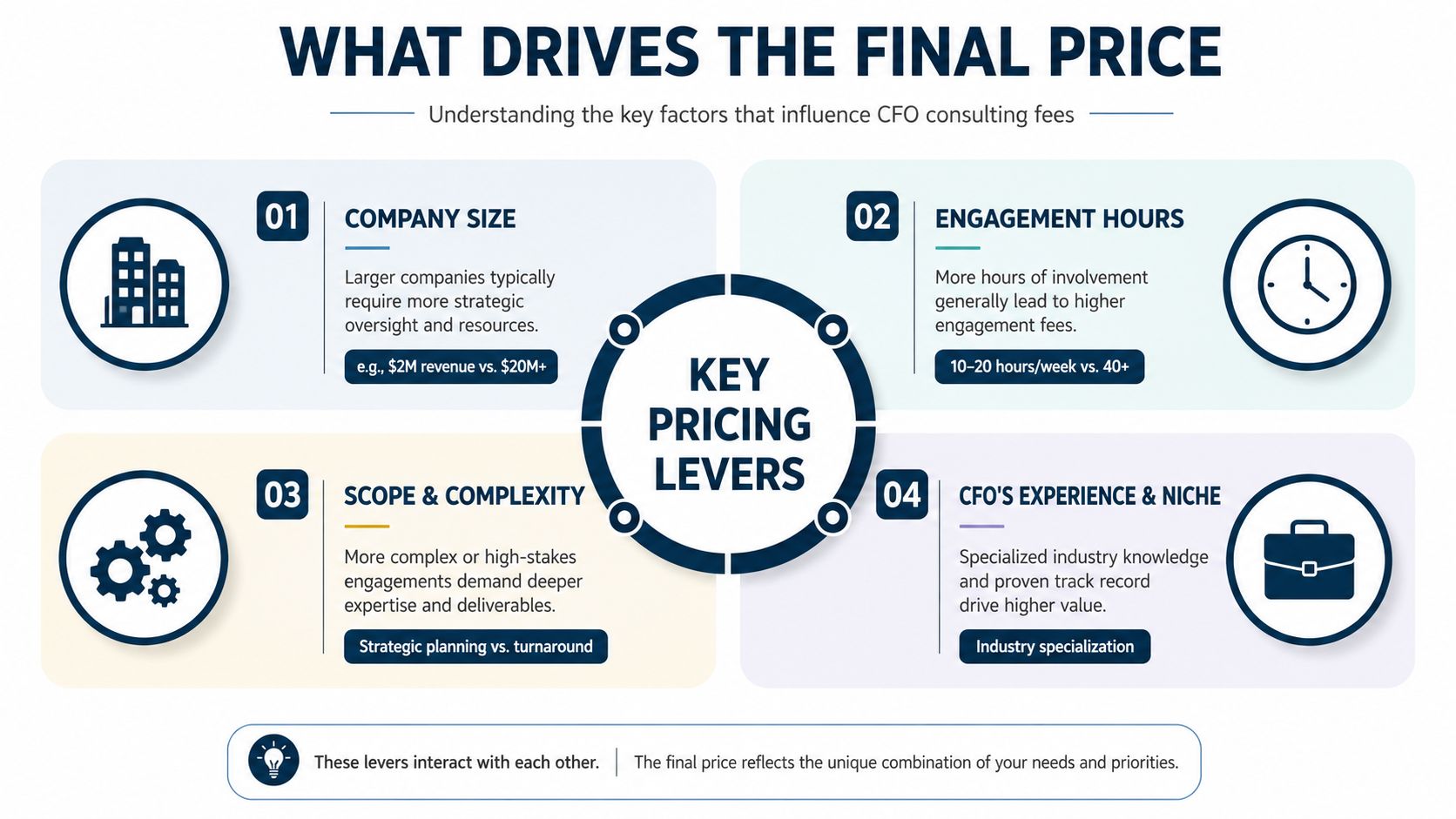
The invoice follows the work, not the title on the contract. Four variables shape it most: company size, complexity, industry, and deliverables. A provider who asks only for revenue before quoting you has not assessed the engagement properly.
Company size changes the amount of attention
A smaller company with one legal entity and straightforward reporting may need limited review. A larger business may need management reporting, department-level analysis, cash planning, and recurring leadership meetings. Revenue does not set the fee alone. It signals how many decisions, people, and financial systems the CFO will support.
Complexity creates hidden hours
Multiple revenue streams, inventory, several legal entities, unusual debt terms, and a growing payroll all add work. Manufacturing may require cost accounting and margin analysis. A software business may need careful recurring-revenue treatment. Healthcare operators may need finance processes suited to a regulated setting.
The CFO charges for the time required to understand those moving parts and produce reliable guidance. Complex books, weak reporting, or scattered data can consume hours before the first recommendation is ready.
Industry knowledge can shorten the learning curve
Specialized knowledge matters when your business depends on industry-specific reporting or operating measures. A CFO familiar with manufacturing can ask sharper questions about production costs and inventory. A SaaS finance leader may know which operating metrics belong in a board package. A healthcare finance leader may recognize issues a generalist would need time to learn.
That expertise can support a higher rate when it reduces setup time or improves the advice you receive. Do not pay for transaction experience or industry credentials your current situation does not require.
Deliverables determine the workload
A monthly bookkeeping review is a smaller assignment than building a three-statement model, preparing a board package, and running scenario planning. Every additional output requires preparation, review, communication, and revisions.
One pricing breakdown reports 15 to 40 hours per month across common engagements, with typical monthly spending from $4,000 to $20,000 (Graphite Financial's fractional CFO rate breakdown). Another guide maps simple packages of 10 to 20 hours to $3,000 to $6,000, standard packages of 20 to 40 hours to $6,000 to $12,000, and premium packages of 40 to 60 hours to $10,000 to $20,000 (The Expert CFO's rate guide).
At the same $200-per-hour rate, a light month and a heavy month can produce very different invoices. Compare each proposal by expected CFO hours and requested outputs. That calculation shows whether the price matches the help your business needs.
Three Real Pricing Scenarios for SMBs
The fastest way to understand the range is to place three businesses beside each other. These are practical planning examples, not promises of what every provider will quote.
The focused service business
A service company with $1.8 million in revenue and 12 employees needs help with cash flow forecasting, monthly close review, and lender check-ins. The owner isn't asking the CFO to run the entire finance function. The need is about 10 hours per month, which supports a retainer of roughly $2,500 monthly.
That engagement is light because the deliverables are narrow. It may be a good fit for a company with clean books, one operating entity, and no active financing or transaction process. It isn't enough for a business that expects weekly decision support or a full board package.
The growth-stage SaaS company
A software company with $6 million in annual recurring revenue and 35 employees is preparing for a Series A. The CFO needs to build financial models, prepare board materials, and establish KPI reporting. At about 25 hours per month, the expected fee lands around $6,000 to $7,000 monthly.
The owner is paying for more than report review. The CFO must turn operating data into an investor-ready story, test assumptions, and help leadership understand how hiring and growth spending affect cash.
The product company with financing pressure
A product company with $22 million in revenue carries inventory, runs multi-state payroll, and faces an upcoming debt refinance. It needs about 40 hours per month for FP&A ownership, lender relations, and scenario planning. A monthly cost between $9,000 and $11,000 is reasonable for that heavier scope.
| Scenario | Revenue | Hours/Month | Key Deliverables | Monthly Cost |
|---|---|---|---|---|
| Focused service business | $1.8 million | 10 | Cash forecast, close review, lender check-ins | About $2,500 |
| Growth-stage SaaS | $6 million ARR | 25 | Modeling, board materials, KPI reporting | $6,000 to $7,000 |
| Product company with refinancing | $22 million | 40 | FP&A, lender relations, scenario planning | $9,000 to $11,000 |
Your business may sit between these examples. That's normal. Start with the work, then choose the pricing structure.
Fractional CFO Cost Compared to the Alternatives
The right comparison is not the monthly invoice alone. Put a fractional CFO beside a full-time hire and the cost of operating without senior financial judgment. Match each option to the hours of real work your business needs, because a low bill can still produce an expensive result.
A full-time CFO can cost $350,000 to $500,000 or more all in for a Series B company, according to OpsFi's CFO cost analysis. Fractional support provides senior guidance without committing to a full executive payroll. Market summaries also place fractional CFO pricing about 40% to 60% below a comparable full-time CFO hire, as reported in Eagle Rock CFO's industry report.
A retainer of $6,000 per month equals $72,000 annually, before extra project work. That may suit a company needing recurring forecasting, cash review, and management guidance, but not a full-time executive presence. The annual figure also gives owners a clearer planning baseline.
Doing nothing has no advisory invoice. It still creates costs when an owner sets prices without margin visibility, misses cash pressure, delays tax planning, or gives weak financial information to a lender. These losses show up as poor timing and missed options, not as a clean line item.
| Option | Annual Cost | Coverage | Hidden Costs | Best For |
|---|---|---|---|---|
| Fractional CFO | About $60,000 to $90,000 for a steady common-band engagement | Part-time senior finance leadership | Extra work outside scope | SMBs needing recurring judgment |
| Full-time CFO | $350,000 to $500,000 or more all in in the cited Series B example | Full-time executive coverage | Payroll commitment and executive overhead | Businesses needing daily leadership |
| No CFO support | No direct advisory fee | Existing accounting and owner judgment | Poor visibility, delayed decisions, financing friction | Stable businesses with limited complexity |
Before treating bookkeeping as the full answer, review the broader small business accounting cost discussion. Clean records support every option, but they do not replace decisions about cash, pricing, financing, or growth. Choose the least expensive level of senior help that provides the work your business cannot handle confidently in-house.
How to Decide If the Cost Is Worth It
Treat the decision as an investment test, not a personality test. You don't need to feel ready for a CFO. You need a problem that senior financial judgment can improve.
Ask yourself three questions:
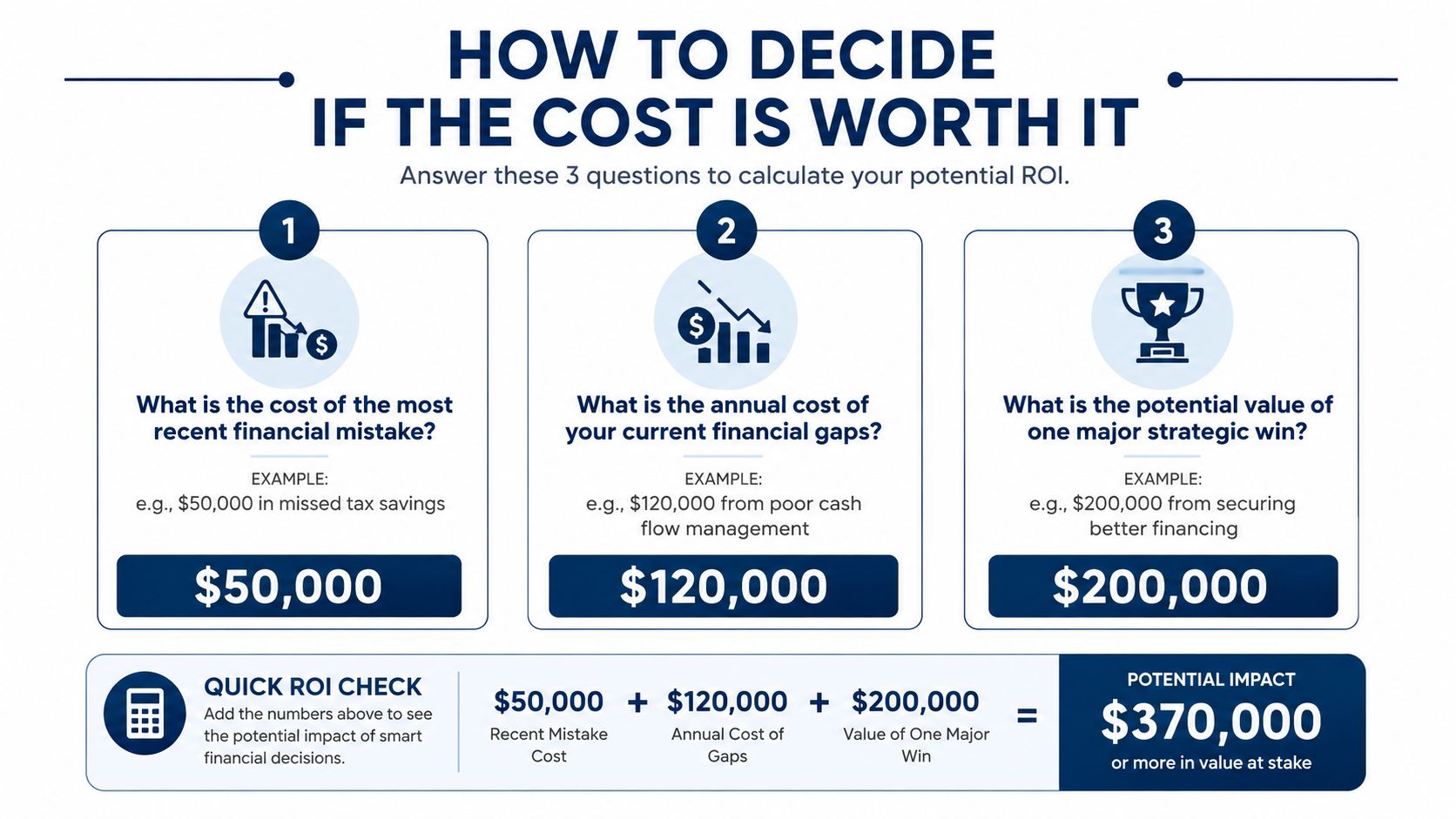
- What did the last bad financial decision cost? Look at a missed margin issue, a poor hiring decision, an avoidable financing problem, or a cash surprise. Use the actual business consequence, not a vague feeling.
- What outcome must change? Choose one primary target, such as cash runway, profit margin, lender confidence, forecasting discipline, or exit readiness.
- How many hours of judgment does that outcome require? A narrow cash review needs a different engagement than recurring management reporting and scenario planning.
Use a simple decision test
A fractional CFO is usually worth serious consideration when one avoided mistake or one captured opportunity could cover several months of the engagement. The relevant comparison isn't revenue alone. It's the value of the decision the CFO will help you make.
Skip the engagement if the business is pre-revenue, pre-payroll, or stable enough that the owner can make financial decisions confidently from current reports. Hold if the problem is real but the scope is unclear. Start with a tightly defined project or smaller advisory package rather than buying a broad retainer.
For owners between $1 million and $25 million in revenue, my practical verdict is simple:
- Thumbs up: You have recurring cash uncertainty, important financing or growth decisions, and no internal person who can lead the analysis.
- Hold: You have a need, but the proposed deliverables and hours aren't clear.
- Skip: Your books are reliable, operations are stable, and no major decision needs CFO-level support now.
Use this guide on when to hire a CFO to pressure-test the timing before signing.
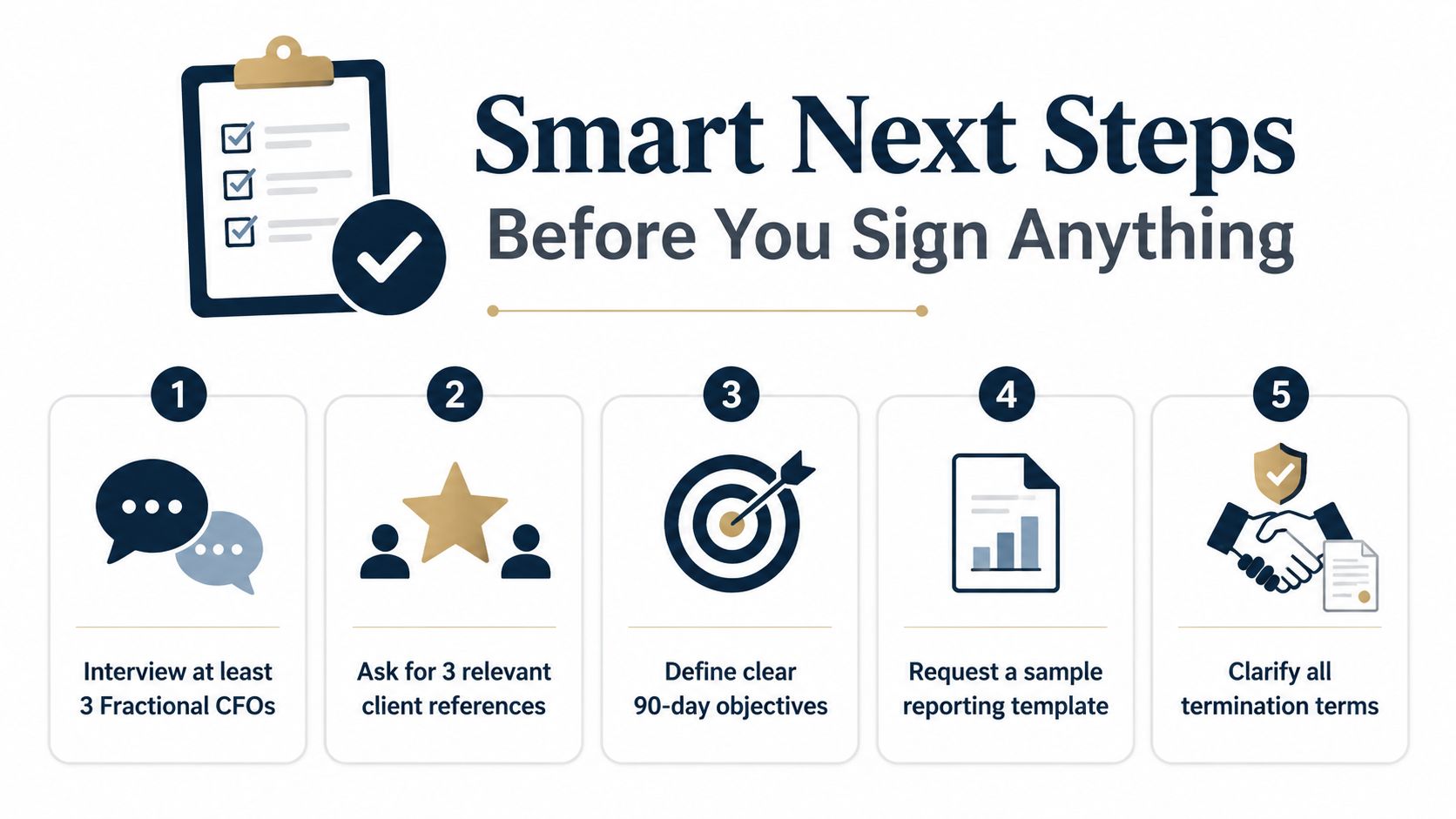
Smart Next Steps Before You Sign Anything
Interview at least three fractional CFOs, and ask each person the same questions in the same order. You're not searching for the most polished sales call. You're comparing scope, accountability, and access to the actual senior person doing the work.
Ask:
- What exactly is included in the monthly scope?
- What reports, forecasts, meetings, and decisions will you support?
- What term length are you proposing, and how does the engagement end?
- What is the exit clause if the fit isn't right?
- Who performs the senior work, and what will a junior analyst or accounting team handle?
Have your records ready before the calls. Bring the last 12 months of profit and loss statements, your current cash position, outstanding debt terms, a cap table if one exists, and the two or three financial decisions already waiting on your desk. A CFO can quote more intelligently when the conversation starts with real work instead of a general description of your business.
Negotiate the structure, not just the rate
A lower hourly rate may not improve the deal if the provider removes the work you need. Ask whether a retainer gives you better access, whether the agreement has a clear scope cap, and how urgent requests are billed. Put an off-ramp in writing so you can leave without a dispute if the relationship fails.
The practical price map is clear. Hourly work commonly falls between $175 and $450, common SMB retainers sit around $5,000 to $7,500, and broader monthly engagements can reach $15,000 or more when the company and workload demand it. Choose the provider who can explain the hours, deliverables, and decision value behind the quote.
MyOfficeOps offers bookkeeping, accounting, payroll integration, financial analytics, and CFO-level advisory for small and midsize businesses, with predictable monthly engagement options. Visit MyOfficeOps to discuss the financial work your company needs and get a practical plan before you commit to a fractional CFO.