
An owner is delivering client work, seeing patients, or managing a job site, then opening the books after dinner to reconcile transactions and chase missing receipts. The work rarely feels finished. Reports arrive late, cash looks different from the profit on paper, and important decisions get made with partial information.
That's why the strongest outsourced accounting benefits go beyond saving bookkeeping time. A capable partner can improve decision quality, strengthen controls, support steadier cash flow, and give the owner access to financial guidance without building a full internal department. A widely cited survey of 529 U.S. small-business owners and managers found that about 37% were already outsourcing part of their operations, while roughly 14% were outsourcing accounting specifically, according to this overview of outsourced accounting benefits.
The right value depends on the business. A professional services firm may need better project margins, a healthcare practice may need cleaner collections and payroll, and a construction company may need job-level cash visibility. MyOfficeOps, a Philadelphia-area partner, supports those needs through Core Accounting, Profit Optimization, and Exit Strategy services. The eight benefits below rank outsourcing by the business problems it solves, not by a generic list of features.
1. You Get Your Time Back to Run Your Business
The first problem outsourcing solves is owner overload. Bookkeeping includes more than entering transactions. It can involve bank reconciliations, receipt collection, accounts payable, accounts receivable, payroll coordination, and report preparation. Those tasks interrupt the work that produces revenue.
A professional services owner may spend less time correcting billing records and more time reviewing client scope. A healthcare owner can spend more attention on patient care and staffing. A contractor can focus on bids, crews, vendors, and project delivery instead of sorting transactions at the end of the week.
This benefit only appears when the handoff is organized. Before transferring the work, document how invoices are approved, how expenses are coded, who reviews payroll, and where receipts live. A provider can process work faster when it understands the rules behind your current workflow.
For practical guidance on setting up remote support, review these remote bookkeeping services.
Practical rule: Track the time you spend on accounting before the transition, then compare it with your time after the first month. The goal isn't just fewer bookkeeping hours. It's more time spent on decisions that move the business forward.
Make the recovered time useful
Schedule regular check-ins rather than disappearing from the process. A quarterly review can uncover unclear responsibilities, missing documents, or reports that don't help you manage the business.
Use the recovered time deliberately:
- Professional services: Review client scope, pricing, utilization, and staffing.
- Healthcare: Improve scheduling, collections, patient access, or employee coverage.
- Construction: Prepare bids, negotiate materials, and monitor active jobs.
Outsourcing doesn't create value if the owner fills the freed hours with more low-value administration. It works when the business turns that time into sales, service quality, stronger operations, or better leadership.
2. Lower Overall Costs Compared to Hiring In-House
Hiring an accounting employee costs more than the salary on the offer letter. Payroll taxes, benefits, workers' compensation, equipment, software, training, supervision, and absence coverage all affect the total. A small business may also pay for senior skills it needs only during month-end close, tax preparation, budgeting, or a growth project.
Outsourcing replaces that fixed structure with a defined service. The business pays for agreed work and can adjust support as transaction volume or reporting needs change. An economics journal analysis notes that outsourcing can reduce spending on accounting software, infrastructure, hiring, and staff training while giving the business access to specialized expertise for accurate reporting and compliance. The analysis of accounting outsourcing costs and expertise provides that context.
Market estimates published in 2026 placed the global finance and accounting outsourcing market at about $58.4 billion in 2025, with a projection of $78.9 billion by 2029. Another overview estimated about $59.05 billion in 2026, projecting $85.92 billion by 2031. These are market estimates and projections, not proof that outsourcing will cost less for every company. The same summaries report average savings of 30% to 40% compared with equivalent in-house operations, with some small-business scenarios reaching 40% to 60% after overhead and turnover are included. Review the 2026 finance and accounting outsourcing market summary for the underlying figures.
Start with the cost of the work, not the provider's invoice. Build a side-by-side comparison covering:
- Employment costs: Payroll taxes, benefits, insurance, paid time away, and replacement coverage.
- Technology costs: Accounting software, reporting tools, payroll systems, security, and data storage.
- Management costs: Training, supervision, corrections, review time, and backup coverage.
- Capacity costs: Extra support during growth, busy seasons, or an employee's departure.
A 15-person IT consulting firm may need dependable monthly reporting without a full-time senior accountant. A dental practice may need payroll and compliance knowledge beyond a general bookkeeper's scope. A contractor may need added support during busy project periods, then less capacity after jobs close. The right comparison measures the work, expertise, and continuity covered, not only the monthly fee. This guide to the cost of outsourcing accounting can help frame that review.

3. Better Financial Reports You Actually Understand
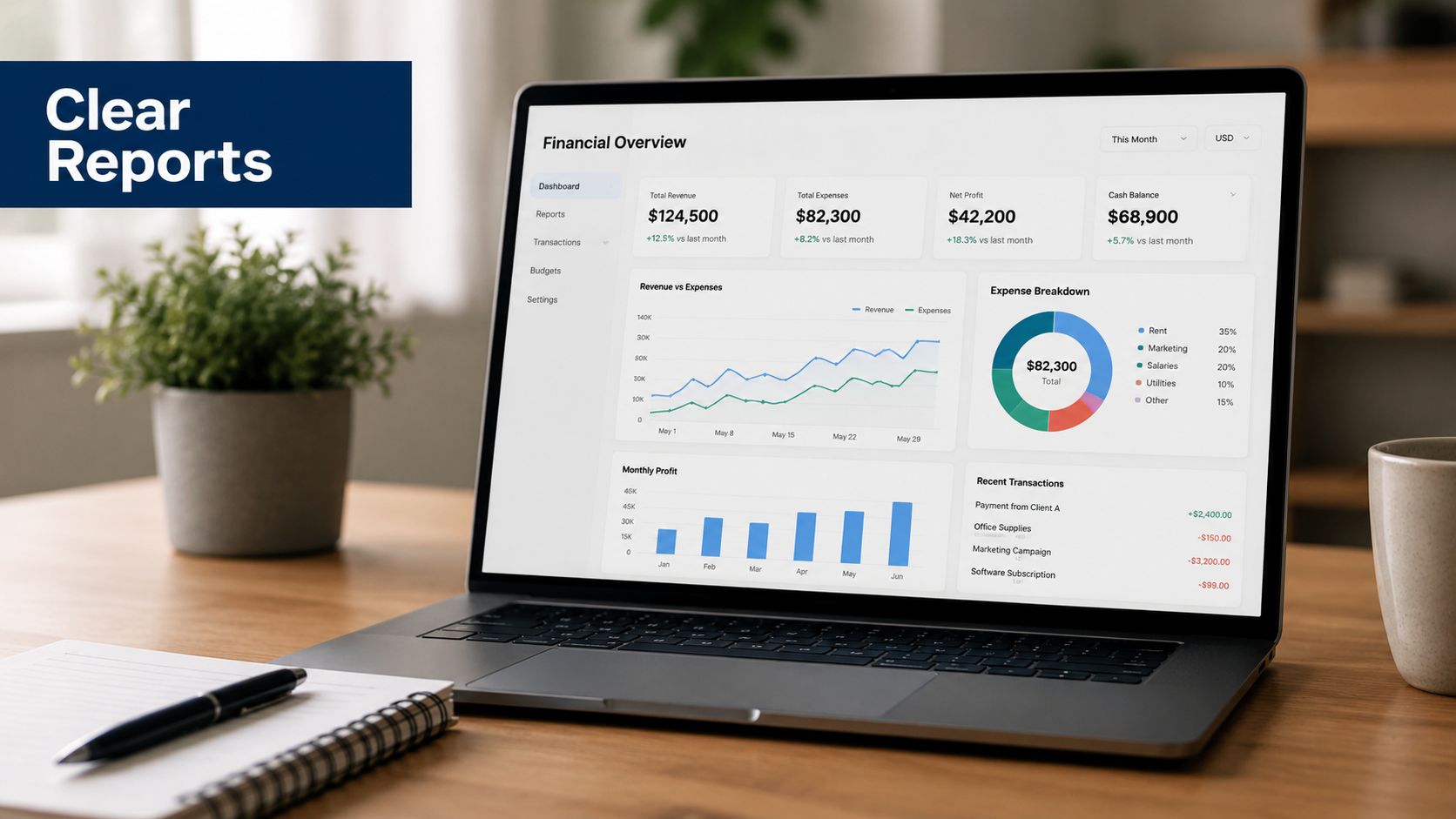
A report earns its place when it changes an owner's next decision. If revenue rises but profit falls, a law firm needs to examine pricing, staffing, or matter costs. If an agency's large client consumes too much unbilled labor, project leaders need to address scope or billing. A healthcare practice may need to investigate slower collections even when appointments remain steady. A construction company needs to see which jobs generate profit and which ones absorb cash.
The service must match the problem. Research published in 2025 on outsourced accounting for small and midsize businesses found that routine and advisory services improved compliance and management benefits. Non-routine services improved management benefits but did not significantly improve compliance benefits. Bookkeeping can produce orderly records, while advisory work helps interpret results and choose an action. The study on outsourced accounting services and SME performance explains that distinction.
Match each report to an operating decision
Ask for answers in business terms:
- Profitability: Which services, jobs, or clients produce acceptable margins?
- Cash position: What can the business safely spend or hire for?
- Receivables: Which customers owe money, and how long have invoices remained unpaid?
- Operating costs: Which expenses are rising faster than revenue?
- Forecasts: What changes if sales, payroll, or project timing shifts?
Keep the dashboard focused. A professional services firm may track revenue by client, billable utilization, and project margin before changing fees or staffing. A healthcare practice may review collections, payroll, and revenue by service before adjusting schedules or follow-up. A construction company may need job profitability, committed costs, and the cash required to finish active work before accepting another project.
Use a short monthly review to turn those figures into a decision. The owner might change a price, delay a purchase, follow up on overdue invoices, or stop an unprofitable service. For help translating statements into plain language, use this guide to read financial reports.
4. Cleaner Books That Pass Audits and Impress Lenders
A lender reviewing a construction company may pause over unreconciled job costs. A healthcare owner seeking financing may struggle to explain payer deposits. A buyer evaluating a professional services firm may ask for support behind ordinary transactions. Disorganized records slow each decision and weaken confidence.
Clean books come from consistent account coding, regular reconciliations, organized documentation, separate personal and business spending, and a documented review of unusual items. The result is a clearer audit trail and financial statements that others can test without repeatedly requesting clarification.
A scholarly accounting study reports that outsourcing may reduce misstatement risk, which can reduce audit effort and shorten audit lag. Fewer errors can mean less time tracing problems and earlier access to usable year-end numbers. The scholarly study on outsourcing and audit effort examines that connection.
Clean records support the next financing or ownership decision
The useful evidence differs by sector. Construction lenders need project costs, equipment needs, receivables, and debt obligations organized around active work. Healthcare practices should be able to explain revenue, payroll, payer activity, and operating expenses. Professional services firms need clear recurring revenue, client concentration, margins, and owner adjustments.
A cleanup should be treated as a defined project when the current books are unreliable. Set a cleanup phase, document the closing process, and agree on the date when reports become dependable. Otherwise, an outsourced team may produce regular reports from opening balances that still contain unresolved problems.
Owners also need visibility into control points. Ask who reviews reconciliations, how corrections are approved, and which questions remain open at month-end. Outsourcing supplies accounting capacity and technical knowledge, but management still reviews the results. That review can catch errors before they affect a loan application, tax filing, audit, or sale process.
For transaction preparation, see Bizbe, Inc.'s guide to sale-ready financials.
5. Real Cash Flow Visibility So You Don't Run Out of Money
Profit and cash are different. A business can show a profit while waiting on customer payments, carrying costly inventory, or paying suppliers before it collects from clients. Owners feel the difference when payroll is due and the checking account is lower than expected.
Outsourced accounting can give the business a regular cash review instead of a backward-looking report. The team can track open invoices, upcoming bills, payroll, taxes, debt payments, and expected project receipts. A forecast then becomes a working decision tool. It can show whether the owner can hire, purchase equipment, accept a large job, or needs to slow spending.
A 2025 CFO survey found that 96% of finance leaders already work with an outsourced finance and accounting partner. The most commonly outsourced activities were FP&A reporting at 62%, budgeting and forecasting at 56%, and cash management at 54%, according to Consero's 2025 CFO survey. These figures point to a shift toward planning and cash decisions, not only transaction processing.
Use the forecast before spending
Professional services firms should connect forecast assumptions to billing dates, retainers, and collection terms. Healthcare practices can use the forecast to plan equipment purchases, payroll changes, and seasonal demand. Construction companies need to compare expected customer receipts with labor, materials, subcontractor, and equipment payments.
Send the accounting team updates about major invoices, delayed customers, planned purchases, and new contracts. A forecast is only as useful as the information behind it.
A cash forecast should answer one practical question: “What can we safely commit to, and when?”
Set a minimum cash reserve target and review it before large spending decisions. The exact target depends on the business, but the discipline is consistent. Owners should know what cash is available, what is already committed, and which expected receipts remain uncertain.
6. Payroll Done Right Without the Headaches
Payroll combines timing, tax rules, employee trust, and compliance. A missed deposit or incorrect withholding can create more than an accounting correction. It can lead to penalties, employee complaints, amended filings, and hours of cleanup.
An outsourced accounting partner may coordinate payroll inputs, deductions, tax deposits, filings, direct deposits, and year-end forms. That doesn't mean the owner can ignore payroll. The business still needs to submit accurate hours, bonuses, new hires, terminations, benefits changes, and jurisdiction information on time.
The risk is especially clear for healthcare practices with many employees and contractors. A construction company may also need payroll processes that account for workers across different states or job locations. A professional services firm may have salaried staff, bonuses, commissions, and contractors that require different treatment.
Keep ownership clear
A reliable process names each responsibility:
- Business manager: Approves hours, compensation changes, and new hires.
- Payroll team: Calculates payroll, prepares filings, and documents deposits.
- Owner: Reviews payroll reports, cash requirements, and unusual changes.
- Employees: Confirm personal and withholding information when requested.
The academic research on outsourced financial services identifies delays in tax payments, including PIT or VAT payments, as important outsourcing risks. Although payroll has its own rules, the process lesson applies broadly. A provider relationship doesn't protect the business if deadlines, documents, and handoffs aren't controlled. Review the study on outsourcing risks and tax-payment delays.
Control that matters: Set a recurring deadline for timesheets and payroll changes, then keep a backup contact for weeks when the normal approver is unavailable.
Ask for an annual compliance checklist. Confirm who handles federal, state, and local filings, how corrections are documented, and how the provider alerts you to missing information. Payroll outsourcing works best when the calendar is visible to everyone involved.
7. Data-Driven Guidance to Actually Increase Profitability
Bookkeeping tells you what happened. Profitability analysis helps explain why it happened and what to change.
A professional services firm may have strong revenue but weak margins on a few large accounts because work expands beyond the original scope. An IT consulting company may discover that experienced staff spend too much time on non-billable administration. A healthcare practice may find that one service line looks busy but doesn't cover its labor, supplies, and overhead.
Research on the outsourced finance and accounting market shows that FP&A, budgeting, forecasting, and cash management are among the most commonly outsourced activities. That matters because owners often need someone to interpret patterns, test assumptions, and turn financial information into an operating decision, not just close the books.
Ask questions that lead to action
Bring these questions to the review:
- Pricing: Are current fees high enough to cover direct and indirect costs?
- Mix: Which services, projects, or customer types create the strongest margins?
- Capacity: Where are skilled employees spending time that doesn't produce revenue?
- Scope: Which clients or jobs regularly require work that isn't billed?
- Investment: Which purchase or hire has a clear financial reason behind it?
The answers should lead to specific changes. A law firm may revise rates for new matters. A clinic may change fees or stop promoting an unprofitable service. A contractor may adjust bid assumptions after reviewing labor overruns.
Don't wait for the accountant to volunteer every insight. Ask directly, “Where are we losing money, and where are we leaving money on the table?” Review pricing and margins regularly, then measure whether the change improved the intended result.
8. Preparation for Selling Your Business or Transitioning Ownership
Exit planning starts before a buyer appears. Inconsistent records, undocumented processes, unclear owner expenses, and customer concentration make a business harder to evaluate and transfer.
An accounting partner can create a reliable operating record over time. The work may include a consistent chart of accounts, documented month-end procedures, job or service-line costing, organized tax support, and reports showing how the business earns money. These records also help an internal successor run the company without depending on the owner's memory.
Before a buyer reviews your numbers, compare accounting features from Rally (https://www.getrally.com/accounting) to confirm that your systems support a clear handoff. The buyer will evaluate whether financial information is consistent, accessible, and supported by repeatable processes.
Sector priorities differ:
- A professional services firm should document recurring revenue, client retention, team capacity, pricing rules, and delivery processes.
- A healthcare practice needs organized collections, staffing, payer, and service-line information.
- A construction company should maintain dependable job costing, backlog reports, committed costs, and contract records.
Prepare the business, not just the statements
A buyer will ask whether results depend entirely on the current owner. Document key client relationships, vendor terms, approval steps, employee responsibilities, and how money moves through the business. Another capable person should be able to understand the operation and make routine decisions.
Exit-focused accounting also supports decisions before a sale. Clear reporting can show which services merit investment, which costs require attention, and which processes create risk. A law firm might identify client relationships that need broader ownership. A clinic may find collection gaps. A contractor can see whether project controls are strong enough for a new owner.
“Sale-ready” means a buyer can follow the numbers and understand the operation without asking the owner to explain every line.
Tell the accounting partner your timeline and goals. A provider with exit support can organize the work in phases, from cleanup to reporting, valuation support, and transaction readiness. Starting early reduces last-minute scrambling and gives the owner a clearer view of the business's value.
8-Point Outsourced Accounting Benefits Comparison
| Benefit | Implementation (🔄) | Resources (⚡) | Expected Outcomes (⭐ 📊) | Ideal Use Cases | Key Advantages (💡) |
|---|---|---|---|---|---|
| You Get Your Time Back to Run Your Business | Moderate 🔄: initial setup and training, then low maintenance | Moderate ⚡: monthly fee + handoff time; saves owner hours | High ⭐📊: reclaim 10–15+ hrs/week; focus on revenue activities | Overworked owners, small teams, service firms | Frees owner time to grow business; tip: document processes before handoff |
| Lower Overall Costs Compared to Hiring In‑House | Low–Moderate 🔄: contract transition and vendor onboarding | Low ⚡: predictable monthly fee vs salary+benefits | High ⭐📊: 30–50% cost reduction vs in‑house hire; predictable budgeting | Firms comparing hiring vs outsourcing; companies with benefit overhead | Cuts overall payroll overhead and training costs; tip: request a full cost comparison |
| Better Financial Reports You Actually Understand | Moderate 🔄: dashboard setup and KPI alignment | Moderate ⚡: accountant time to build reports; monthly reviews | High ⭐📊: clearer decisions, faster action, improved margins | Businesses needing actionable insights or lender-ready reports | Plain‑English dashboards and highlighted KPIs; tip: pick 3–4 metrics to track |
| Cleaner Books That Pass Audits and Impress Lenders | High 🔄: cleanup can take months; then consistent monthly processes | Moderate–High ⚡: one‑time cleanup effort + ongoing reconciliations | Very High ⭐📊: audit‑ready records; better loan/investor access | Preparing for loans, audits, investors, or M&A | Qualify for financing and speed due diligence; tip: document reconciliations monthly |
| Real Cash Flow Visibility So You Don't Run Out of Money | Moderate 🔄: set up forecasting, AR aging, and collection processes | Moderate ⚡: monthly forecasts + AR tracking; owner input required | High ⭐📊: reduce cash surprises; improve working capital planning | Seasonal businesses, firms with slow receivables | Predict cash needs and time investments; tip: update accountant on major expected invoices |
| Payroll Done Right Without the Headaches | Low–Moderate 🔄: integrate payroll systems and compliance workflows | Moderate ⚡: ongoing service cost; compliance expertise included | High ⭐📊: eliminate penalties, accurate filings, audit trail | Businesses with employees across jurisdictions or complex payroll | Reduces compliance risk and admin burden; tip: submit timesheets by deadline |
| Data‑Driven Guidance to Actually Increase Profitability | Moderate 🔄: periodic margin analysis and scenario planning | Moderate ⚡: reporting, benchmarking, advisor time | High ⭐📊: identify unprofitable work, pricing wins, measurable profit gains | Companies seeking growth, pricing optimization, or lacking CFO | Provides CFO‑level recommendations; tip: ask where you're losing money |
| Preparation for Selling Your Business or Transitioning Ownership | High 🔄: multi‑year cleanup, process documentation, valuation prep | High ⚡: sustained investment in systems, reporting, and advisory work | Very High ⭐📊: higher sale multiples, faster due diligence, better offers | Owners planning exit, M&A, or succession | Maximizes enterprise value and buyer confidence; tip: start preparation years ahead |
Choose the Benefits That Match Your Next Business Move
You don't need to outsource every accounting function at once. Start with the business problem that is costing you the most attention, cash, or confidence.
If the owner is buried in transactions, begin with time recovery and cost control. Outsource bookkeeping, reconciliations, bill processing, and routine reporting so leadership can return to clients, patients, crews, sales, and hiring. Compare the full cost of internal work, including payroll taxes, benefits, software, training, supervision, and backup coverage. A low monthly fee isn't automatically good value if the provider doesn't handle the work your business needs.
If the books are technically complete but hard to use, focus next on reporting and cash flow. Ask what you'll receive each month, when you'll receive it, and who will explain it. Define the measures that matter to your business. A law or consulting firm may need project margin and accounts receivable aging. A healthcare practice may need collections, payroll, and service-line performance. A construction company may need job profitability, committed costs, and cash required to complete active work.
Then add profitability analysis and exit planning as the business grows. Outsourced finance has moved beyond basic bookkeeping. A 2025 CFO survey found that leaders commonly outsource planning, forecasting, and cash management, which supports using an external team for higher-value financial work when internal capacity is limited. The service should match the decision. Routine accounting can support compliance, while advisory work can support pricing, staffing, investment, and growth choices.
Use this action path:
- Document current tasks: List who handles transactions, payroll inputs, reconciliations, invoices, reports, and tax-related handoffs.
- List the decisions: Write down which decisions the financial data should support, such as hiring, pricing, equipment purchases, or borrowing.
- Request a custom plan: Ask providers to explain the workflow, controls, deliverables, technology, responsibilities, and total cost.
- Set a review date: Choose a date to assess timeliness, accuracy, cash visibility, owner time recovered, and decision support.
MyOfficeOps is one possible partner for SMBs that need bookkeeping, payroll integration, financial analytics, or CFO-level advisory. Its three-tier model, Core Accounting, Profit Optimization, and Exit Strategy, is designed to support clean books first, better decisions next, and stronger enterprise value over time. The Discovery Call and Custom Plan process gives an owner a practical way to discuss current needs before building the engagement.
The right outsourced accounting benefits should be visible in daily operations. You should spend less time chasing records, receive reports you understand, see cash risks earlier, and make decisions with clearer numbers. If those changes aren't happening, the process, scope, or provider needs review.
MyOfficeOps provides bookkeeping, accounting, payroll integration, financial analytics, and CFO-level advisory for small and midsize businesses. Visit MyOfficeOps to schedule a Discovery Call and discuss a Custom Plan for cleaner books, better cash visibility, and stronger profitability.