

You can run a solid contracting company, stay busy, and still get a valuation that feels far too low. The usual surprise comes when the owner points to trucks, tools, revenue, and a full job list, while the buyer focuses on normalized earnings, unfinished work, cash tied up in jobs, and how much of the company still depends on one person.
That gap is why learning how to value a construction business takes more than multiplying revenue by a quick rule of thumb. A buyer is paying for cash flow that can continue after closing, supported by accurate records, profitable backlog, capable management, and a business that doesn't need the owner on every jobsite.
What Value Really Means for a Construction Business
A contractor I once worked with had plenty to show a buyer. The fleet was in good shape, the company had a strong local reputation, and revenue looked healthy. The owner expected the equipment and job volume to carry the valuation. Instead, the buyer found that project approvals, estimating decisions, customer relationships, and collections all ran through the owner. Several jobs also had margins that looked fine at the estimate stage but had weakened during production.
The buyer wasn't saying the company had no value. The buyer was separating business value from the value of the assets sitting in the yard. Trucks, excavators, trailers, and tools matter, especially for equipment-heavy contractors, but those assets don't automatically create a premium. A buyer wants to know whether the company can produce reliable earnings without requiring the seller to remain the chief estimator, salesperson, project manager, and collections department.
That distinction also affects how enterprise value is discussed. A plain-language explanation of the concept is available in this guide to what enterprise value means. In a transaction, the headline value still has to be tested against debt, working capital, WIP balances, and other closing adjustments.
Buyers pay for transferability
A transferable contractor has more than profitable jobs. It has systems, documented customer relationships, managers who can make decisions, and a record that a buyer can review without guessing. Owner dependence creates risk because the buyer may lose customers, estimating judgment, or production control when the owner leaves.
Bonding capacity is another practical issue. A contractor may have a good income statement but lack the balance sheet, banking relationships, or management depth needed to support its existing work. That can reduce the pool of buyers and make the backlog less useful.
Backlog visibility matters for the same reason. Signed work with understandable scopes, realistic margins, and a credible staffing plan gives a buyer more confidence than verbal opportunities or contracts that depend on uncertain pricing.
Internal planning uses the same logic
You don't need to be preparing for a sale to use these standards. Owners use valuation work for succession planning, a partner buyout, estate planning, lender discussions, or deciding whether growth is creating value or only consuming cash.
The first practical step is to establish normalized earnings. That means removing personal expenses and one-time items, recasting owner compensation, checking job-level margins, and making sure the reported profit reflects the operation a buyer would actually acquire.
Practical rule: A valuable construction company is one that another capable operator can run from reliable records, repeatable processes, and profitable contracts.
The takeaway is simple. Revenue and equipment may open the conversation, but clean earnings and transferability determine the price. The rest of the valuation process exists to measure how dependable those earnings really are.
How Buyers Actually Value Construction Companies
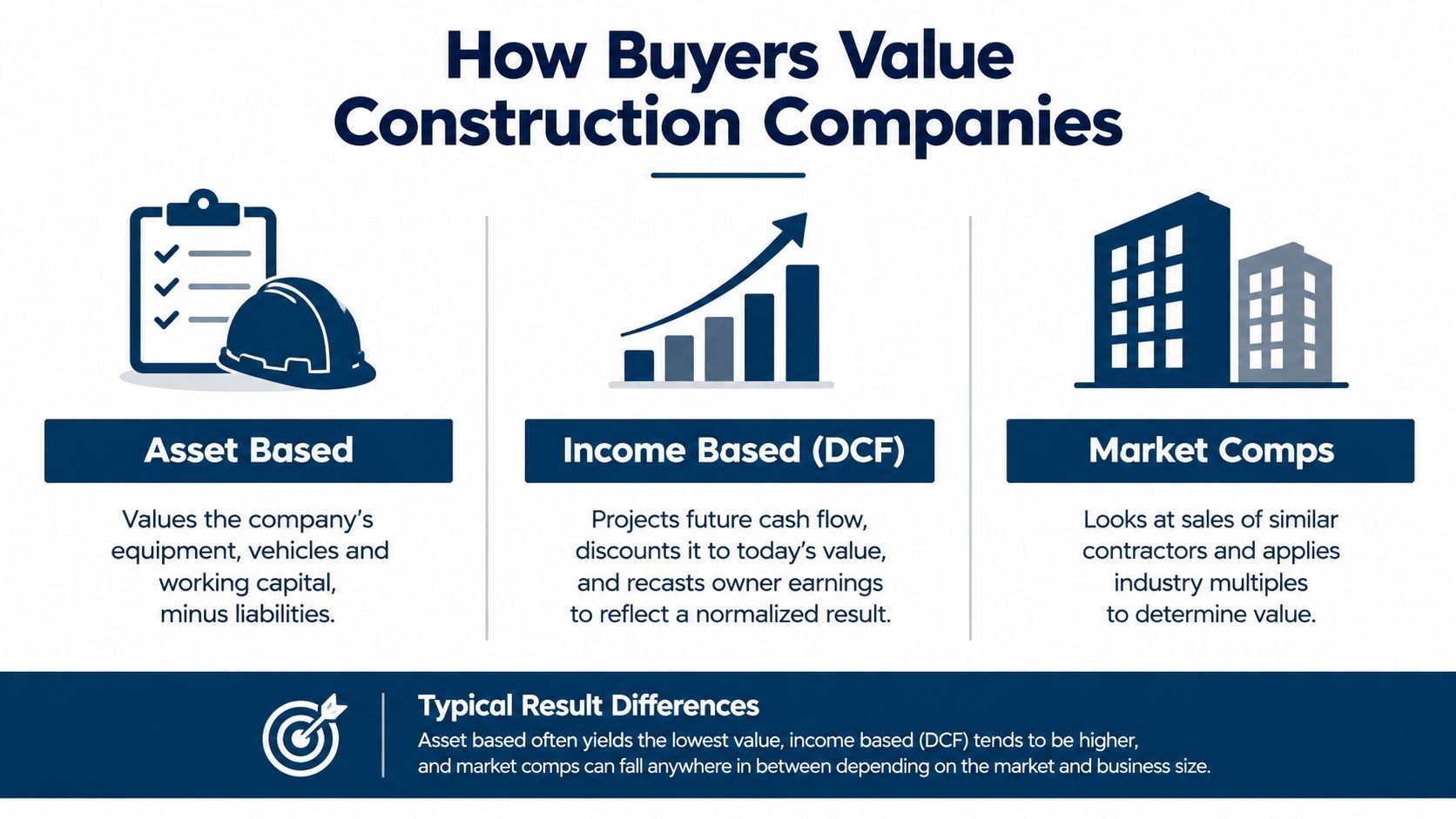
Most construction valuations use three approaches. Buyers and advisors may weigh them differently, but each one answers a different question. The asset approach asks what the company owns. The income approach asks what cash flow the operation can produce. The market approach asks what comparable businesses have sold for.
Good valuation work usually starts with clean financial records from at least three years, then adjusts the numbers for owner pay, personal expenses, and one-time items. Construction valuation guidance also identifies asset-based, market-based, and income-based methods, while noting that buyers usually focus on EBITDA or SDE after normalizing the books. See the supporting discussion from Exit Consulting Group on construction business valuation.
The three methods in plain English
Asset based valuation starts with equipment, vehicles, real estate, inventory, and working capital, then subtracts liabilities. It fits a company whose value is closely tied to its fleet or whose earnings are weak and inconsistent. It can miss goodwill, customer relationships, estimating systems, and future earnings power.
Income based valuation uses SDE for many smaller owner-operated businesses and EBITDA for larger companies. A discounted cash flow method projects future cash flow and discounts it back to today. That method can help when forecasts are credible, but a projection built on unsupported growth won't persuade a careful buyer.
Market comps compare the company with transactions involving similar contractors and apply an appropriate earnings multiple. Comps help anchor expectations, but they aren't a shortcut. A specialty electrical contractor with recurring work shouldn't be compared directly with a project-heavy residential remodeler because both have similar revenue.
| Method | Best For | What It Misses |
|---|---|---|
| Asset based | Equipment-heavy or struggling contractors | Transferable earnings and goodwill |
| Income based | Profitable businesses with usable records | Weak forecasts and unstable margins |
| Market comps | Testing a realistic market range | Differences in trade, geography, backlog, and risk |
Choosing the primary method
Start with income when the business has steady, documented cash earnings. Use assets as a cross-check, not the main answer, unless equipment or real estate drives most of the value. Use market comps to challenge the selected multiple and identify whether the company belongs near the lower or higher end of a range.
A useful workflow is:
- Recast the financial statements.
- Verify project margins and WIP.
- Select SDE or EBITDA as the earnings base.
- Compare the result with relevant market multiples.
- Test the value against equipment, debt, and working capital.
The method gives you a starting point. The quality of the information determines whether the result survives buyer diligence.
Cleaning Up Your Numbers Before You Apply a Multiple
A multiple applied to messy profit produces a precise-looking mistake. Construction owners often have legitimate add-backs, but every adjustment needs a clear explanation and supporting records.
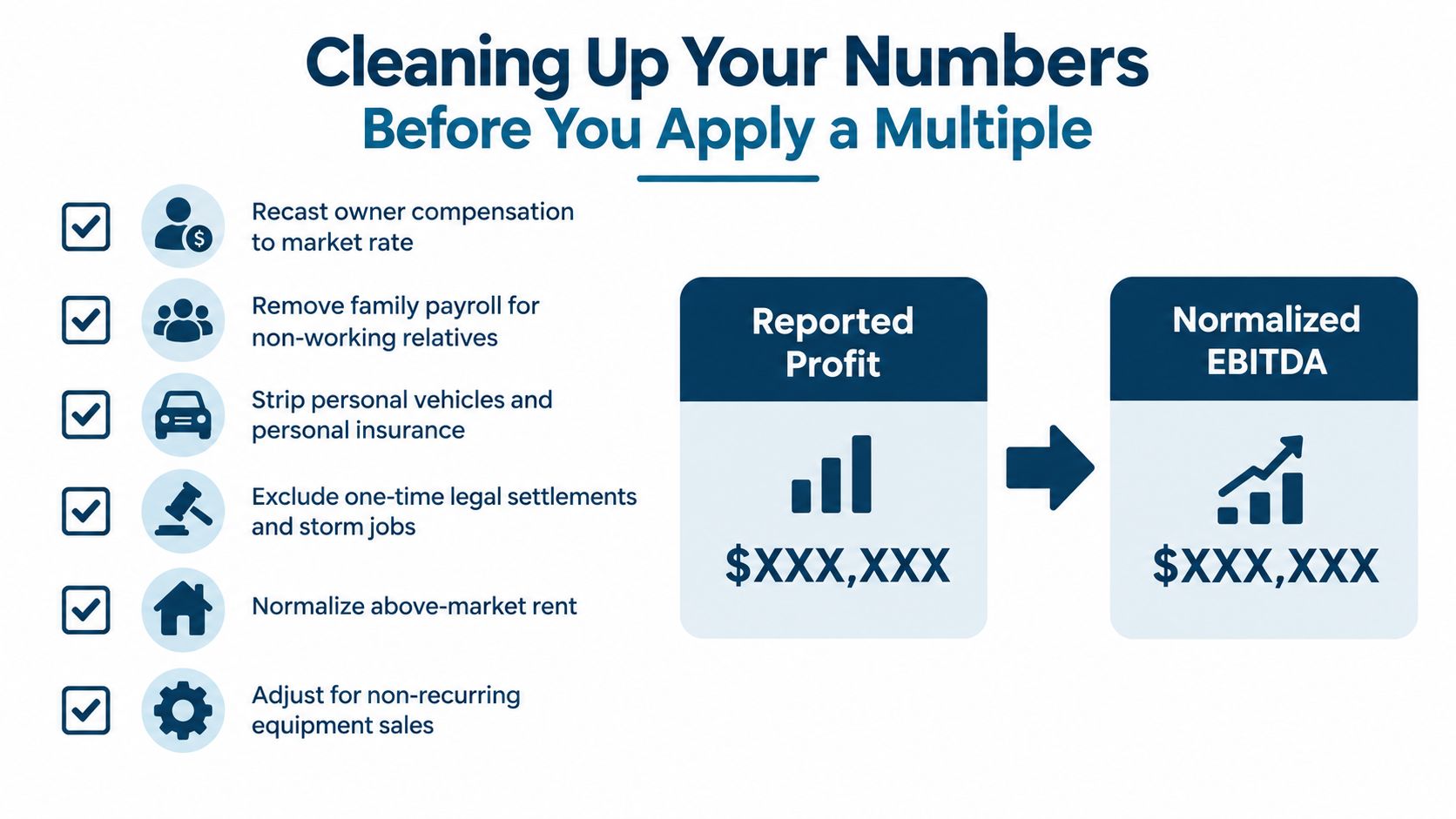
Recast the owner and related-party costs
Owner compensation is the first place to look. If the owner takes an unusually high salary but a buyer won't need to replace all of that work, part of the cost may be added back. If the owner takes very little pay while doing estimating, sales, and project oversight, the buyer may reduce earnings by adding a market replacement cost.
Family payroll needs the same treatment. A relative who performs real work at a reasonable wage belongs in the operating expense base. A relative who receives pay without a meaningful role may be an add-back, but the buyer will expect evidence.
Review these items line by line:
- Personal vehicles and insurance: Separate business use from costs that benefit the owner personally.
- One-time legal costs: Remove unusual settlements or transaction-specific expenses when they won't recur.
- Storm or emergency work: Treat isolated work carefully. It may be valid revenue, but don't present it as recurring if the company can't repeat it.
- Rent: Compare related-party rent with a market cost. Above-market rent may be added back, while below-market rent may need to be increased.
- Equipment sales: Exclude non-recurring gains from operating earnings.
- Personal expenses: Identify costs run through the company that a buyer won't inherit.
A construction-focused EBITDA valuation guide can help owners understand why these adjustments matter. The goal isn't to make profit look better. The goal is to show the earnings a buyer can reasonably expect after taking over.
Verify the job-level margin
The general ledger can't tell you whether a profitable year came from good estimating or from jobs that haven't finished yet. Review each significant project against its original estimate, approved changes, costs incurred, costs to complete, billings, and expected gross profit.
WIP accuracy is central here. Underbillings can indicate that the company has earned more than it has billed, while overbillings can mean the company collected cash ahead of the work performed. Neither balance should be treated casually. Retainage, project-cost accruals, and change orders can move both reported profit and cash needs.
A buyer will also test whether the margin can hold. Labor shortages, material price changes, tariffs, subcontracting mix, and weak change-order discipline can turn an apparently strong job into a future loss. A pattern of estimate-to-final margin erosion usually affects both normalized EBITDA and the multiple.
Adjust the risk around the earnings
Published construction guidance places many private firms around 3.5x to 6.5x EBITDA, while stronger specialty trades and infrastructure-exposed contractors may command higher ranges when recurring work and execution visibility support them. The relevant source is DealStream's heavy construction valuation guide.
That range isn't a promise. Buyers adjust it for subcontracting mix, backlog quality, bonding capacity, safety and claims history, and working-capital intensity. A contractor with clean WIP and a strong superintendent team may deserve a better multiple than a similar contractor where the owner approves every purchase order and one customer supplies most of the work.
What Multiples and Backlog Really Tell Buyers Today
Two contractors can report the same EBITDA and still sell at very different prices. The difference often sits in the work behind the earnings. A buyer wants to know whether the next jobs are signed, profitable, collectible, and manageable with the company's current people and bonding support.
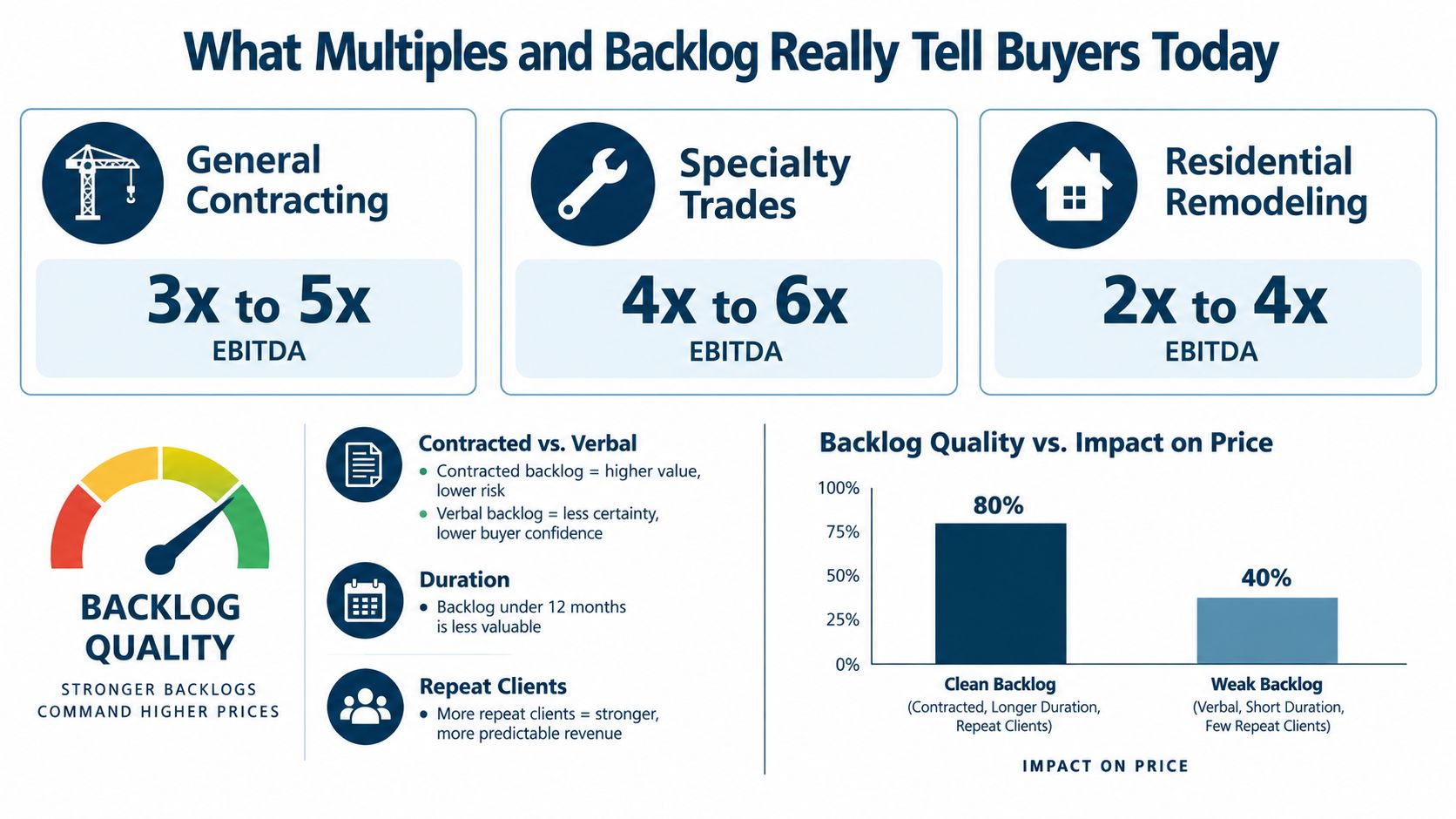
Recent industry summaries place most construction businesses in a broad 4.0x to 12.0x adjusted EBITDA range, with the spread driven by sub-sector, backlog quality, and buyer type rather than size alone. Within one 2026 market summary, residential and general contracting clustered around 4.0x to 5.5x, civil and site-work contractors with public-funded backlog around 5.5x to 7.5x, and specialty trades such as electrical, mechanical, prefab, and modular businesses with data-center or power-infrastructure exposure at 8x to 11x and sometimes higher. These figures come from Ad Astra Equity's construction company EBITDA multiples summary.
Compare the work, not just the trade label
A general contractor with thin margins, short project visibility, and heavy dependence on new bids carries a different risk profile from a mechanical contractor with recurring service work and specialized customers. A civil contractor may benefit from public-funded backlog, but the buyer still needs to understand bonding, bid requirements, equipment needs, and execution capacity.
A specialty trade doesn't automatically earn a high multiple either. If its work is concentrated in one customer, one facility, or one owner relationship, the buyer may discount the headline range. Specialized skills help, but they must be transferable.
Qualify the backlog
Backlog isn't cash in the bank. One published construction rule of thumb values contracted backlog at 80% of projected gross profit, then discounts it again for execution risk and possible cancellations. Another source says the gap between marketed backlog and qualified backlog can be 30% to 50%, which is why buyers separate signed, executable work from a sales pipeline. See DealStream's construction backlog valuation guidance.
A buyer will usually ask:
- Is it signed: Check the executed contract, scope, pricing, and termination language.
- Is the margin real: Compare current costs and production assumptions with the original estimate.
- Can the company execute: Match the work with available labor, equipment, subcontractors, and bonding.
- Will the customer pay: Review billing terms, retainage, disputes, and collection history.
- Is the end market durable: Consider exposure to infrastructure, power, electrification, data centers, residential construction, or other concentrated markets.
A full schedule is not the same as a valuable schedule. Buyers pay more for work they can verify and deliver profitably.
Headline revenue can make a contractor look large. Qualified backlog makes future earnings believable, and that credibility can influence the multiple more than volume alone.
Sample Calculations That Make Valuation Click
The formula is simple. The inputs are where sellers get into trouble. Start with the right earnings measure, apply a range that fits the company, and then account for debt and working capital separately.
Smaller owner-operated contractor using SDE
Suppose a small contractor has $500,000 of SDE. Published construction benchmarks place smaller companies around 2.0x to 4.0x SDE. The valuation range would be:
- Lower end: $500,000 × 2.0 = $1.0 million
- Upper end: $500,000 × 4.0 = $2.0 million
Those figures come from DealStream's construction business rules of thumb. The range is wide because the buyer still needs to assess owner dependence, customer concentration, recurring work, equipment condition, backlog, and the cost of replacing the owner's role.
If the SDE includes a personal vehicle, a one-time legal bill, and family payroll for a non-working relative, those items may change the earnings base. They shouldn't be added back automatically. Each adjustment needs support and a realistic view of what the buyer will have to spend after closing.
Mid-sized contractor using EBITDA
Now consider a mid-sized contractor with $1.2 million of normalized EBITDA. A published benchmark places mid-sized construction companies around 3.0x to 6.0x EBITDA.
- Lower end: $1.2 million × 3.0 = $3.6 million
- Upper end: $1.2 million × 6.0 = $7.2 million
The table below shows the two examples in one place.
| Scenario | Earnings Base | Multiple Applied |
|---|---|---|
| Smaller owner-operated contractor | $500,000 SDE | 2.0x to 4.0x SDE |
| Mid-sized contractor | $1.2 million normalized EBITDA | 3.0x to 6.0x EBITDA |
For a deeper construction-specific explanation, review this guide to construction business valuation. These are enterprise value illustrations, not final seller proceeds. Debt, excess cash, working capital, WIP, and transaction terms still affect what reaches the owner.
Backlog and closing adjustments
Assume a contractor markets $2 million of backlog. The buyer won't automatically add $2 million to the price. The buyer may first evaluate the expected gross profit, then discount for cancellation, cost overruns, unclear scope, weak customers, or limited execution capacity.
The same caution applies to working capital. If the business needs a normal operating level of receivables, retainage support, payables, and project accruals to operate, the buyer may require that amount at closing. A shortfall can reduce the seller's proceeds even when the agreed enterprise value doesn't change.
The practical lesson is that small earnings adjustments can affect value across the selected multiple, while poor WIP or inadequate working capital can reduce cash paid at closing.
Your Pre Valuation Checklist and Next Steps to a Stronger Price
A sale process is easier when the records already answer the buyer's questions. Start before you hire a broker or request a formal valuation.
Gather the operating evidence
Prepare:
- Financial records: Assemble at least three years of income statements, balance sheets, general ledgers, tax returns, and bank records.
- Job files: Organize estimates, contracts, change orders, cost reports, WIP schedules, and closeout results.
- Backlog support: Separate signed contracts from proposals, verbal commitments, and work that still depends on approval.
- People and process records: Document who estimates, sells, schedules, manages production, and handles customer relationships.
- Risk files: Collect bonding information, insurance records, safety history, claims, litigation details, and customer concentration data.
Then build a working-capital schedule. Construction deals commonly include WIP receivables, retainage, accounts payable, and project-cost accruals in the calculation. Buyers often set the required operating level using a trailing 12-month average or a negotiated peg. Inaccurate WIP reporting can create an unfavorable adjustment at closing, as explained in Redpath CPAs' construction valuation guidance.

If estimates and job cost records are scattered, construction estimating software such as Exayard construction estimating software can give the team a more consistent way to organize project assumptions and pricing evidence. It won't replace accounting cleanup, but better estimating records make margin review and backlog qualification easier.
A formal valuation makes sense for a planned sale, ownership transfer, estate matter, or complex transaction. A broker opinion can help with early market positioning, but it shouldn't replace normalized financial statements and a WIP review.
MyOfficeOps helps construction owners clean up bookkeeping, connect job-level reporting to financial statements, normalize EBITDA, and prepare for valuation or exit planning. Visit MyOfficeOps to discuss your records, working-capital process, and the steps needed to protect value before a buyer starts asking questions.