
A contractor can finish a profitable quarter and still watch payroll bounce because three customers paid late. The income statement says the work made money. The bank account says the money hasn't arrived yet. That uncomfortable gap is where most small-business cash flow trouble starts.
Cash flow management is the daily practice of knowing what money is coming in, what's going out, and when each movement will happen. It isn't just a monthly budget. It's a visibility and timing system that helps you pay employees, clear rent, cover vendors, and decide whether you can safely take on another job.
The pressure is especially sharp for small and midsize businesses. A single slow-paying customer can affect the timing of several bills at once. The median U.S. small business holds only 27 cash buffer days, according to data summarized from the JPMorgan Chase Institute, with median daily inflows of about $381, daily outflows of about $374, and an average daily cash balance of $12,100 (cash flow statistics and financing pain points). Those figures show why a business can look healthy on paper and still have very little room for delay.
What Cash Flow Management Really Means
The contractor in that opening scene didn't necessarily have a pricing problem. He had a timing problem. Materials had been paid for, crews had been paid, and the work was complete. The customer checks were still somewhere between “approved” and “deposited,” while payroll had a firm due date.
That's the difference between profit and cash. Profit measures sales and expenses under accounting rules. Cash flow management watches the money that has reached the bank, then lines it up against the payments the business must make.
The four questions that matter
Every owner should be able to answer these questions without digging through a year-end report:
- What's available now? Start with cleared bank balances, not invoices that might be paid.
- What's coming in? List expected customer payments and assign realistic dates.
- What's going out? Include payroll, rent, taxes, loan payments, vendor bills, and recurring software.
- What cushion remains? A balance that looks large today may be committed to bills due next week.
This is why a simple cash flow analysis can be more useful than staring at revenue totals. It shows whether the business can fund its daily work while waiting for customers to pay.
Practical rule: Treat expected cash as uncertain until you know the customer, amount, and likely deposit date.
Cash flow management also matters when financing enters the picture. Borrowing can help bridge a known timing gap, but the repayment schedule becomes another outflow that must be forecast. Owners considering managing revenue-based financing cash flow should map the repayment mechanics against their actual collection pattern, not just against projected sales.
A useful system doesn't require a finance degree. It requires current bookkeeping, honest payment assumptions, and a routine for reviewing the next several weeks. The objective isn't to predict every dollar perfectly. It's to see a shortage early enough to call a customer, delay a purchase, adjust a job schedule, or arrange a bridge before the account reaches zero.
Operating Cash Flow and Free Cash Flow Explained
Think about a lemonade stand. Customers pay for cups, and the money lands in the jar. After paying for lemons, sugar, and cups, the jar shows what the stand's regular selling activity produced. If the owner then buys a new table and umbrella, the jar gets smaller again.
That first result is close to operating cash flow. It asks whether the business's normal work generates cash after ordinary operating payments. The second result is closer to free cash flow, which asks what remains after the business also pays for equipment, technology, or other investments needed to keep operating and grow.
A small-business example
Suppose a consulting firm collects $30,000 from clients during a month. It pays $18,000 for payroll, contractors, rent, and ordinary operating bills. Its operating cash flow for that period is $12,000.
Now suppose the firm buys laptops and pays for a major software setup costing $7,000. Free cash flow falls to $5,000. The firm's core work is producing cash, but the investment has used part of what was available for hiring, taxes, reserves, or owner pay.
These numbers are an example of the calculation, not a benchmark. The point is to separate two questions:
- Does daily work pay its own bills? Operating cash flow answers this.
- What's left after maintaining or expanding the business? Free cash flow answers this.
A company can have positive operating cash flow and weak free cash flow if it keeps buying equipment, opening locations, or spending heavily on systems. That spending may be sensible, but the owner needs to know whether it's being funded by current operations or by credit and delayed payments.
The reverse can also create confusion. A business may show cash from a loan or asset sale even while its regular operations are losing money. That cash can keep the bank balance up for a while, but it doesn't prove the business model is working.
Cash in the account tells you where you are. Operating and free cash flow help explain how you got there and what the balance can support next.
Forecasting Techniques and the Cash Conversion Cycle
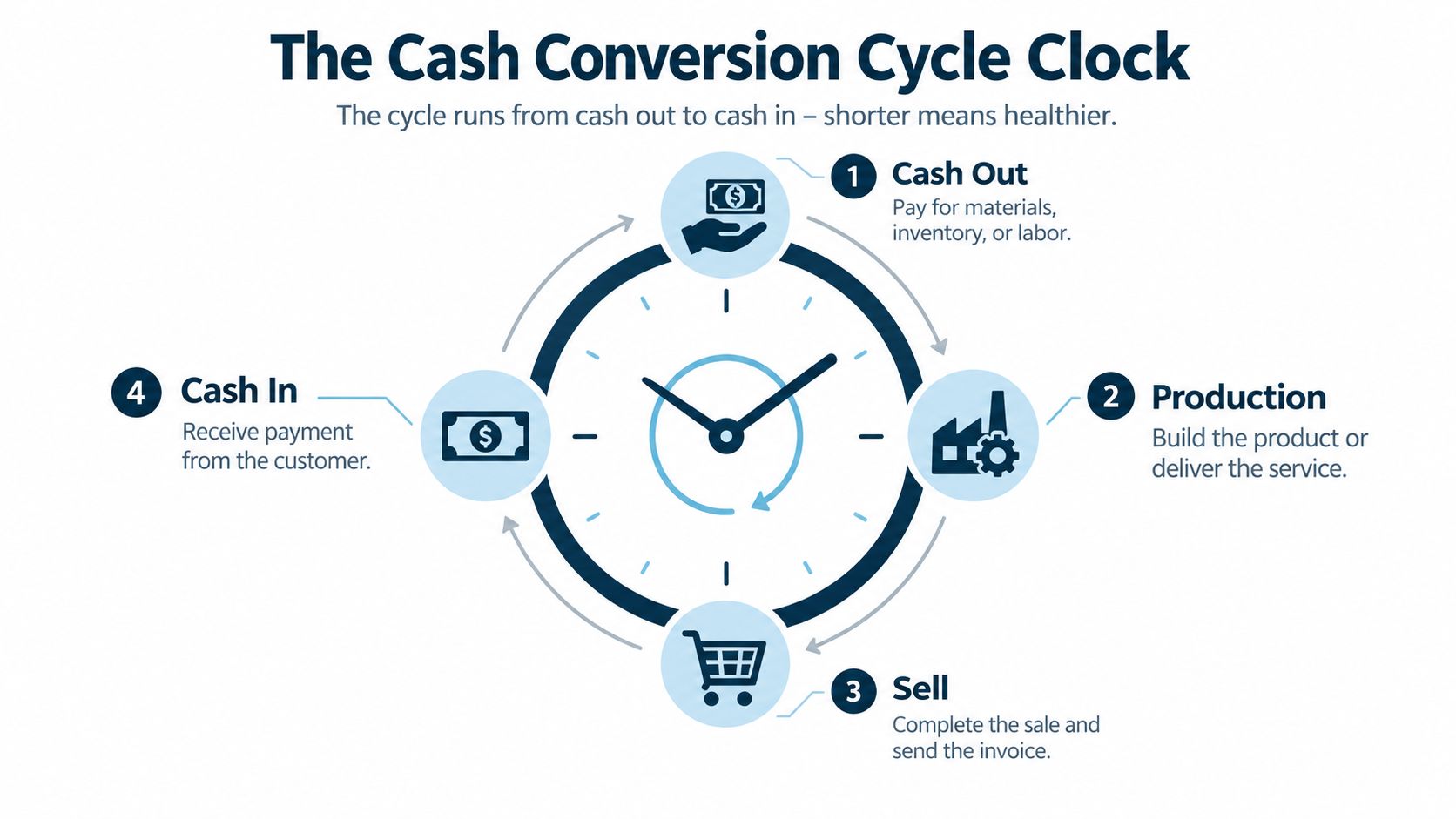
Cash moves through a business like a clock. It goes out to pay for materials, labor, or inventory. The business produces something or delivers a service. It sends an invoice. Then it waits for the customer to pay.
The cash conversion cycle, or CCC, measures that operating wait. Its standard formula is CCC = DSO + DIO − DPO, using days sales outstanding, days inventory outstanding, and days payable outstanding (working capital benchmarks by industry).
Three timing levers
- DSO, or days sales outstanding: How long customers take to pay. An owner can improve it by invoicing immediately, checking that invoices reach the right person, and following up before an account becomes seriously overdue.
- DIO, or days inventory outstanding: How long stock sits before sale. A retailer or contractor can review slow-moving items and avoid buying more of what already isn't moving.
- DPO, or days payable outstanding: How long the business takes to pay vendors. Longer terms can preserve cash, but only if the arrangement protects supplier relationships and doesn't trigger penalties or lost discounts.
Peer-group medians, quartiles, and seasonally adjusted trailing data are more useful than one broad industry average. A business doesn't need to chase the biggest possible DPO or the lowest possible DSO. It needs terms that fit its customers, suppliers, and operating cycle.
Build a rolling forecast
A 13-week rolling cash forecast is practical because it keeps attention on the near term. Put each week in a column. List the opening bank balance, expected customer deposits, payroll, rent, taxes, debt payments, vendor bills, and planned purchases. Calculate the projected closing balance, then carry that balance into the next week.
Use three levels of confidence for incoming money:
- Committed: The customer confirmed the payment date.
- Likely: The invoice is approved, but the date isn't firm.
- Uncertain: The work is billed or expected, but collection depends on follow-up.
Cash forecasts are less reliable than earnings forecasts in analyst models. One study reported a mean relative squared error of 0.8900 for beginning-of-year cash flow forecasts compared with 0.3595 for earnings forecasts, and found that cash flow forecasts improved more slowly over the forecast period (cash flow forecast accuracy research). For an owner, the lesson is simple: refresh often, use shorter windows, and validate inflows and outflows separately.
More guidance on building a usable model is available in these cash flow forecasting techniques.
Best Practices That Actually Improve Cash Flow
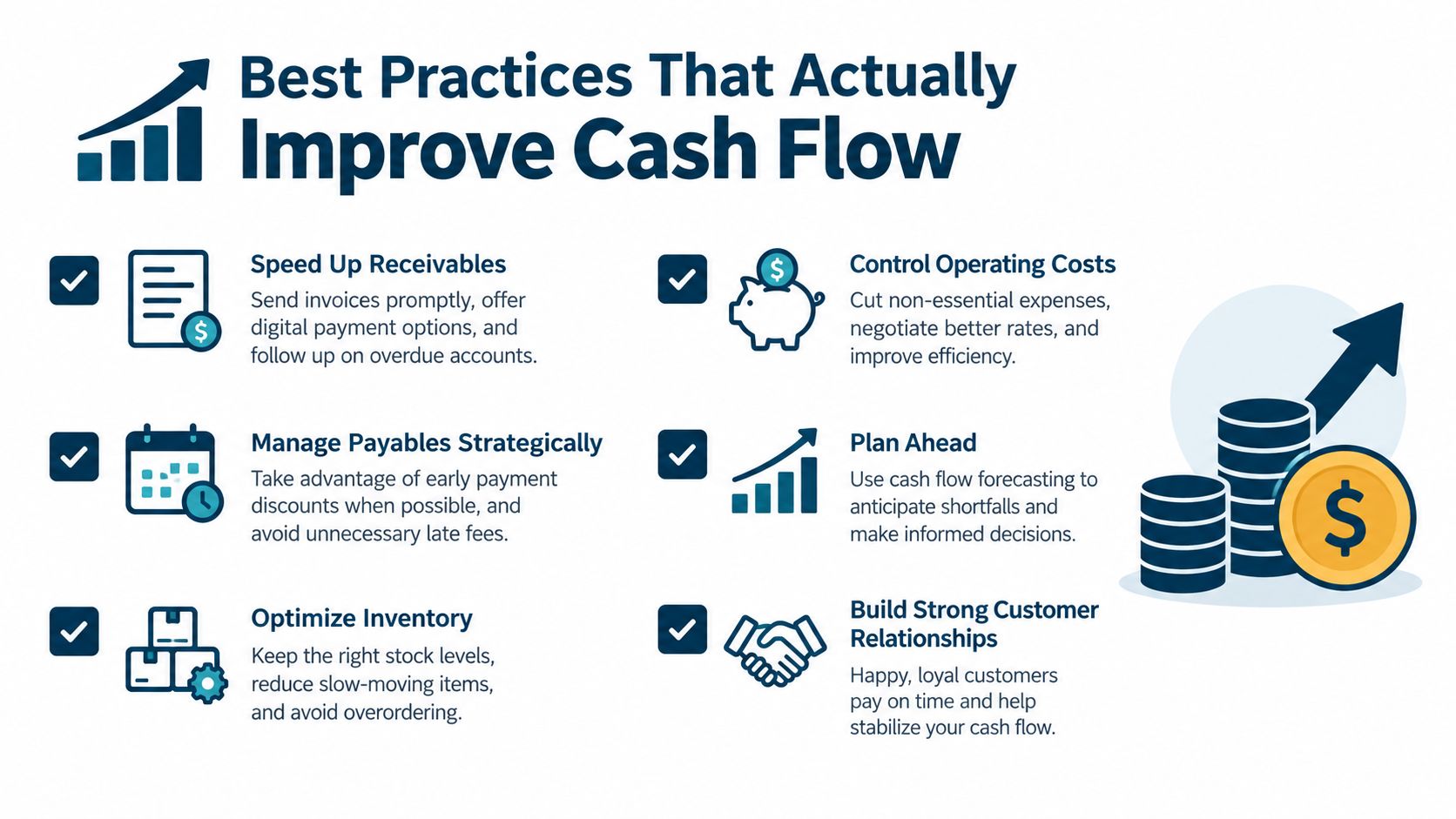
Good cash flow management usually improves through a handful of ordinary actions done on schedule. Fancy dashboards won't rescue a business that invoices late, lets old receivables sit untouched, or buys inventory without checking demand.
Start with the money you can move
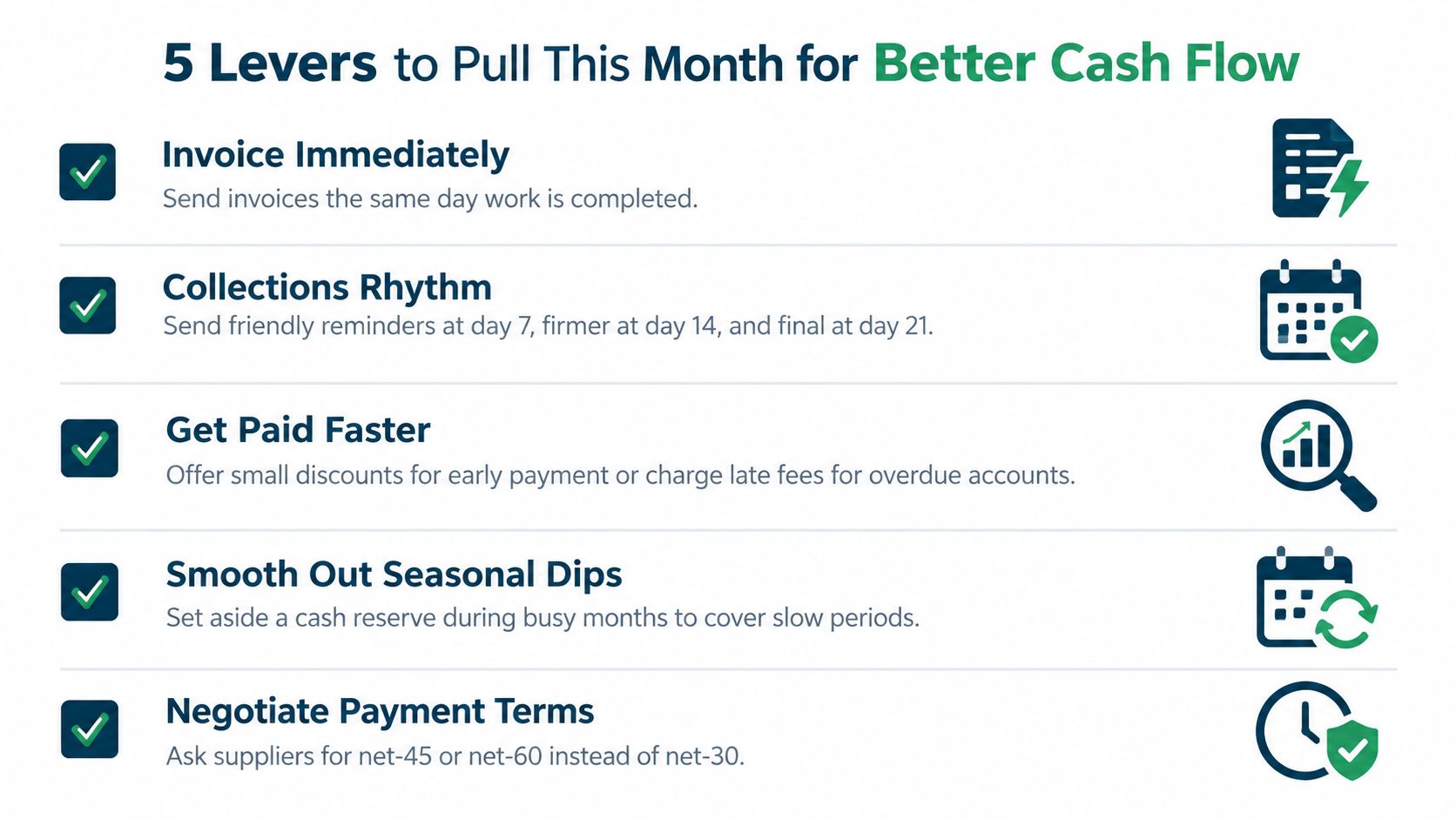
Invoice the day the work is complete. Every day between delivery and invoicing gives the customer another day before the payment clock starts. Check the billing contact, purchase order details, service dates, and payment instructions before sending. A rejected invoice isn't just an administrative nuisance. It creates another delay.
Create a collections rhythm. Review open invoices on a set day each week. Send a friendly reminder at day 7, a firmer follow-up at day 14, and a final escalation at day 21. Those checkpoints create a habit, so collections don't depend on whether the owner happens to remember an account.
Use accounts receivable best practices to assign ownership for each invoice and record the next action. A customer shouldn't receive three different messages from three people, and no one should assume someone else is handling the account.
Stretch the cycle without damaging trust
Ask reliable vendors whether payment terms can change. The right agreement may protect cash while keeping the supplier confident that payment will arrive as promised. Don't pay late and call that a strategy. It can damage terms, supply, and reputation.
Inventory needs the same scrutiny. Cash sitting in products that don't sell can't pay payroll. Review what has moved, what hasn't, and what upcoming work requires before placing the next order.
Short-term financing can bridge a timing gap, but it shouldn't fund a permanent operating loss. A line of credit makes sense when the owner knows why cash is short, when repayment will come, and which customer payments support the draw.
For ecommerce owners, improving the timing and quality of revenue can also support liquidity. A practical resource on how to boost ecommerce revenue with Tagada may help connect sales decisions with the cash those sales eventually produce.
How Cash Flow Looks Different by Industry
A consultant can finish a month with a full calendar and an empty bank account. The firm completes the work, sends the invoice, and waits while payroll and software bills arrive. Its pressure point is receivables timing, especially when client approval slows collection.
A dental practice runs on a different clock. Patients may pay part of the bill at the visit, while the practice waits for insurance reimbursement. A claim needing correction or additional review can delay cash for weeks. The pressure point is payer timing and claim accuracy.
Construction creates a longer gap between spending and collection. A contractor may pay for materials and labor well before a project reaches completion. Retainage can hold back 10 percent of every invoice, making a profitable job look cash-poor until the withheld amount is released (industry cash flow trends). The pressure point is job-level working capital, so each project needs its own cash view.
A small landlord may record rent on the first of the month, but deposits rarely follow a perfect schedule. Late tenants, repairs, and vacancy gaps produce uneven cash. The pressure point is occupancy and collection reliability.
The right cash question depends on how an industry gets paid, not only on how much it sells.
| Industry | Main Cash Flow Pressure | Typical Payment Delay | Working Capital Lever |
|---|---|---|---|
| Professional services | Work completed before collection | Client approval and invoice processing | Deposits, clear milestones, prompt billing |
| Healthcare | Insurance reimbursement | Claims and payer processing | Clean claims, patient collection policies |
| Construction | Materials and labor paid before completion | Retainage and milestone approval | Job costing, progress billing, deposits |
| Real estate | Vacancy and late rent | Tenant payment timing | Screening, reserves, fast maintenance response |
Home care adds a labor-timing problem. Owners may schedule and pay caregivers before clients or payers send funds. A hiring process that reduces open shifts can help, but it does not remove the payroll gap. For operators examining that bottleneck, how AI improves home care hiring provides context on technology-supported hiring workflows. Pair that efficiency with a forecast showing scheduled hours, payroll dates, and expected collections. That view can reveal a shortfall weeks before it reaches the bank account.
Common Cash Flow Pitfalls Owners Fall Into
A business can look profitable on paper and still leave its owner short before the next deposit arrives. The problem usually starts with timing, then gets disguised as a sales or spending issue.
Owners often pay vendors, employees, and lenders first, then take whatever remains. That may preserve relationships for a while, but it also hides the cost of operating the company. If owner pay is repeatedly postponed, the business may depend on unpaid household labor and personal sacrifice.
More sales can create the same pressure. Receivables grow faster than deposits while the company buys materials, adds labor, and grants longer payment terms. Revenue rises, yet the cash required to support each job rises with it. A forecast that tracks invoice dates and expected deposits exposes that squeeze before the bank balance does.
Stopgaps can keep a company open while making the underlying gap harder to see. Reported responses include using lines of credit, delaying pay to the owner or family, and making only minimum credit-card payments. Some owners also draw from personal savings or skip their own pay when collections fall behind. These actions may buy time, but each one carries a cost that belongs in the cash plan.
The warning signs owners dismiss
- Receivables keep rising: Revenue appears healthy, but older invoices continue rolling forward.
- Credit pays routine bills: Borrowing covers normal payroll, supplies, or rent instead of a defined, temporary shortfall.
- Discounts hide the float: A lower price or extended terms may win the sale while forcing the business to finance the customer.
- The owner has no pay plan: The books show a profit, but the person carrying the risk has no dependable personal cash.
Analysts at the JPMorgan Chase Institute found that cash flow pressure can leave small businesses unable to pay vendors, meet loan obligations, or pay themselves and employees (JPMorgan Chase Institute small business report). The report also connects limited cash to missed projects and sales opportunities. The exact amount matters less than the operating lesson: a shortfall can reduce options before it becomes an emergency.
Hustle does not correct a timing mismatch. A rolling forecast does. When owners can see collections, payroll, debt payments, and bills crossing in the same weeks, they can change terms, delay a purchase, or arrange funding before the account reaches zero.
How MyOfficeOps Helps With Cash Flow
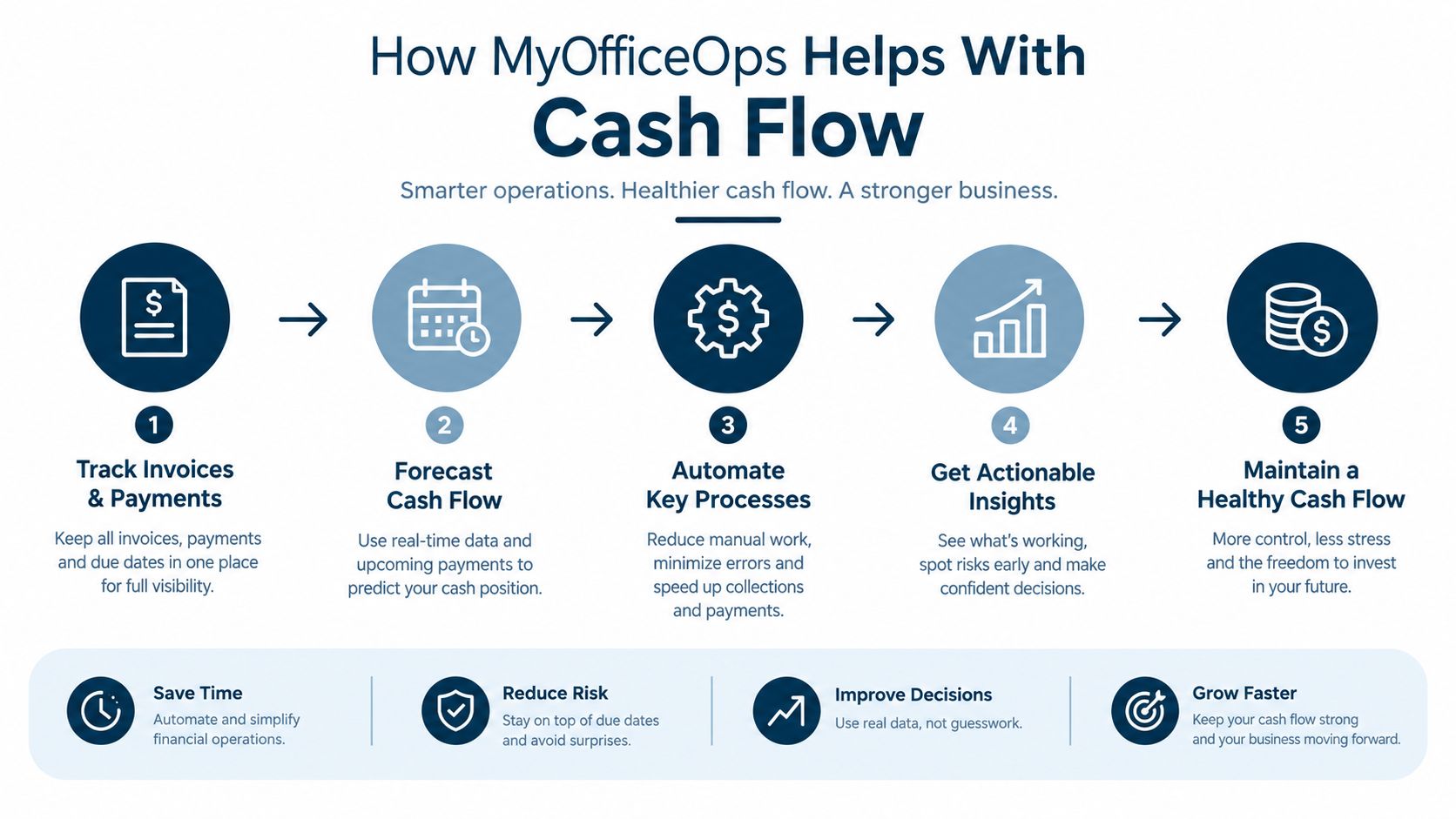
A useful cash flow routine should show up in the owner's week, not only at tax time. On Monday, the accounts are reconciled. The 13-week forecast is updated with current invoices, expected customer payments, payroll, and scheduled bills. A short review identifies which customers are trending late and which payments can be safely accelerated or held.
Clean books create a usable forecast
Bookkeeping closes the gap between revenue recorded on the income statement and money deposited. If reconciliations are delayed, invoices are missing, or bills are posted to the wrong period, the forecast starts with bad information.
MyOfficeOps provides bookkeeping, accounting, payroll integration, financial analytics, and CFO-level advisory for small and midsize businesses. Its work can include account management, bill pay, forecasting, budgeting, KPI dashboards, profitability consulting, valuation, and merger and acquisition readiness.
The value is practical. A contractor deciding whether to accept a second job needs to know the effect on materials, payroll, deposits, and collections. A clinic considering another provider needs to understand the added payroll and overhead before the new revenue arrives. A forecast turns that gut feeling into a written cash question.
Advisory connects the forecast to choices
The owner still makes the decision. The advisory process supplies the evidence around it.
That might mean testing whether a line-of-credit draw fills a short gap or merely delays a larger problem. It might mean changing the timing of an inventory purchase, adjusting payment terms, or checking whether a proposed hire fits the next several weeks of cash. The company's numbers stay at the center of the discussion, with plain reports instead of unexplained accounting language.
For owners in the Philadelphia area, West Chester, and beyond, the engagement can begin with a discovery call, move into a custom plan and onboarding, then continue as a growth partnership. The weekly rhythm matters more than a one-time cleanup because cash conditions change as customers, jobs, payroll, and bills change.
Your Next 30 Days of Cash Flow
Start on Monday morning with the last three months of bank activity, then list known invoices, payroll, rent, loan payments, and tax dates in a simple 13-week forecast. The first version won't be perfect, and that's fine. A rough forecast that gets reviewed every week is more useful than a polished file nobody updates.
Three moves to make now
Tighten collections. Review every open invoice that's more than 30 days old. Send a specific payment request, confirm the customer's approval status, and record the next follow-up date. Move recurring clients toward shorter terms or ACH where appropriate, and require deposits on new work when the job creates early costs.
Control the timing of outflows. Schedule vendor payments around expected deposits rather than paying every bill as soon as it arrives without checking the forecast. Ask suppliers about better terms, protect relationships by honoring agreed dates, and trim inventory that has stopped moving.
Compare forecast with reality. Each week, compare projected deposits and payments with what cleared. Mark why the forecast missed, whether a customer paid late, a bill arrived early, or an expense was larger than expected. Then update the next 13 weeks.
DIY stops working when the owner can't keep the forecast current, doesn't trust the bank reconciliations, or sees forecast and actual results drifting by more than 10 percent for two months in a row. At that point, outside help can turn a stressful monthly chase into a dependable operating routine. Don't wait for a bounced payroll payment to prove the system is broken.
MyOfficeOps helps small and midsize businesses keep books current, build rolling cash forecasts, and connect weekly numbers to decisions about hiring, inventory, pricing, and financing. Visit MyOfficeOps to schedule a conversation about building a cash flow management process you can use.