
You check the bank balance before opening your email. Payroll is due Monday. Three vendors have already called. The income statement says the business made money last month, but the account is too low to cover the next round of bills.
That situation doesn't mean the business is failing. It means cash arrived later than the obligations attached to the work. A business with cash flow problems needs a diagnosis of timing, collections, and payment commitments before it needs a new loan.
When the Bank Account Says One Thing and the Books Say Another
An owner I worked with once had a profitable month on paper and bounced payroll direct deposits on Monday morning. By lunch, she had taken three vendor calls and moved money from her personal account to keep the week alive.
Her business had completed the work. The bookkeeper had recorded the revenue. The customers hadn't paid yet. Meanwhile, payroll, rent, software, taxes, and supplier invoices came due on their normal schedule.
That is the difference between profit and cash. Under the accrual method, a business records income when it earns it, even if the customer hasn't paid. Under the cash method, it generally records income when the money arrives. The IRS explanation of cash and accrual accounting gives a useful example: an agency can complete a $20,000 project in March, record the revenue in March under accrual accounting, and still wait until May for payment.
Diagnose the gap, not the emotion
The Federal Reserve found that 94% of employer firms experienced at least one financial challenge during the prior 12 months. Rising costs were the most common challenge, but 54% had difficulty paying operating expenses and another 54% reported uneven cash flows. Those findings come from firms with fewer than 500 employees, which includes many agencies, practices, contractors, and other owner-led companies. Read the Federal Reserve's small-business survey.
The wrong first move is cutting expenses without knowing what caused the shortfall. The right first move is to compare actual bank movement with expected collections and required payments.
Practical rule: Don't make a permanent cost decision to solve a temporary timing gap.
Start with two tools. Run a seven-day cash diagnostic so you can see what happened recently. Then build a 13-week forecast so you can see the next pressure point before it arrives. A clean bank reconciliation process helps confirm that the balance you're using is real.
The next step is concrete. Pull the transactions, sort the obligations, and find the exact delay between work completed and cash received.
Your 7-Day Cash Diagnostic Before You Change Anything
You don't need a finance degree to run this check. You need the same information every day for one week and the discipline to stop guessing.
Day one starts with the last 90 days
Pull the last 90 days of bank and credit card transactions. Put every outflow into one of five buckets:
- Payroll: Wages, payroll taxes, benefits, and related payments.
- Rent and loans: Rent, debt payments, equipment leases, and other fixed commitments.
- Vendors: Materials, subcontractors, suppliers, and software used to deliver work.
- Taxes: Sales tax, payroll tax, income tax, and other tax obligations.
- Owner draws: Transfers to you or other owners that aren't operating expenses.
Don't hide unusual payments in an “other” category. Name them. A large insurance payment or annual software renewal can explain why a month felt worse than the income statement suggested.
On the same page, write down three numbers:
| Number to Capture | How to Get It in 10 Minutes | What It Tells You |
|---|---|---|
| Current cash on hand | Check cleared balances across operating accounts, then subtract payments already scheduled | What you can use now, not what the accounting system says you own |
| Average weekly outflow | Add the last 90 days of cash payments and divide by the number of weeks in that period | The pace at which cash leaves the business |
| Largest upcoming bill | Review the next 30 days of payroll, taxes, rent, debt, and supplier obligations | The single payment most likely to change your immediate plan |
Compare runway with receivables
Divide current cash on hand by average weekly outflow. That gives you a rough cash runway. Then open the receivables aging report and mark every invoice by expected payment date, not by the invoice date.
If your runway is short and the largest invoices are already overdue, you have a collections problem. If invoices are current but a tax bill or annual premium lands before customer payments, you have a timing problem. If cash is low every week even when customers pay, you may have a pricing, margin, or cost problem.
Revenue isn't cash. An invoice isn't cash. A promise to pay isn't cash.
Spend 15 minutes each day during the diagnostic. Check cleared deposits, payments made, invoices collected, and bills due in the next seven days. Write one decision beside each change. For example, “Call client about approval delay,” “move vendor payment to Friday,” or “hold owner draw.”
At the end of the week, you'll have a short list of causes instead of a general feeling that money keeps disappearing.
Build a 13-Week Cash Forecast on One Page
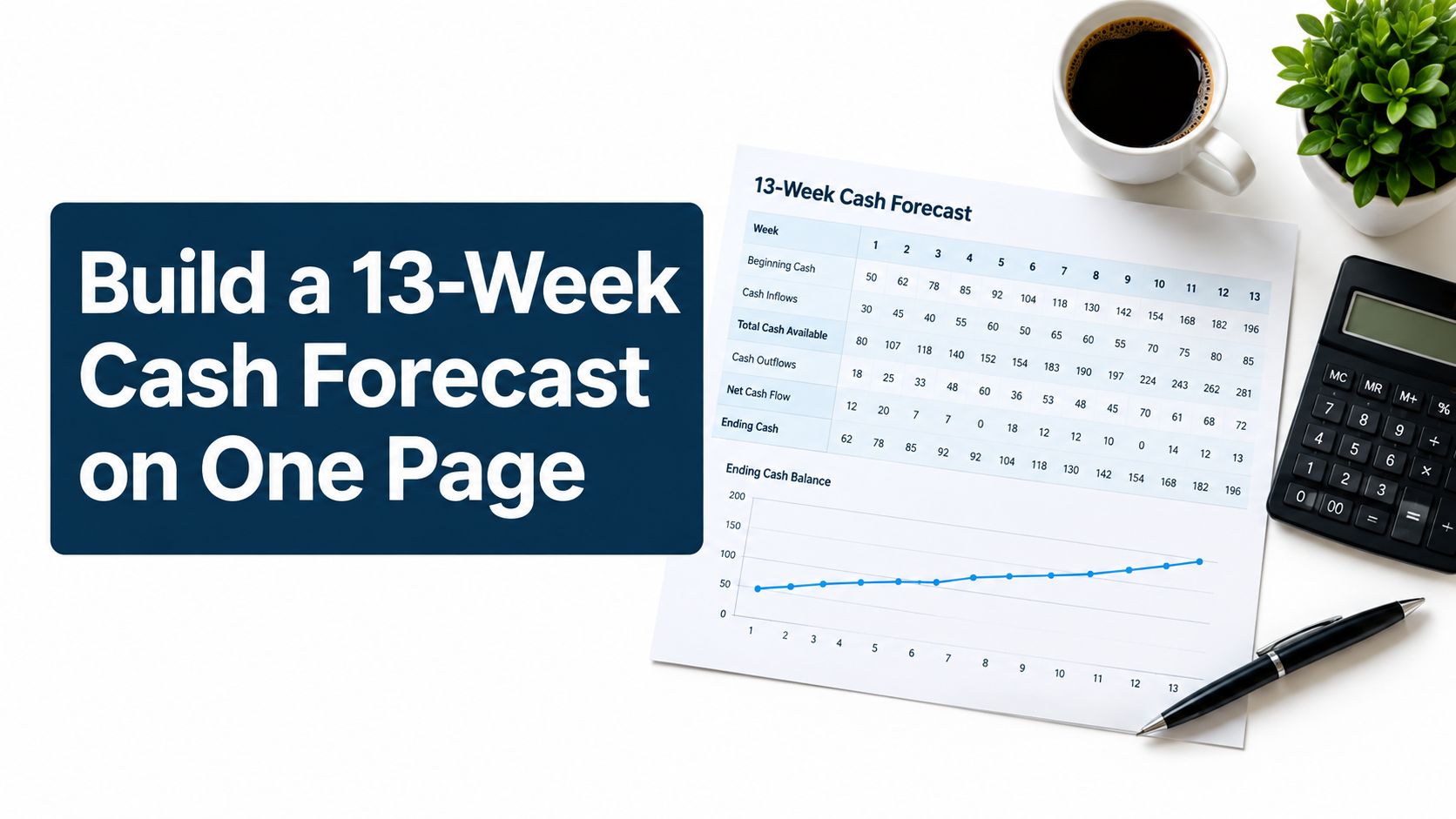
A 13-week forecast isn't a budget. A budget tells you what you hoped would happen. A rolling cash forecast tells you when money is expected to arrive and when it must leave.
Open one spreadsheet tab. Put the next 13 weeks across the top. Put these rows down the left side:
- Starting cash
- Expected receivables by week
- Confirmed payables
- Recurring outflows
- Ending cash
Expected receivables should be realistic. A customer who says, “We'll pay soon,” doesn't belong in the same column as a scheduled ACH payment. Use separate lines for confirmed deposits, invoices awaiting approval, and invoices with no clear payment date.
Include the payments owners forget
Most forecasts fail because the owner remembers normal bills and misses irregular ones. Add lines for:
- Upcoming tax payments
- Insurance premiums
- Loan principal and loan interest as separate items
- Owner draws
- Seasonal revenue dips
- Large equipment or material purchases
- Payroll changes already approved
For each week, subtract total outflows from starting cash and expected inflows. The ending cash becomes the next week's starting cash. Update the file every Friday, then replace estimates with actual cleared amounts.
The lowest ending-cash week matters more than the highest week. If the forecast shows plenty of cash in one week but a negative balance three weeks later, the business still has a problem. The cumulative gap tells you how much cash must be moved, collected, delayed, or reduced to stay solvent.
Use the forecast as a scoreboard. Compare the forecast from last Friday with what happened. Were customer payments late? Did payroll run higher? Did a supplier pull money sooner than expected? Those variances improve the next forecast.
You can use a simple cash flow forecasting template as a starting point, but the format matters less than the weekly habit.
The rule is simple: If the lowest week goes negative, fix the timing first before starting a new financing conversation.
Get Paid Faster Without Picking a Fight With Clients
Slow receivables aren't a personality problem. They're usually a process problem. The owner sends the invoice late, the client routes it to the wrong approver, the terms are vague, and nobody owns the follow-up.
Start with the aging report. List every invoice more than 14 days past due and rank it by dollar amount. Don't rank clients by friendliness. Your largest overdue invoice gets attention first, even if the customer is pleasant and responsive.
The Government Accountability Office found that outstanding receivables were the primary reason small businesses reported cash-flow problems. It also found that 14.5% of invoices issued by small businesses were paid late. Review the federal payment findings.
Change the default by industry
Agencies should require 50% deposits on new engagements, use milestone billing, and invoice on the day work ships. Net-15 or net-10 terms are easier to manage than waiting through a long approval cycle. A clear invoice format also prevents avoidable questions. For a practical example of what a trade invoice should contain, see this AurenWell painting invoice guide.
Contractors should tie progress draws to inspection or completion milestones instead of arbitrary calendar dates. Use lien rights correctly and make payment applications complete the first time. A missing form can delay a payment that everyone agrees is owed.
Healthcare practices need a different workflow. Verify eligibility before the visit, collect copays at check-in, and automate patient statements weekly. Separate payer delays from coding errors and denied claims. Those are different problems and need different owners.
| Business Type | Default Terms to Switch To | Highest-Leverage Fix | Common Mistake to Drop |
|---|---|---|---|
| Agencies and consultants | Deposits, milestone billing, net-15 or net-10 | Invoice when work is delivered | Waiting until the end of the month |
| Contractors | Progress draws tied to inspections | Submit complete payment applications promptly | Billing only on a calendar date |
| Healthcare practices | Payment at check-in where appropriate | Verify eligibility and track denials | Treating every unpaid claim as a patient issue |
| Professional services | Retainers and card-on-file or ACH | Assign one person to collections | Assuming the relationship will produce payment |
For everyone else, make the polite path the fast path. Put ACH or card-on-file authorization in the standard contract. Consider 2/10 net-30 for customers who can pay early. Send a short reminder at days 1, 7, and 30 after the due date. The tone can stay professional. The process can't stay optional.
A written collection strategy turns collections from an awkward favor into a normal operating task.
Stack-Rank Your Payables and Cut Burn the Smart Way
A business with cash flow problems can't treat every expense equally. Cutting the wrong expense can damage delivery, delay collections, or remove the tools that produce revenue.
Use four tiers.
Tier one is protected. Keep payroll, core software you use to bill clients, taxes, and key supplier credit lines current. You may need to negotiate timing, but don't casually cut the systems and people that let you deliver and collect.
Tier two is negotiable. Call the landlord, insurer, software vendors, and recurring service providers. Ask for a 60- to 90-day deferral, a smaller plan, fewer software seats, or a 10% to 15% reduction. Be specific about what you can pay and when. Vendors respond better to a clear plan than to silence.
Tier three is paused or downgraded. Cancel subscriptions nobody has used in 30 days. Reduce contractor hours not connected to signed work. Put travel, office perks, and nonessential projects on hold. Freeze new hires until the forecast supports them.
Tier four is cut cold. Remove discretionary spending with no clear connection to revenue, delivery, compliance, or collections. Don't preserve a vanity expense while delaying a supplier who keeps jobs moving.
Protect the operating engine
Track weekly burn against the 13-week forecast. If payroll is higher than planned, find out why. If contractor hours rose, connect them to signed work. If software costs grew, match each seat to a person and a business need.
Do not slash expenses across the board. A blanket cut feels fair, but it ignores consequences. Removing a project manager may create billing errors. Cutting a scheduling tool may slow jobs. Delaying taxes can create penalties and a larger crisis.
The target is not the smallest possible business. The target is a business that can keep delivering while the collections gap closes.
Before You Borrow, Run This Decision Test
Financing is a tool. It isn't a treatment for ongoing losses, weak pricing, or invoices nobody is collecting.
Debt can also make a cash problem harder to fix. The Federal Reserve reported that 39% of small firms had more than $100,000 in debt in 2024, compared with 31% in 2019. In the same report, 41% of firms were denied financing because of high debt in 2024, compared with 22% in 2021. See the Federal Reserve analysis of small-firm debt.
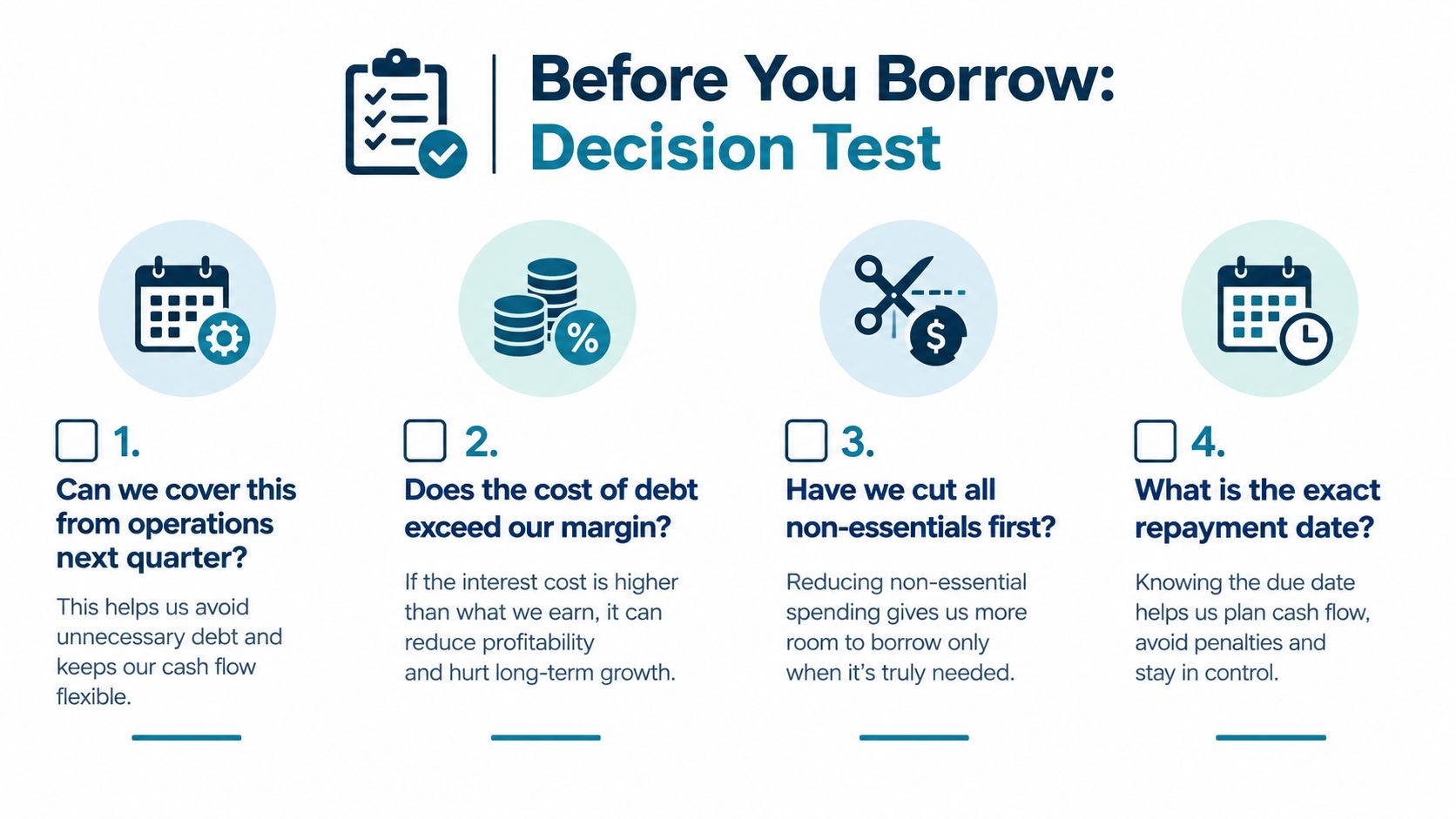
Before you sign, answer four questions in writing.
- Does this close a specific, dated gap? A loan that covers payroll until a named customer pays is different from a loan that covers losses every month.
- Can the forecast support the payment? Include fees and the full cost of capital. Don't rely on the headline rate or your best-case sales month.
- What personal exposure are you accepting? Review guarantees, liens on personal assets, and cross-default language on other facilities.
- Have you used cheaper options first? Consider accelerated receivables, vendor extensions, an owner infusion, or a 0% business credit card for a defined 60- to 90-day bridge, if the terms and repayment plan are clear.
Compare the financing to the gap
A line of credit may fit a short working-capital mismatch that repeats and then clears. A short-term loan may fit a defined purchase with a predictable return, but its fixed payments can strain a business with uncertain collections. Invoice factoring can convert receivables into cash, but the cost and customer communication need careful review.
In Q3 2025, 57% of surveyed small businesses used a business line of credit to manage cash flow, while 53% delayed payments to themselves or family and 42% made only minimum credit-card payments. Review the small-business financing data. Those choices show pressure, not proof that borrowing is wise.
Businesses using business financing rather than personal funds were more likely to report healthy cash flow, 56% versus 43%, and profitability, 88% versus 76%, in the same source. Financing can help when it funds a short, understood gap. It can hurt when it hides a recurring operating loss.
Before considering insolvency, speak with a qualified attorney about your situation and location. Owners who need to understand possible bankruptcy options for Minnesota businesses should get legal advice early, not after accounts are frozen or lawsuits begin.
If the loan purpose is vague, the repayment date is imaginary, or the payment only works if every customer pays on time, don't borrow. That isn't progress. It's a larger obligation waiting for the next bad week.
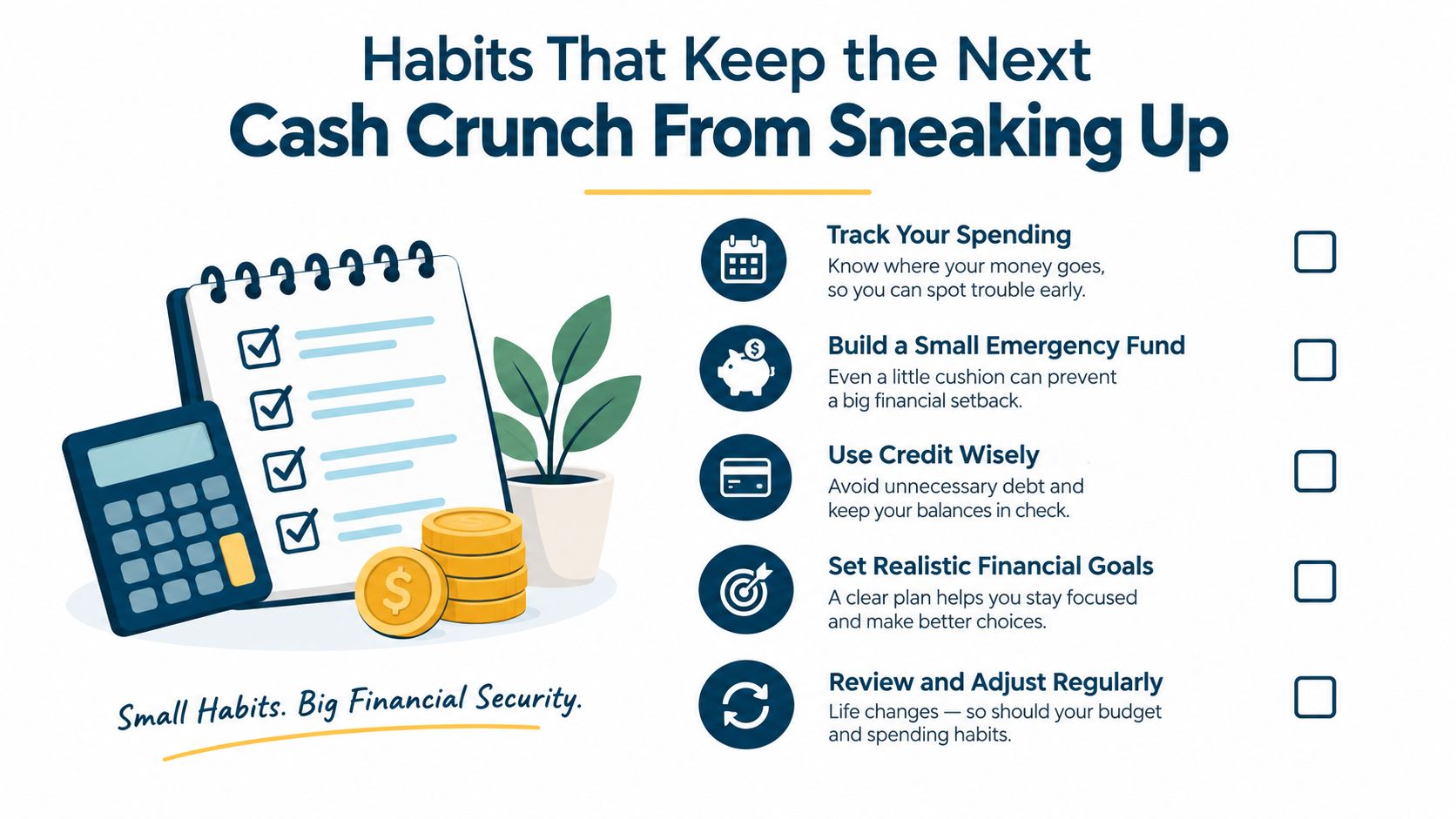
Habits That Keep the Next Cash Crunch From Sneaking Up
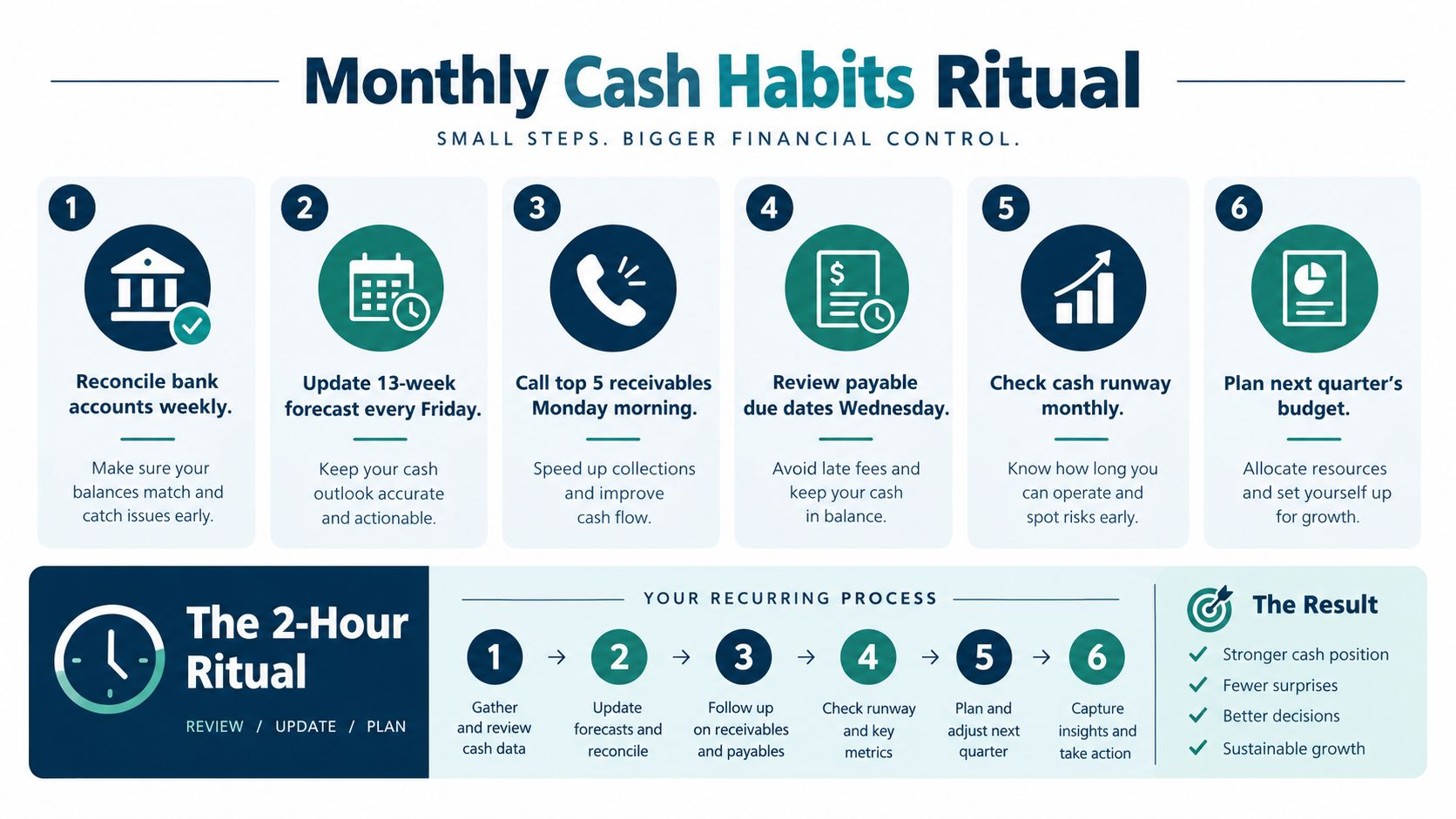
Cash control becomes easier when it has a calendar. A solo owner can run a monthly ritual in under two hours if the books are current and the responsibilities are clear.
Reconcile bank accounts by the 5th. Review the 13-week forecast by the 10th. Call the top three slow-paying clients by the 15th. Pay yourself last when the business is under pressure, and record the draw properly when you take it.
The six standing habits below prevent most surprises from staying hidden:
- Invoice the day work is delivered. Don't make your customer wait because invoicing feels like an administrative task.
- Require deposits on larger projects. Set a written project threshold that triggers a deposit and milestone billing.
- Write down the operating reserve target. Keep the target visible on a sticky note and include it in the forecast.
- Review recurring subscriptions quarterly. Match every charge to a user, a customer, or a required process.
- Separate tax money when it lands. Move it into a dedicated account instead of treating it as available operating cash.
- Run a one-page cash check every Friday at 4 p.m. Review cash, collections, payments due, and the lowest forecast week.
Use the two-hour ritual
The first hour is for facts. Reconcile the accounts, update cleared payments, refresh receivables, and replace forecast estimates with actual results.
The second hour is for decisions. Chase the largest overdue invoices, confirm upcoming payables, cancel or renegotiate one unnecessary cost, and decide whether an owner draw can happen safely. Write down who owns each action and when it must be complete.
Keep this checklist beside the monitor:
Reconcile. Forecast. Chase. Pay. Protect. Repeat.
A cash-flow problem becomes dangerous when the owner manages it from memory. Make the review visible, repeatable, and tied to a specific day. That turns a crisis response into an operating system.
If your business has cash-flow pressure, MyOfficeOps can help with bookkeeping, receivables and payables processing, cash-flow monitoring, forecasting, and CFO-level decision support. Visit MyOfficeOps to turn your bank activity and open invoices into a clear weekly plan.