

When you ask an employee to drive their personal car for a client visit or a supply run, how do you pay them back? That’s what company mileage rates are all about. It's a set amount of money you give an employee for each mile they drive for business.
What Are Company Mileage Rates
Think of company mileage rates like this: "How much does it cost to drive my car for one mile?" Instead of collecting gas receipts and calculating oil changes, you just use a flat rate for every mile driven. This keeps everything fair and simple.
When you're setting this up, you have two main choices. Most businesses just use the official rate set by the government because it's the easiest path.
The Two Main Paths for Reimbursement
You can either use the federal standard rate or create your own. Each way has its pros and cons, depending on how your business works.
- IRS Standard Mileage Rate: This is what most people use. The IRS figures out a standard rate each year that covers all the main costs of using a car: gas, maintenance, insurance, and even the value the car loses over time. It's an all-in-one number that makes life easy.
- Company-Set Rate: Some businesses create their own rate, which is sometimes called a Fixed and Variable Rate (FAVR) plan. This might happen if your team drives vehicles that cost more to run, like big work trucks that use a lot more fuel than a regular car. This method is more work but can be more exact in special cases.
For most small and medium-sized businesses, sticking with the IRS standard rate is the simplest and safest option. It's widely accepted and saves you from the headache of doing complicated math.
IRS Mileage Rate vs Company-Set Rate
Here’s a quick comparison to help you decide which reimbursement method is right for you.
| Feature | IRS Standard Rate | Company-Set Rate (FAVR) |
|---|---|---|
| Simplicity | High – just track miles | Low – requires complex math |
| Administration | Easy to manage | Needs a lot of oversight |
| Accuracy | Good for typical cars | More accurate for unique vehicles |
| IRS Compliance | Simple and widely accepted | Must follow strict IRS rules |
| Cost | One rate for everyone | Varies by location and car type |
While a custom rate can be more precise, the IRS Standard Rate offers a simple, compliant, and predictable solution that works great for almost everyone.
Why the IRS Rate Is So Important
The rate the IRS sets isn't just a suggestion; it's a key number that affects your company's money. The rate changes based on what's happening in the economy, so it reflects the real costs drivers are facing.
The 2026 IRS Standard Mileage Rate for business use is 72.5 cents per mile, up from 70 cents in 2025. This change shows how rising car and gas costs affect everyone.
This isn't a new trend. The rate climbed from 57.5 cents in 2020 to today's 72.5 cents—a 25.6% jump in six years. Imagine you have a consultant who drives 20,000 miles a year. At the 2026 rate, they can deduct $14,500. That's $500 more than the year before. You can learn more about how historical IRS mileage rates have changed over time.
This makes tracking every mile more important than ever. It helps you get the most tax benefits and keeps your financial records clean.
Why the IRS Mileage Rate Changes
Ever feel like the standard mileage rate is always changing? You're right. That number isn't random. The IRS adjusts it to keep up with the real costs of owning and driving a car.
Think of the mileage rate as a recipe for the cost of driving one mile. The biggest ingredients are always fuel and depreciation—that's the value your car loses just by getting older. Other costs include insurance, oil changes, and new tires.
When gas prices go way up or car prices get crazy, the IRS has to change its recipe. This is important to make sure the company mileage rates that businesses use are fair and actually cover what employees are spending.
This timeline shows how much the rates have had to change to keep up with the economy.
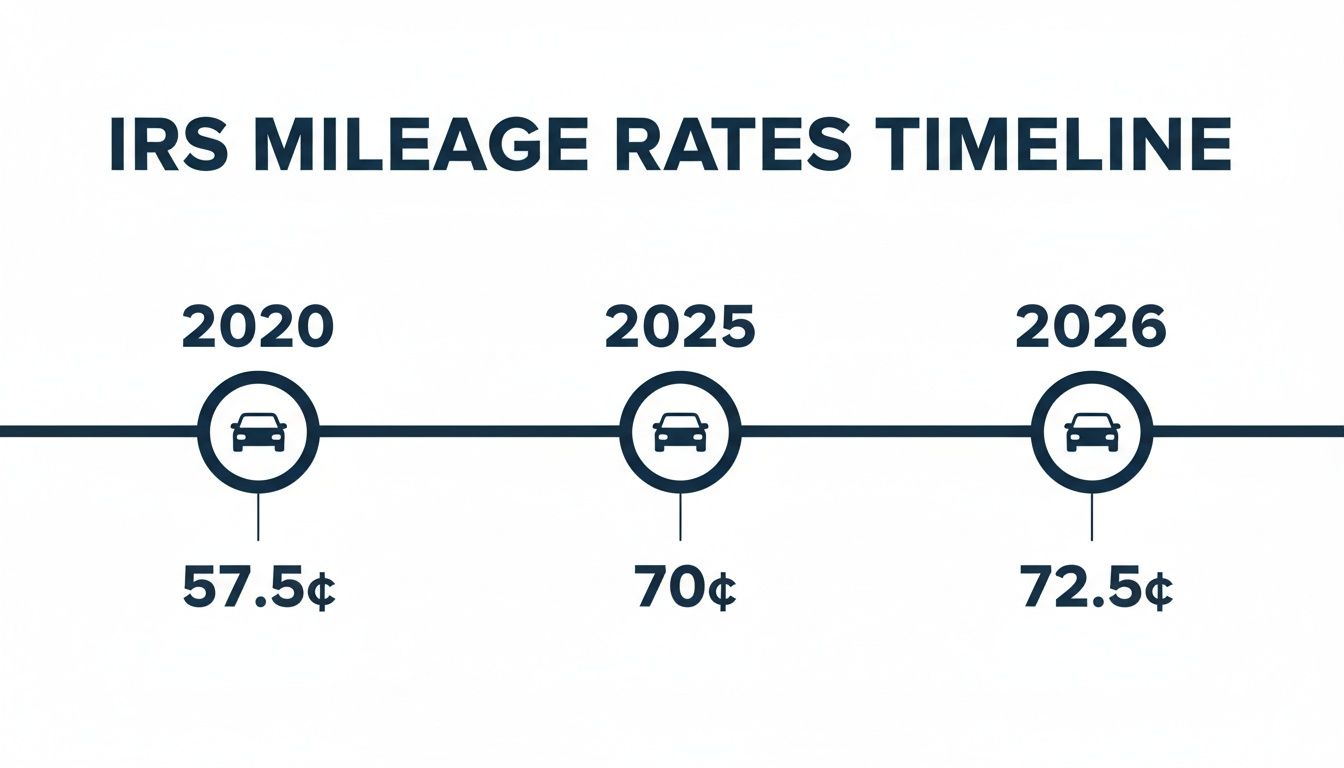
As you can see, the rates keep going up, which makes sense when you see how much more it costs to drive these days.
The Math Behind the Rate
The IRS doesn't just guess these numbers; they use a detailed formula. Depreciation and fuel costs are the two biggest factors, making up about 75% of the total calculation.
Here’s a quick breakdown:
- Depreciation: This is the biggest piece of the puzzle, making up about 45% of the total cost.
- Fuel: Gas prices change a lot and make up about 30% of the rate.
- Insurance: This is pretty steady at about 12% of the cost.
- Other Costs: The last 13% includes everything else—registration, taxes, tires, and general repairs.
Because fuel and car costs are such big factors, major world events can force the IRS to make big changes to the rate, sometimes even in the middle of the year.
When Real-World Events Force a Change
Sometimes, things happen in the world that cause costs to spike so fast that the IRS can't wait until the new year to change the rate. We've seen this happen a few times.
For example, back in 2011, problems in the Middle East made gas prices shoot up. The IRS did something rare and raised the business rate halfway through the year, from 51 cents to 55.5 cents per mile.
We saw it again in 2022. With supply chain problems and high inflation, the IRS bumped the rate from 58.5 cents to 62.5 cents in the middle of the year. For a construction company in Philadelphia, a surprise jump like that can really affect their budget. If a roofer doesn't account for a mid-year rate hike, they might bid too low on a big job and lose money. To learn more about these changes, check out this brief history of the IRS rate changes on companymileage.com.
Keeping up with these changes isn't just about good paperwork; it’s about protecting your business. When you understand why the company mileage rate changes, you can plan your budget better and make smarter financial decisions.
It’s a common mix-up. Many business owners think there’s just one official mileage rate, but it's a bit more complicated. The IRS actually sets different rates for different kinds of driving. Knowing the difference is key to getting your reimbursements and deductions right.
Think of it like tools in a toolbox. You wouldn't use a hammer to cut wood, and you shouldn't use the charity mileage rate for a business trip. Using the wrong one will cost you money.
The Three Main Mileage Categories
The IRS has three main buckets for mileage. Each one has a specific purpose and its own reimbursement rate.
- Business Rate: This is the big one. It's the highest rate and the one most companies use for work-related driving. Think client visits, trips to a job site, or picking up supplies. It's meant to cover the full cost of using your personal car for work, including gas, repairs, and depreciation.
- Medical and Moving Rate: This rate is for driving to doctor's appointments or for some moving expenses (though the moving part now only applies to active-duty military members). It's lower than the business rate because it doesn't cover all the same car costs.
- Charity Rate: This one’s for miles you drive while volunteering for a charity, like delivering meals for a local nonprofit. As you'll see, this rate is way lower than the others.
The difference in these rates is huge. If you accidentally log a 100-mile business trip as a charity drive, you'll lose out on a lot of money.
Why the Rates Are So Different
The business rate is the highest because it’s meant to cover the full, real-world cost of using a car for work. As more people start driving electric cars, companies also have to think about how things like electric car maintenance costs will affect how they pay employees back in the future.
The charity rate, on the other hand, is surprisingly low and almost never changes.
Here's a surprising fact: the charity mileage rate is set by Congress, not the IRS. This is why it has been stuck at just 14 cents per mile since 2011, and hasn't been affected by inflation or rising gas prices.
This is very different from the other rates, which the IRS changes to match what's happening in the economy. The medical and moving rates, for example, have changed more often. In 2023, the rate was 22 cents per mile, but it dropped to 21 cents for 2024 and 2025. This shows how the IRS tries to match rates to the actual costs for each type of driving.
For a doctor's office in the Philadelphia area with staff who make house calls, knowing this difference is key. Those trips should be logged at the medical rate, not the business rate. Understanding these little details makes sure your company—and your team—are handling mileage the right way.
How to Create a Simple Mileage Policy
Knowing the right mileage rate is one thing. Actually using it without creating tons of paperwork is another. That's where a clear, simple mileage policy comes in. It's your official rulebook for how you pay employees for driving.
The goal isn't to write a complicated legal document. The simpler, the better. If your policy is confusing, people will either ignore it or find ways around it. A great policy is easy to understand, fair, and gives you the clean records you need for the IRS.
What Counts as a Business Trip
This is the most important part of your policy. You have to be very clear about what kind of driving gets paid for. If you're vague, you'll end up with confusion and problems later.
Here are the key things you need to explain:
- Business Travel (You Pay For It): This is any driving that isn't part of an employee's normal commute. Examples include driving to a client’s office, visiting a job site, picking up supplies, or running a company errand.
- Commuting (You Don't Pay For It): The drive from an employee's home to their main workplace (your office) is their personal commute. The IRS says this is a personal expense, so your policy needs to be clear that you don't pay for these miles.
- Personal Errands (You Don't Pay For It): If an employee stops at the grocery store on their way back from a business trip, those extra miles are on them. Your policy should say that only the direct business route is covered.
For example, if your project manager in West Chester drives 20 miles to a client meeting in Philadelphia, that’s a business trip. But their daily 10-mile drive from home to your office is just their commute.
What Information to Record for Each Trip
To keep the IRS happy, you can't just pay an employee for a number they write on a napkin. You need detailed, consistent records for every trip. Your policy should tell employees exactly what they need to write down.
The IRS requires what’s known as an “accountable plan” for reimbursements to be tax-free. This just means you have a formal process for tracking business expenses, and a clear mileage policy is the foundation of that plan.
At a minimum, every mileage log entry needs these four things:
- Date: The full date the trip took place.
- Miles Driven: The total number of miles for the business part of the drive.
- Destination: Where they went (e.g., "Client XYZ Office, 123 Market St, Philadelphia").
- Business Purpose: A short, clear reason for the trip (e.g., "Project kickoff meeting" or "Pickup materials from Supplier ABC").
Having this information makes your records solid and ensures every payment is accurate. You can learn more about how a solid policy protects your business in our guide to understanding mileage rates for employees.
How to Submit and Get Paid
Finally, your policy needs to explain the process. How do employees turn in their mileage logs, and when do they get their money? Keep this part simple and predictable to avoid frustration.
Your submission process should clearly state:
- How Often: Will you collect logs weekly, bi-weekly, or monthly? Monthly is often the easiest for everyone.
- How to Submit: Do you want them to use a spreadsheet, a specific form, or a mileage tracking app? Tell them exactly what you expect.
- When to Submit: Set a clear deadline, like, "All mileage logs must be submitted by the 5th of the following month."
- When They Get Paid: Let employees know when they'll get their money. A common practice is to include it in their next regular paycheck after the log is approved.
The Best Ways To Track Business Miles
Messy paper logs and forgotten trips used to be the only way. Luckily, technology has made keeping accurate mileage records so much easier—it's almost automatic now. For a small business, picking the right method can save tons of time and make sure your records are perfect for tax time.
Let's look at the best ways to track business miles today, from simple spreadsheets to apps that do all the work for you.

Old School vs. New School Tracking
The old-school way is a simple spreadsheet. It’s free and easy to set up, but it completely depends on your employees remembering to write everything down. One missed trip or a typo can lead to wrong payments and headaches. It's better than a paper log, but it's not perfect.
The real game-changers are modern mileage-tracking apps. These tools use your phone's GPS to automatically log every drive your team takes. All the manual work and guesswork disappears.
How Mileage Tracking Apps Work
Think of a mileage app as a smart assistant in the passenger seat. Apps like MileIQ, Everlance, or Driversnote run in the background on an employee’s phone, recording every trip automatically.
At the end of the day or week, the employee just opens the app and sorts their trips with a swipe.
- Swipe Right for Business: A drive to a client meeting gets marked as business.
- Swipe Left for Personal: A trip to the grocery store gets marked as personal.
This simple action creates a perfect, detailed log without anyone having to write down odometer readings or remember addresses. It’s a huge time-saver that also makes your records more accurate—which is key for any business that uses company mileage rates for reimbursement.
These apps don't just log miles; they create detailed, IRS-ready reports with one click. This means no more chasing down employees for their logs at the end of the month. You get a clean, professional report ready for your books.
Properly tracking mileage is a key part of managing your money. You can learn more about how it fits into the bigger picture in our guide on how to track business expenses.
Choosing The Right Method For Your Business
While apps have huge benefits, seeing how the different methods compare can help you pick the best one for your team.
Mileage Tracking Methods at a Glance
| Method | Pros | Cons | Best For |
| :— | :— | :— |
| Spreadsheets | Free, easy to set up, and most people know how to use them. | Easy to make mistakes, relies on memory, and can take a lot of time. | Very small teams or solo business owners who don't drive much for work. |
| GPS Apps | Automatic and very accurate, saves a lot of time, and creates IRS-ready reports. | Usually has a small monthly subscription fee per user. | Businesses of any size with employees who drive regularly for work. |
| Point-to-Point Software | Calculates the most direct route between two places, preventing extra miles from being claimed. | Not great for trips with multiple stops or detours. | Companies that want to control costs and routes, like a home healthcare service. |
For most small businesses, the small cost of a mileage tracking app pays for itself very quickly. Studies show that businesses using these apps can save 20-30% on reimbursement costs just by getting rid of errors and inflated mileage claims.
And the time you save on paperwork? That’s a bonus.
How Mileage Reimbursement Affects Your Books
Paying an employee for their mileage isn't just about writing a check. It has a very specific and important place in your company’s financial records. When you do it right, it's a win-win for both you and your team.
When you reimburse mileage correctly, that payment is not taxed for your employee. They get the full amount. For your business, every dollar you reimburse becomes a deductible business expense, which lowers the amount of income you pay taxes on.
The Magic of an Accountable Plan
This tax-friendly situation only works if you follow a set of rules the IRS calls an "accountable plan." It sounds fancy, but it's really just your official mileage policy in action.
As long as your policy makes employees track their trips properly and turn them in on time, you're doing it right.
An accountable plan has three simple rules:
- Business Connection: The driving must be for a clear business reason.
- Proof: Employees have to provide detailed records (date, miles, purpose) in a reasonable amount of time.
- Return Extra Money: If you give an employee cash upfront, they must return any money they didn't use.
If you skip these steps, the IRS can change how those payments are treated.
The biggest risk is that the IRS will treat mileage payments as extra wages. If that happens, that tax-free reimbursement becomes taxable income. This means both you and your employee will have to pay payroll taxes (like Social Security and Medicare) on that money, and all the tax benefits disappear.
A Simple Look at the Bookkeeping Entry
So, what does this look like in your accounting software? It's pretty simple. Let’s say you pay an employee $65.50 for driving 100 miles using the 2023 IRS rate.
Here’s how you would record it:
- You would debit (increase) an expense account, like "Travel Expense" or "Mileage Reimbursement," by $65.50.
- You would credit (decrease) your "Cash" account by $65.50 to show the money left your bank.
That's it. This simple entry records the expense, lowers your taxable profit, and keeps your books clean. Keeping these records straight is a big part of good financial management. If you want to get better at it, we have a helpful guide on small business bookkeeping basics.
The Big Picture on Vehicle Expenses
Recording mileage the right way is a key piece of your financial puzzle. It makes sure your books are accurate and that you're paying the right amount of taxes.
Besides direct payments, it's smart to understand other related topics, like company car tax implications, which become more important as your business grows.
By handling mileage reimbursement correctly, you keep your finances clear, your employees happy, and your business out of trouble. It’s a small task that has a big positive impact on your company's financial health.
Common Questions About Company Mileage Rates
When it comes to company mileage rates, a few questions always seem to come up. It’s easy to get confused, so let's get some straight answers.
Is Mileage Reimbursement Required by Law?
This is a big one. The short answer is: it depends on where your business is. There is no federal law in the U.S. that says employers have to pay employees back for using their personal cars for work.
However, some states—like California, Illinois, and Massachusetts—have their own rules. Their laws say that if you don't pay for business mileage, you might be causing an employee's pay to drop below minimum wage once you factor in their car expenses. My advice? Always check your state and local labor laws to be sure. It's a simple step that can save you from a big headache.
Do I Have to Use the IRS Rate?
No, you don't have to use the standard IRS mileage rate. It’s a guideline—a very popular one—but it's not a rule. You can set your own company mileage rate.
But there’s a good reason why most businesses that pay for mileage stick with the IRS number. It’s simple, it’s considered fair, and it gives you a clear standard that keeps the payments tax-free for your employees (as long as you have an accountable plan). If you decide to pay a rate higher than the IRS standard, that extra amount is considered taxable income for your employee.
Can We Just Give Employees a Monthly Car Allowance?
You can, but it’s usually not the best idea from a tax perspective. A flat monthly car allowance—say, $400 a month—might feel easier than tracking trips, but it comes with a big tax problem.
A car allowance that isn't based on actual miles is treated as taxable wages. This means both the employee and the employer have to pay payroll taxes on the entire amount. It ends up costing everyone more money and isn't tied to the actual miles driven for work.
A mileage-based reimbursement under an accountable plan is almost always the better way to go. It makes sure you're paying only for actual business drives, and the payments aren't taxed. It’s the cleanest, most accurate, and smartest way to handle car expenses.
Ready to stop worrying about the complexities of mileage rates and get back to growing your business? At MyOfficeOps, we provide the bookkeeping and financial clarity you need to make smart decisions. Let us handle the numbers so you can focus on what you do best. Book a free discovery call with us today!