
If you want to make more money in your business, you first have to understand profit margins. Think of them as a report card for your company's health. The two big ones are your gross profit margin (what you make from a sale after the direct costs) and your net profit margin (what's left after all the bills are paid). Figuring out these two numbers gives you a clear picture of how your business is doing and shows you where to focus.
Your Starting Point: What Are Your Profit Margins Telling You?
Before you can make smart changes, you need to know where you stand right now. It's like a checkup for your business. It’s easy for business owners to get so busy with day-to-day work that they forget to check these important numbers. But without knowing them, you’re just guessing.
The first step is to find your gross profit margin. This number tells you how much money you make from each sale after paying for the things needed to make your product or do your service. Accountants call these direct costs the Cost of Goods Sold (COGS). For a roofer, this would be stuff like shingles and nails. For someone who builds websites, it might be the salary of the developer doing the work.
Gross Profit Margin vs. Net Profit Margin
Gross margin is a great way to see if your prices are right and if you're efficient. A good gross margin means you’re charging enough to cover your direct costs and still have money left over. If it's too low, it's a big red flag. It means your prices might be too low or your costs are too high. If you want to learn more, our guide on the Cost of Goods Sold explains it all.
Next is your net profit margin. This is the real bottom line—it’s the percentage of money left after all your expenses are paid, like rent, marketing, office salaries, and taxes. It shows you how profitable your whole business is. You could have a great gross margin but a terrible net margin if your overhead costs are out of control.
Knowing both margins is key. Gross margin tells you if you make money on each sale. Net margin tells you if your company as a whole is making money. You need both to be healthy.
How Do Your Margins Compare?
It helps to see how you're doing compared to others. Are your numbers good, bad, or just average? The chart below shows the typical range for business profit margins in the U.S., along with some highs and lows to give you an idea.
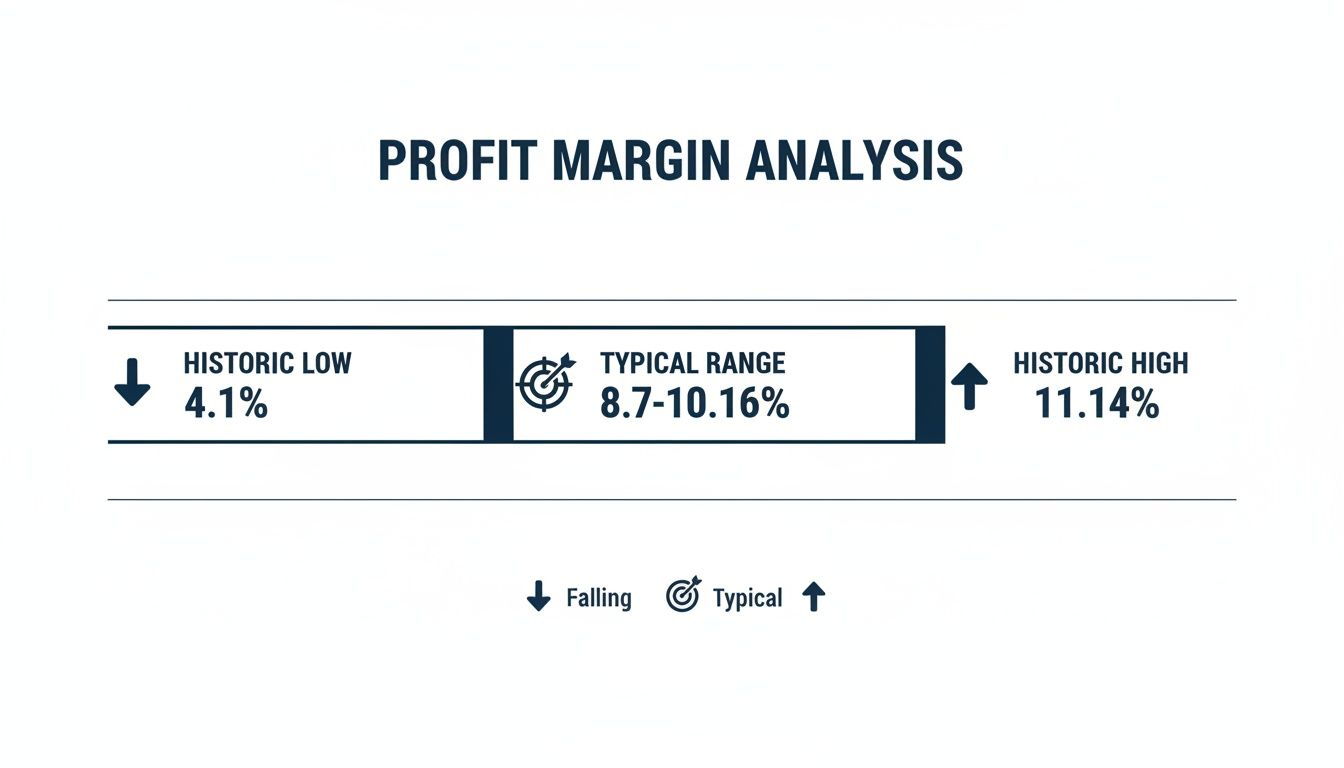
This shows that while profits can change with the economy, a healthy business usually stays in a certain range. The average after-tax profit margin for U.S. companies has gone from a low of 4.1% to a high of 11.14%.
For most businesses I've worked with, a good, steady net profit is somewhere between 8.7% and 10.16%. If your numbers are below this, it’s a clear sign that you need to look at your pricing, costs, or how you stack up against your competitors.
Profit Margin Benchmarks by Industry
Of course, "good" margins are very different depending on your industry. A software company has different costs than a construction company. The table below gives you a rough idea of what to expect in a few areas.
| Industry | Typical Gross Profit Margin | Typical Net Profit Margin |
|---|---|---|
| Professional Services | 40% – 60% | 15% – 25% |
| Healthcare (Private Practice) | 50% – 70% | 10% – 20% |
| Construction | 15% – 25% | 4% – 8% |
| Real Estate (Brokerage) | 80% – 90% (Commission Split) | 5% – 15% |
Use these as a gut check. If your numbers are way off from your industry's average, it doesn't mean you're failing, but it does mean you should find out why. It could be on purpose, or it could be a sign of a hidden problem.
Pricing Strategies That Actually Boost Your Bottom Line

Let’s be honest, raising your prices can be scary. The first thing most business owners think is, "What if I lose all my customers?" That fear keeps us stuck, but your pricing is the most powerful tool you have for improving your profit margins.
It's time to stop just covering costs and start charging what you're really worth.
Too many businesses set prices by looking at what their competitors charge or by just adding a standard markup. That's a race to the bottom. A much smarter way is to base your pricing on the value you give to customers.
For example, a marketing agency isn't just selling hours; it’s selling more customers and growth. A roofer isn't just selling shingles; they're selling peace of mind that a family's biggest investment is safe. When you talk about the results you provide, the conversation changes from cost to value.
Shift Your Mindset From Cost to Value
First, get really clear on the problem you solve. What pain are you taking away? What result are you creating for your client? Once you can explain this, you can build your prices around it.
A great way to start is by looking at your best customers. Why do they stay with you? I bet it’s not because you’re the cheapest. They stay because they trust you to do a great job.
When you present your prices, lead with the value. Instead of saying, "Our service costs $5,000," try saying, "We'll solve this big problem for you, and the investment is $5,000." It’s a small change in words, but it makes a big difference in how people see it.
Practical Ways to Adjust Your Prices
You don't have to announce a huge price hike overnight. There are smarter ways to increase your income and boost that important gross profit margin.
Here are a few tricks I’ve seen work really well:
- Test Small Increases: Start by adding a small increase of 3-5% on all new quotes. Most new customers won't even notice a small change like this, but it can make a big difference to your profits over a year.
- Create Tiered Packages: Give customers choices by offering different service levels at different prices. The classic "Good-Better-Best" model works because it often gets people to choose a more expensive package than they might have otherwise.
- Add a Premium Option: Introduce a high-priced "premium" or "all-inclusive" option. Even if only a few people choose it, this high price makes your other options look more reasonable. It’s a classic psychology trick called price anchoring.
The goal isn't to be greedy; it's to match your price with the value you provide. When you do that with confidence, the right customers will be happy to pay it because they know what they’re getting.
Interestingly, a balanced approach often works best. Back in 2020, for example, 59% of companies managed to improve their profit margins. While more customers (45%) and lower costs (34%) were the biggest reasons, the study showed a common mistake: most businesses only planned to raise prices to keep up with inflation, which meant they were leaving money on the table.
This shows that smart pricing, combined with controlling costs and taking advantage of demand, is the key to getting more profitable.
Communicate Your Value Clearly
If you do decide on a bigger price increase for current customers, how you tell them is everything. Don't just send an email with the new prices. Explain why the change is happening.
Have you bought new equipment? Hired more skilled people? Added a new feature? Talk about the price increase as part of your effort to give them the best quality and results. Loyal customers who value what you do will almost always understand.
For more specific ideas, check out our guide on how to improve gross profit margin.
Remember, your price says something about your quality and confidence. Pricing too low can actually make people question how good you are. When you price based on value, you not only improve your profit margins but also start attracting better clients who respect the work you do.
Cutting Costs Without Sacrificing Quality

When business owners think about improving profits, they often think about cutting costs. And while that's a powerful tool, it can be dangerous if you’re not careful. The goal is to spend smarter, not just cheaper.
This isn't about using bad materials that will make your customers unhappy or getting rid of your customer service team. Those kinds of cuts can ruin your reputation and cost you a lot more in the long run. Real cost control is about trimming the fat, not the muscle.
Let's break this down into the two main places your money goes: the direct costs to deliver your product or service (Cost of Goods Sold or COGS) and your general business expenses (operating expenses).
Start With Your Direct Costs
Your direct costs are the expenses tied to a specific job or product. For a landscaper, this means things like mulch, plants, and the gas for their mowers. Cutting these costs goes straight to your gross profit margin.
A great first step is to simply review your main suppliers. Are you getting the best deal? It’s amazing how many business owners sign a contract with a vendor and then never look at it again.
Let's say you're a builder. Take your top five materials—lumber, concrete, drywall, etc.—and get new quotes from two other suppliers once a year. You might find that being loyal to one supplier is costing you thousands. Even if you don't switch, you now have the power to ask for a better price.
Don't assume your current suppliers are giving you the best price. A simple yearly review of your top 3-5 suppliers can find big savings without changing the quality of your materials at all.
Think about waste, too. If that same builder sees a huge pile of leftover lumber at the end of every job, that's wasted money. Improving your ordering process to be more accurate can make a real difference. It’s not about buying cheaper wood; it’s about buying the right amount of good wood.
Scrutinize Your Operating Expenses
Next, let's look at your operating expenses, also known as overhead. These are the costs to keep your business running—things like rent, software, and office salaries. These costs can slowly go up over time if you're not paying attention.
My favorite place to start is with software and subscriptions. Pull up your latest credit card or bank statement and highlight every monthly charge. Do you know what they all are? Are you actually using all of them?
I once worked with a company that was paying $400 a month for a project management tool their team hadn't used in six months. That’s almost $5,000 a year thrown away for nothing.
Here are a few other areas to look at:
- Insurance: When was the last time you shopped around for your business insurance? Prices change all the time, and another company might offer the same coverage for less.
- Office Space: If your team is working from home more, do you still need such a big office? A smaller space could be a huge win.
- Administrative Tasks: Looking at new ways to handle overhead can help. You can review ideas for saving on office work, like minimizing HR costs through outsourcing.
Finally, don't forget to ask your team for ideas. The people doing the work often see problems that you can't. Ask them! Offer a small bonus for any idea that saves the company money. They might point out a process that wastes time or a supply that's always being over-ordered.
By focusing on these smart cuts, you can lower your expenses and improve your profit margins without hurting the quality your customers expect.
How Operational Efficiency Directly Widens Margins
Wasted time is wasted money. It’s a common saying for a reason—it’s true. Every clunky process, extra step, and moment of confusion eats away at your profits. Improving your operational efficiency is about doing more with what you already have.
It means making your entire workflow smoother, from the first time a new client calls to the day you get their final payment. It’s about finding and fixing all the little problems that slow everyone down and frustrate your team.
From Wasted Hours to Wider Margins
Think about a real estate agency. The team might spend hours on each sale just dealing with paperwork, getting signatures, and sending the same follow-up emails over and over. By using a simple software tool, they could automate a lot of that work, saving hours on every single sale. They could use that saved time to find new clients, which brings in more money without paying more people.
Or what about a local mechanic's shop? If they improve their scheduling, they might find they can fit one more oil change into each day. That one extra job, every day for a year, could add thousands of dollars to their profit—all without hiring another person or buying new equipment.
The idea is simple: every minute you save on boring, repetitive tasks is a minute your team can spend on work that makes money. This is how smart businesses improve profit margins without just cutting costs.
This focus on efficiency is a big reason why top companies have seen their profits grow. For example, the S&P 500's average net margin went from 5.85% between 1989–2015 to 9.75% by early 2024. A huge reason for this growth was technology and automation, which let companies grow without adding a lot of labor costs.
Finding and Fixing Your Bottlenecks
Every business has bottlenecks—those annoying spots where work always seems to get stuck. Maybe it’s a decision that needs three different people to approve it. Maybe it’s a manual invoicing system that takes your office manager a whole day each month.
Finding them is the first step. You can start right now:
- Ask Your Team: Seriously, just get your employees together and ask, "What's the most annoying or time-wasting part of your job?" They are on the front lines and know exactly where the problems are.
- Walk Through a Process: Follow a single job from start to finish. Whether it’s signing up a new client or shipping an order, follow every single step. You’ll be surprised at the extra work and delays you find.
Once you’ve found a bottleneck, you can start fixing it. For a deeper look at improving how your business runs, check out these top tips for improving operational efficiency.
Putting Simple Automation to Work
"Automation" sounds like a big, expensive word, but it doesn't have to be. For a small business, it can be as simple as setting up automatic appointment reminders to reduce no-shows. It could also mean using accounting software that automatically sends invoices and payment reminders, which saves time and helps you get paid faster.
Here are a few easy wins to think about:
- Customer Communication: Use tools that automatically send appointment confirmations or "thank you" emails. This keeps customers informed and saves your team from doing it manually.
- Invoicing and Payments: Switch from manual invoicing to a system that can create and send repeating invoices automatically. This gets you paid faster and reduces headaches.
- Internal Workflows: Use simple project management software to assign tasks and track progress. This cuts down on the endless "what's the status of…" emails and meetings that kill productivity.
Making your business run smoother isn't a one-time project; it's a way of thinking. By always looking for small ways to save time and effort, you create a more efficient, less stressful, and much more profitable business. For more ideas on this, check out our guide on how to improve operational efficiency.
Uncovering Your Most Profitable Work

Here’s a hard truth most business owners learn: not all money is good money. I bet that if we looked closely at your business, we’d find that a small number of clients or jobs are actually making most of your profit.
We’d also likely find some that are barely making any money, or even worse, costing you money.
Your total profit number is a good start, but it hides a lot. It doesn't tell you which parts of your business are really driving growth. To really boost your margins, you have to dig in and figure out which specific work is paying off.
This means asking some tough questions. Which projects make the most money? Which clients seem to take up all your team’s time for very little pay? Knowing the answers is like getting a treasure map for your business.
Why Job-Level Profitability Matters
Most business owners I work with have a gut feeling about their best and worst clients. The problem is, feelings can be wrong. You might think that big client who pays you a lot is your best one, but after you add up all the extra meetings, last-minute changes, and support calls, they could be one of your least profitable.
I once worked with an IT company that was proud of a big client they had—it was their biggest contract. But when we actually calculated the hours their best engineers were spending on that client, the profit margin was a tiny 3%.
Meanwhile, a few of their "smaller" clients were making them margins over 60%.
That big contract wasn't just hurting their profit; it was a huge missed opportunity. All those expert hours could have been spent finding and serving more of their ideal, high-profit clients.
Without looking at each job or client separately, you're flying blind. You might be putting all your marketing efforts into finding the wrong kind of work.
Calculating Profitability on a Single Job
Figuring this out doesn't require an accountant. The idea is simple: for any job, you subtract the direct costs of doing that job from the money it brought in. This gives you the gross profit for that specific job.
Let's break down the key parts:
- Revenue: This is the easy part. It’s how much the customer paid you for the project.
- Direct Costs (COGS): These are the costs that you have only because you took on this specific job. Think materials, labor hours, and any special software or helpers you had to pay for.
The most common mistake I see is forgetting to include labor. You have to include the full cost of your team's time. If an employee who costs you $50 an hour (including taxes, benefits, etc.) spends 10 hours on a project, that's $500 in direct labor costs that you have to include.
Once you have those numbers, the math is simple:
Gross Profit = Revenue – Direct Costs
Gross Profit Margin (%) = (Gross Profit / Revenue) x 100
This simple math tells you exactly how much money you really made from that one job.
Simple Job Profitability Calculator
To make this even easier, you can use a basic template to look at your projects. Grab your last five completed jobs and run them through this. The results might surprise you.
| Item | Revenue | Direct Costs (COGS) | Gross Profit | Gross Profit Margin (%) |
|---|---|---|---|---|
| Job 1: Website Redesign | ||||
| Revenue | $10,000 | |||
| Direct Costs: | ||||
| Designer Labor (40 hrs @ $60/hr) | $2,400 | |||
| Developer Labor (50 hrs @ $70/hr) | $3,500 | |||
| Stock Photos & Plugins | $300 | |||
| Total Direct Costs | $6,200 | |||
| Gross Profit | $3,800 | |||
| Gross Profit Margin | 38% |
After running a few jobs through this calculator, you'll start to see a much clearer picture of what's actually making your business successful.
What to Do With This Information
After you look at a few projects, you'll start to see patterns. You’ll clearly see your most and least profitable types of work. This information is power. It lets you make smarter decisions to improve your overall profit margins.
You can now:
- Focus your marketing: Stop spending money trying to get everyone. Aim your marketing at finding more of your ideal, high-profit clients.
- Reprice your services: For those low-profit jobs, you have a choice. You can raise your prices to make them more profitable, or you can decide they aren't worth the effort and stop doing that type of work.
- Improve your processes: Are certain jobs always less profitable because they are inefficient? Now you know exactly where to focus on improving how you work and cutting waste.
By taking the time to understand where your profits really come from, you stop guessing and start building a stronger and much more profitable business.
So, What's Next? Putting This Playbook to Work
Alright, we've covered a lot. You have the guide for building a more profitable business, but let's be honest—reading about it is one thing. Actually finding the time to do these things while you're busy running the company is a whole different challenge.
The key is to not get overwhelmed. It all starts with one simple step: block off one hour on your calendar each month to review your finances and focus on your margins. That's it. This small habit is what separates business owners who just react to problems from those who actively build a profitable company.
Your Immediate Action Plan
To make this real, here’s a simple, three-step plan you can start today. This isn't about changing everything at once; it's about making small, steady moves that add up.
- This Week: Grab the numbers from one single job you just finished. Use the calculator we talked about earlier to figure out its real profit. The only goal here is to try it out and see how it works.
- This Month: Take a hard look at your top three repeating expenses. Look at those software subscriptions, supplier contracts, or insurance bills. Ask yourself two questions: "Is this still useful?" and "Can I get a better deal?"
- This Quarter: Test one small price increase. This could be a 5% raise for all new clients, or maybe you create a new premium service package. Just pick one thing and see what happens.
The biggest mistake I see business owners make is trying to fix everything at once. That leads to feeling burned out, not to results. Instead, focus on making one smart, profit-focused decision each month. That's how you build real, lasting growth.
When It's Time to Call in an Expert
At some point, you might get stuck. You'll realize you're spending so much time working in the business that you have no time left to work on the business. If you're always putting out fires and can't find a moment for the big-picture thinking we've talked about, it might be time for help.
Bringing in an outsourced bookkeeping partner or a fractional CFO isn’t about giving up control—it’s about getting a smart partner. Their whole job is to handle the financial details and give you the information you need to make better decisions. This frees you up to do what you do best: lead your team, serve your customers, and grow your company.
Think of it as an investment, not an expense. It's an investment in building a stronger, healthier, and more profitable business for the future.
Common Questions About Improving Profit Margins
Here are a few of the most common questions business owners ask when we start looking at their profit margins.
What Is a Good Profit Margin for a Small Business?
This is the big question, and the honest answer is: it really depends on your industry.
A 10% net profit margin is often called a healthy number, but that's almost meaningless without knowing more. A consultant with low costs might aim for 20% or more, while a retail shop with a lot of inventory could be doing great at 5%.
The best thing to do is compare your numbers to your specific industry averages. But more importantly, you should focus on slowly improving your own margins over time. Even small improvements each quarter can make a huge difference for your business.
How Can I Raise Prices Without Losing Customers?
The trick is to talk about value, not price. Remind your customers (and maybe yourself) why they chose you in the first place—is it your quality, your great service, or your expertise?
Instead of suddenly raising prices on everyone, think about making smaller, slower increases. Another great idea is to introduce new service packages or different levels that offer more value at a higher price. This gives customers a choice and makes the increase feel like an upgrade.
The truth is, most loyal customers will stick with you if they feel they’re getting their money's worth. A price increase that’s explained well and is tied to better service or a better product is almost always understood and accepted.
Where Should I Start When Cutting Costs?
Go for the easy wins first. Your biggest changing costs and those repeating monthly bills are often the easiest places to find quick savings without messing up your main business.
Look at your top three to five supplier contracts. Has it been a while since you negotiated? There might be a chance for a better deal. It’s also a great time to check all your software subscriptions—you’d be surprised how many companies are paying for tools their team hasn’t used in months.
Just be careful you're not cutting things that are really important. Slashing anything that hurts your product quality or your team's happiness will almost certainly cost you more in the long run.
Ready to stop guessing and start making smart decisions that actually improve your profit margins? The team at MyOfficeOps provides the financial clarity you need to grow your business with confidence. Schedule your free Discovery Call today.