
If you're doing payroll on Friday afternoon, matching bank activity on Sunday, and still getting surprise notices in the mail, you're not running finance. You're stuck in it. I see that all the time with owners who started with one person doing “just a little bookkeeping” and ended up with a pile of receipts, a half-working payroll process, and no clean answer when a lender, partner, or buyer asks for the numbers.
That's why outsource bookkeeping and payroll is worth a hard look. Not because it sounds efficient in a proposal, but because the true win is recovered management capacity and tighter control over payroll risk. The business owner should still approve, review, and decide. The outside team should do the repeatable work fast, clean, and on time.
The problem is bigger than most owners think. Survey evidence shows 84% of small businesses reported payroll errors, and 40% said payroll problems had resulted in penalties, with the most common failures being incorrect wage calculations (48%), late or missing payments (38%), incorrect hours (36%), and incorrect tax calculations (27%) (International Accounting Bulletin). That's not a small annoyance. That's a warning that the usual “we'll just keep handling it ourselves” approach breaks down fast.
When the Books and Payroll Run You Instead of the Other Way Around
It usually starts the same way. An owner opens the laptop at night, pulls three bank tabs, tries to make sense of payroll, and realizes nobody on the team can answer a simple question like, “How much cash do we really have after payroll clears?” At that point, bookkeeping is not a back-office chore. It is a daily drag on judgment.
The problem is not a lack of effort. The business has outgrown a casual setup. One person cannot keep up with receipts, bank feeds, payroll runs, tax notices, and management questions without something slipping. In Philadelphia and in every similar market I've worked in, that is the point when owners either bring in help or finally admit they need it.
Practical rule: if the books are always late and payroll always feels rushed, the issue is the operating model.
A good outsourced setup gives you cleaner books, fewer payroll mistakes, and a clearer view of cash without turning you into a passenger in your own company. The goal is not to hand away control. The goal is to stop spending owner time on work that should be handled by a system.
The labor market shows sustained demand for bookkeeping work, even as the occupation changes. The Bureau of Labor Statistics reported approximately 1.82 million jobs for bookkeeping, accounting, and auditing clerks in 2023, with a 2024 employment level of about 1.6 million and a projected decline of roughly 6% from 2024 through 2034, while still anticipating around 170,000 openings per year as workers retire or leave the occupation. That is a labor base built for recurring work, and it is a good reason providers have to do more than data entry.
For a practical comparison of software options that support this kind of workflow, the top rated payroll platforms roundup is a useful starting point. The software matters, but the operating model matters more.
What Bookkeeping and Payroll Actually Are in a Small Business
A lot of owners treat bookkeeping and payroll as one back-office bucket. That is how mistakes slip through. Bookkeeping records, reconciles, and reports the money moving through the business. Payroll handles paying people correctly, withholding the right taxes, and filing on time.
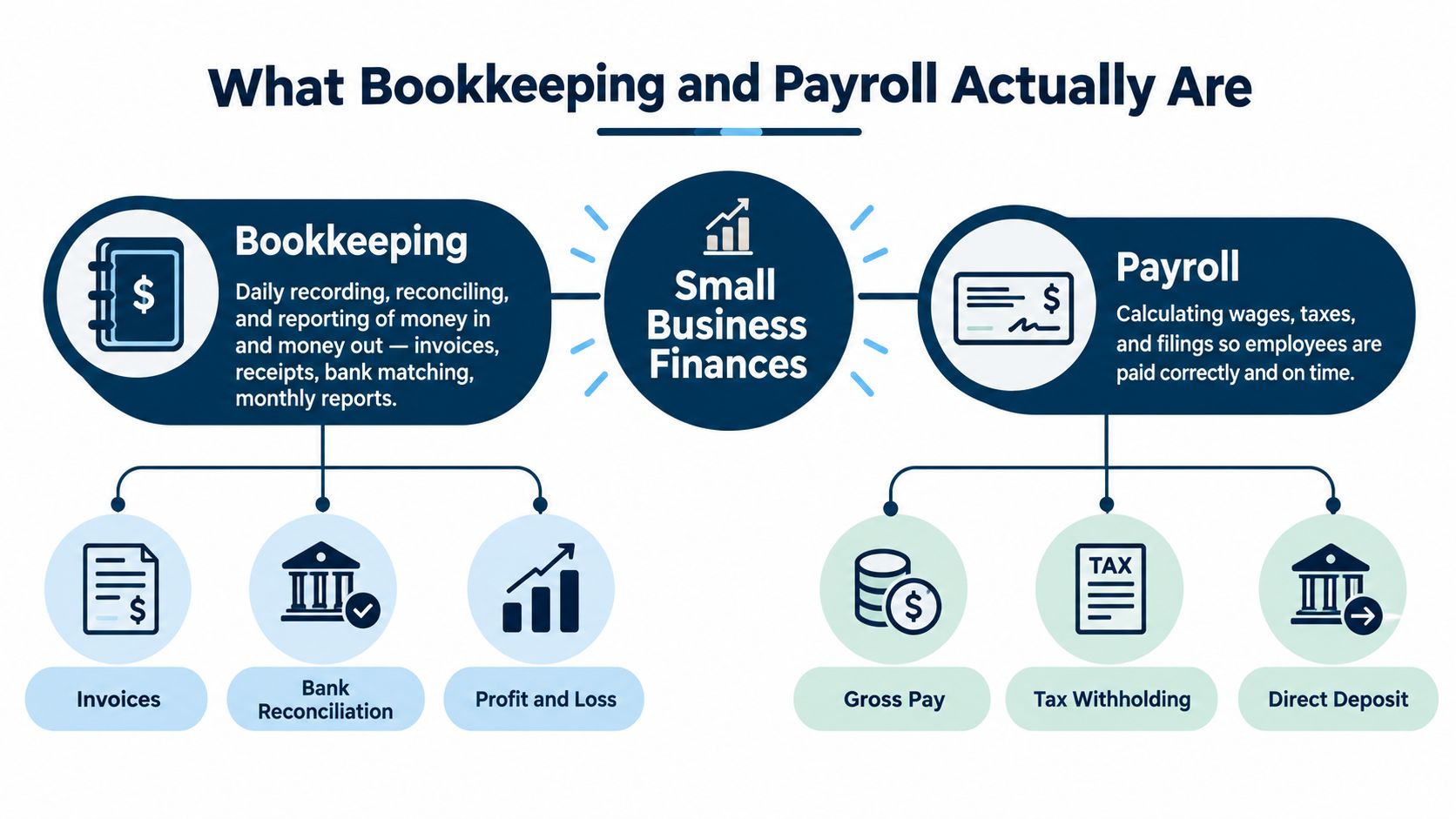
Bookkeeping is the scoreboard. It shows whether the business is making money, where cash is going, and which bills are still open. Payroll is a compliance checklist with teeth. If it goes wrong, employees notice first, and tax and filing problems follow fast.
Why the two functions have to talk to each other
Payroll never lives in isolation. Every pay run creates wage expense, tax expense, and liability balances that have to land in the books correctly. If one team runs payroll and another team posts the entries, someone has to reconcile the gap, or the ledger drifts away from reality.
Integrated handling is cleaner. When the same team, or tightly connected teams, runs payroll and posts it to the ledger, you cut handoff errors and stop chasing missing entries. For owners comparing software and process choices, the top rated payroll platforms roundup is a useful starting point. The software matters, but the operating model matters more.
This is also where responsibility needs to stay clear. Outsourcing should remove manual work, not blur approvals. Owners should still approve pay changes, bonus decisions, new hires, and anything unusual before it hits payroll.
What the labor base looks like
The bookkeeping labor base is large, but the key point is the work itself. It has shifted toward software, review, and interpretation, which is exactly why providers need more than data entry. That shift also explains why good bookkeeping support is about process control, not just faster typing.
A useful way to see the workflow is the guide to outsourced HR for UK employers, which shows how administrative functions can be assigned with clear responsibility. If you want a practical breakdown of how payroll is organized in day-to-day operations, this overview on how payroll services work is the right companion read.
The Three Service Models Owners Can Choose From
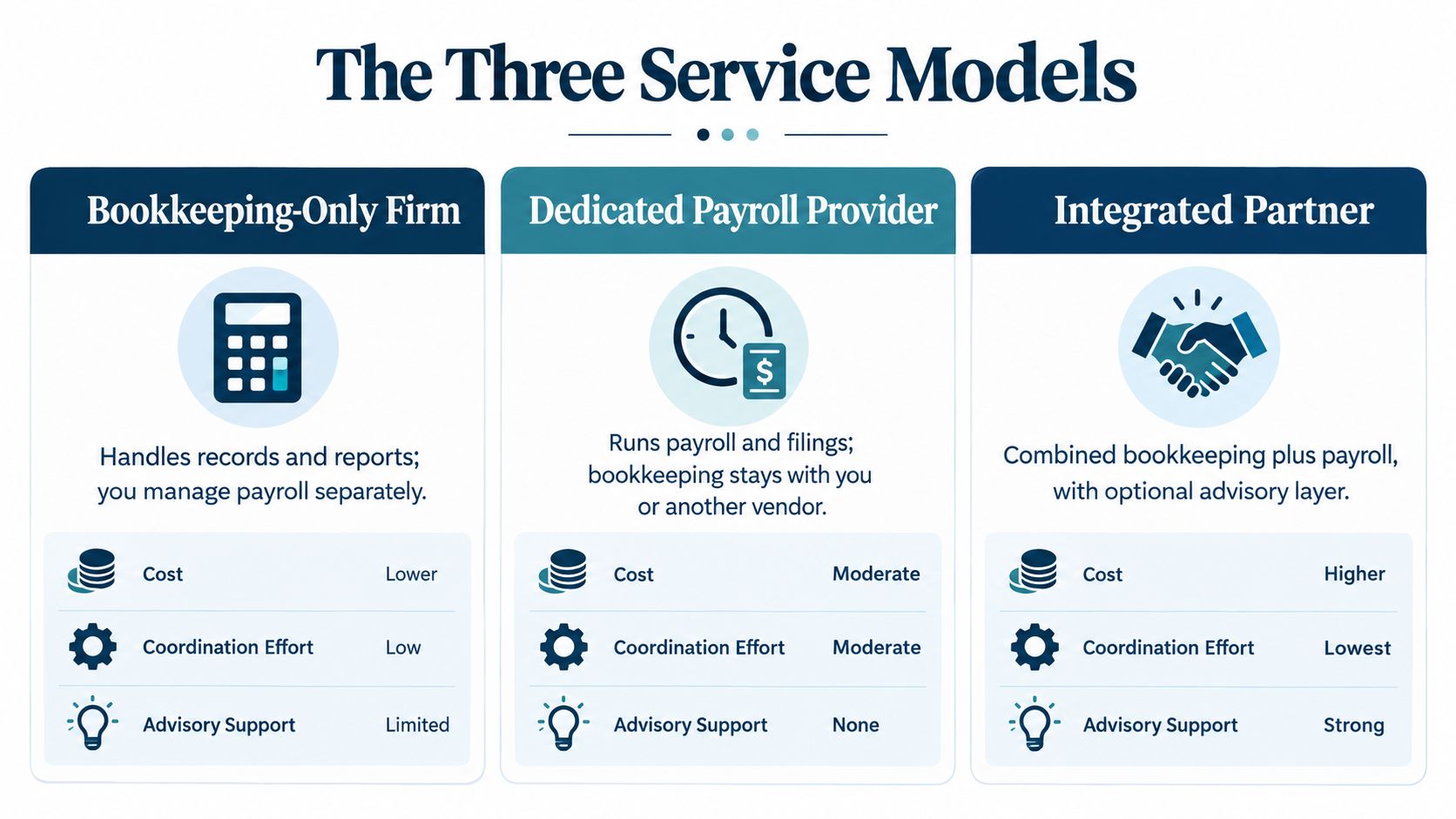
Owners usually think they are choosing one vendor. What matters most is how much control stays inside the business. You have three models, a bookkeeping-only firm, a payroll-only provider, or one integrated partner that handles both and can add advisory support when needed.
Bookkeeping-only firm
This model fits when payroll is simple and steady, or when the business already has a payroll system that works. You get reconciliations, records, and financial reports, but you still own payroll setup, tax handling, and the link between each pay run and the general ledger.
It can work, but the weak spots show fast. If payroll sits elsewhere, someone still has to post it correctly, check liabilities, and explain odd wage swings. That means more owner oversight, more coordination, and more chances for details to slip.
Dedicated payroll provider
This is the better fit when payroll is the bigger problem than bookkeeping. A formal payroll services industry exists under NAICS 541214, with roughly 5,700 establishments, about 222,000 workers, and approximately $22 billion in annual revenue, and about 55% of businesses outsource payroll, with 23% of small businesses doing so (Fair Market Value).
That gap matters. Small firms often delay because they treat payroll outsourcing as another bill. In practice, it is usually a control decision. If the books are fine but pay runs are messy, this model can be enough. For a plain-English look at how vendors structure the process, see this overview of how payroll services work.
Integrated partner
This is the model I recommend for owners who want less friction and tighter visibility. One team handles bookkeeping and payroll together, so payroll data lands in the books without extra cleanup. That cuts handoffs, gives you a single point of accountability, and makes management reporting more useful.
It also fits businesses with real operational complexity. Professional services firms need clean job and staffing data. Healthcare has schedule and compliance issues. Construction and trades deal with variable hours, multiple locations, reimbursements, and labor tied to jobs. Those businesses need one partner who can connect payroll, bookkeeping, and reporting without making the owner referee three vendors. The guide to outsourced HR for UK employers makes the same point on the administrative side, clear ownership matters more than a fancy handoff.
My rule of thumb
If payroll is simple and stable, a payroll-only provider may be enough. If bookkeeping is the bigger issue and payroll barely changes, bookkeeping-only can work. If you want cleaner control, stronger reporting, and less handoff pain, go integrated.
The return from outsourcing is recovered management capacity and tighter payroll controls. Owners still need to approve pay changes, bonus decisions, new hires, and anything unusual before it hits payroll. Keep those decisions inside the business, and let the provider handle the repetitive work.
What This Outsource Really Costs and What It Saves
People always start with price. That's the wrong first question. The question worth asking is what it costs to keep doing this in-house, and what value you get back if the work gets done better.
A current labor-cost benchmark for U.S. bookkeeping, accounting, and auditing clerks is a median wage of $50,670 annually, with private-industry benefits at roughly 30% of total compensation, producing an estimated fully loaded annual cost of about $72,386, or roughly $6,032 per month, before recruiting, supervision, software, training, leave coverage, and compliance oversight (Virtustant). That's one person. It's not a department.
In-House Versus Outsourced Bookkeeping and Payroll
| Cost Driver | Annual | Effective Monthly |
|---|---|---|
| Base labor and benefits | about $72,386 | about $6,032 |
| Recruiting, supervision, software, training, leave coverage, compliance oversight | additional cost | additional cost |
| Outsourced provider fee | varies by scope | varies by scope |
| Error cleanup and correction work | variable, often hidden | variable, often hidden |
The point of that table isn't to pretend outsourcing always wins on sticker price. It doesn't. The point is that in-house labor comes with a full load of hidden costs, while outsourced pricing often bundles process, software, and review into one predictable line item.
What outsourced pricing usually changes
Outsourced bookkeeping and payroll usually shifts you away from one salary and into a mix of service fees, payroll fees, and optional advisory work. You still pay for the work. You just stop paying for idle time, leave coverage, and the drag of one person being the only person who knows how everything works.
That matters when the payoff is faster monthly close, cleaner reconciliations, fewer payroll corrections, and better lender or buyer readiness. If you're comparing bids, this internal breakdown on how much does it cost to outsource accounting is a useful frame for asking the right questions.
Bottom line: don't buy outsourcing because it looks cheaper on paper. Buy it because it turns messy data into decisions sooner.
Security and Compliance and Where Owners Stay Accountable
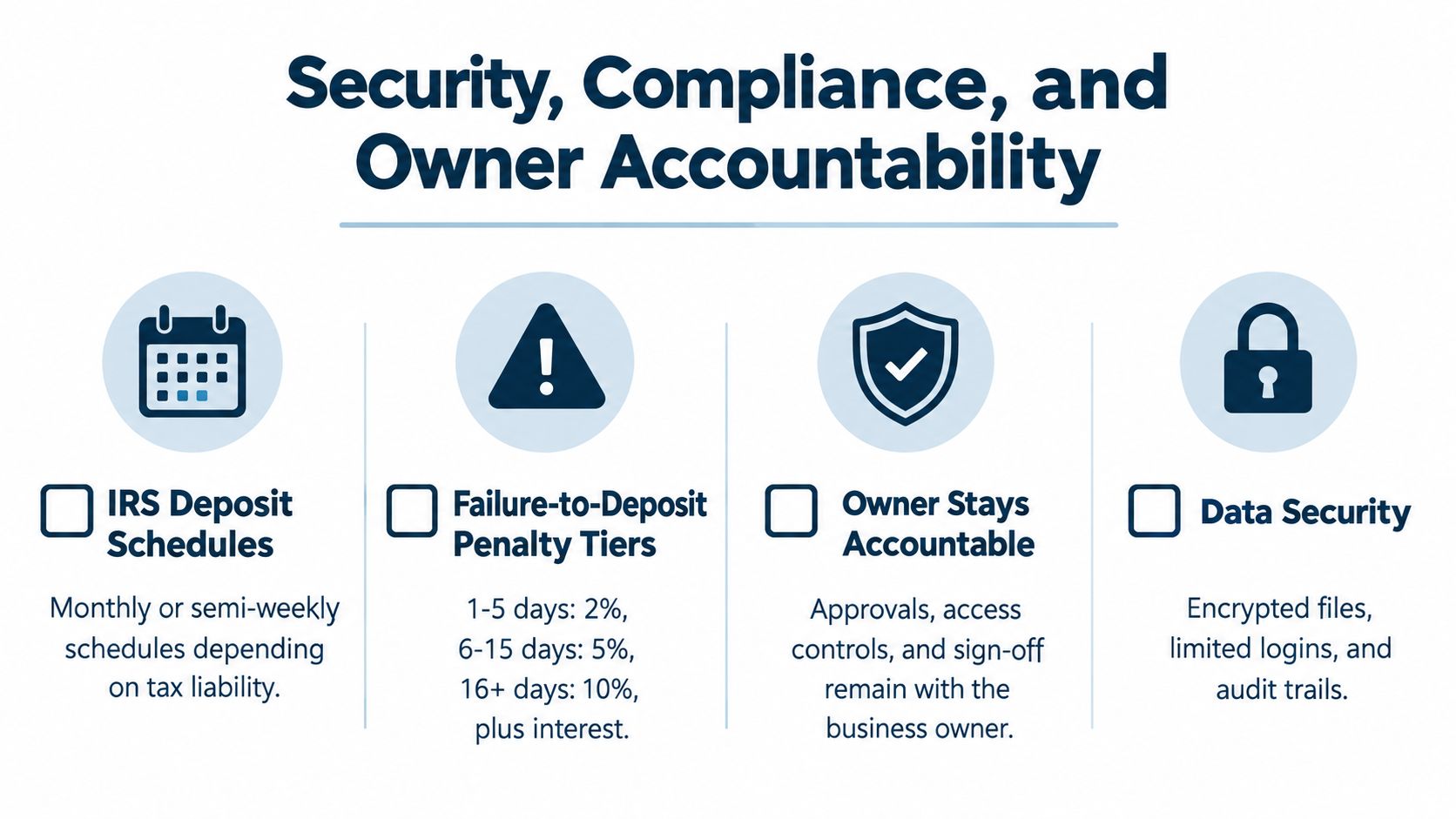
A lot of owners think outsourcing payroll means they can wash their hands of it. That's a mistake. The provider can process the work, but the business still owns the risk, the approvals, and the judgment.
The IRS uses two main deposit schedules. A business that reported $50,000 or less in employment taxes during the lookback period is generally a monthly depositor. A business that reported more than that is generally a semiweekly depositor, and there's also the $100,000 rule that can push a deposit to the next business day if payroll taxes hit that amount on a single day (IRS).
Federal failure-to-deposit penalties are generally assessed at 2% for deposits 1 to 5 days late, 5% for 6 to 15 days late, and 10% when more than 15 days late. Late employment-tax returns can incur a penalty of 5% of unpaid tax per month, up to 25%, and for an employer with $50,000 in quarterly payroll-tax deposits, a deposit more than 15 days late could create a $5,000 penalty before interest (Paychex).
Why worker classification matters
Payroll gets even messier when workers are misclassified. The IRS generally requires employers to withhold federal income tax, Social Security, and Medicare taxes from employee pay, while independent contractors usually handle their own income and self-employment taxes (IRS). The contract label is not enough by itself. The actual working relationship decides the tax treatment.
That matters in healthcare, construction, and professional services, where schedules, supervision, and service arrangements can look different from person to person. If a clinic controls how and when a receptionist works, that may be an employee relationship. If a specialist serves multiple clients on their own terms, that may be contractor treatment. Get that wrong, and the business can end up on the hook for taxes that were never withheld.
What a defensible outsourced workflow should include
A solid setup needs a documented payroll calendar, segregated approval and payment duties, role-based access, exception reports, payroll-register-to-general-ledger reconciliation, and monthly reconciliation of tax-payment confirmations. That sounds formal because it is. Payroll is not the place for casual habits.
I'd also point owners to this internal resource on internal controls for small business. The core idea is simple, keep the approval power inside the business, even if the processing lives outside it.
Outsourcing transfers processing, not governance. If the owner isn't reviewing exceptions and signing off, the control structure is weak.
A Practical Onboarding Plan for the First 90 Days
Good onboarding starts before any software gets connected. Bring the prior-year financials, chart of accounts, payroll history, tax IDs, and a clean list of systems, approvals, and contacts. If the provider has to chase basic documents for weeks, the relationship starts sloppy.

Week one
The first call should settle scope, pricing, exclusions, and who approves what. That's where you decide whether bill pay, payroll, and reporting all sit in the same workflow or not. If a provider can't explain that clearly, keep looking.
Month one
This is the setup phase. Bank feeds get connected, payroll systems are mapped, bill pay is organized, and document storage gets cleaned up. The provider should also explain how corrections, late items, and unusual transactions will be handled.
Month two and beyond
The rhythm should settle into a weekly cash check, payroll cut-off and approval, monthly close checklist, management report delivery, and a quarterly review. That's where you measure whether the handoff is working. I'd watch days to monthly close, unreconciled-item aging, payroll correction frequency, on-time tax deposits, labor-cost variance, and whether the reports help you make decisions.
If you want a broader service map for this kind of setup, MyOfficeOps offers outsourced bookkeeping, payroll integration, and financial reporting for small and midsize businesses. A good engagement should feel calm after the first few cycles, not more confusing.
A Short Checklist and the Questions Worth Asking Before You Sign
Ask these questions before you choose a provider:
- Pricing clarity: What is included, what is excluded, and what changes the fee?
- System integration: How do payroll entries reach the books, and who checks them?
- Review responsibility: Who reviews the work before it goes out?
- Escalation path: What happens when there's a tax notice, a missed approval, or bad data?
- Access controls: Who can view, edit, approve, and file?
- Reporting: How are reports delivered, and will someone explain what they mean?
There are cases where outsourcing may not fit. If you need highly specialized internal cost accounting, or if the owner wants full internal control over every step, keep more of it in-house. That's a real preference, not a flaw.
The stronger reason to outsource is still the same. KfW found that SMEs spend about 7% of working time on administrative processes, and an independent 2025 small-business outlook found bookkeeping was the task owners most wanted to delegate, while payroll-software adoption increased from 49% to 54% of employers (KfW). The best use of that recovered time is not more admin. It's pricing, hiring, cash-flow forecasting, job profitability, and making the business easier to sell or finance.
FAQ
How long does onboarding usually take? It depends on how organized your records are, but a clean handoff should move in weeks, not forever. The first month should focus on setup and fixes, then the rhythm should stabilize.
Can I switch payroll providers mid-year? Yes. The key is clean payroll history, correct tax IDs, and careful coordination so filings and wage records stay aligned.
What if the IRS sends a notice after outsourcing? Don't ignore it. Send it to the provider right away, confirm the payroll period involved, and verify the return, deposit, or classification issue before any correction is filed.
If your books are messy and payroll still feels like a weekly fire drill, MyOfficeOps can take over the bookkeeping and payroll side while keeping approvals and decision-making with you. Visit MyOfficeOps if you want a Philadelphia-area partner that handles the work, builds the controls, and helps you turn clean numbers into better decisions.